
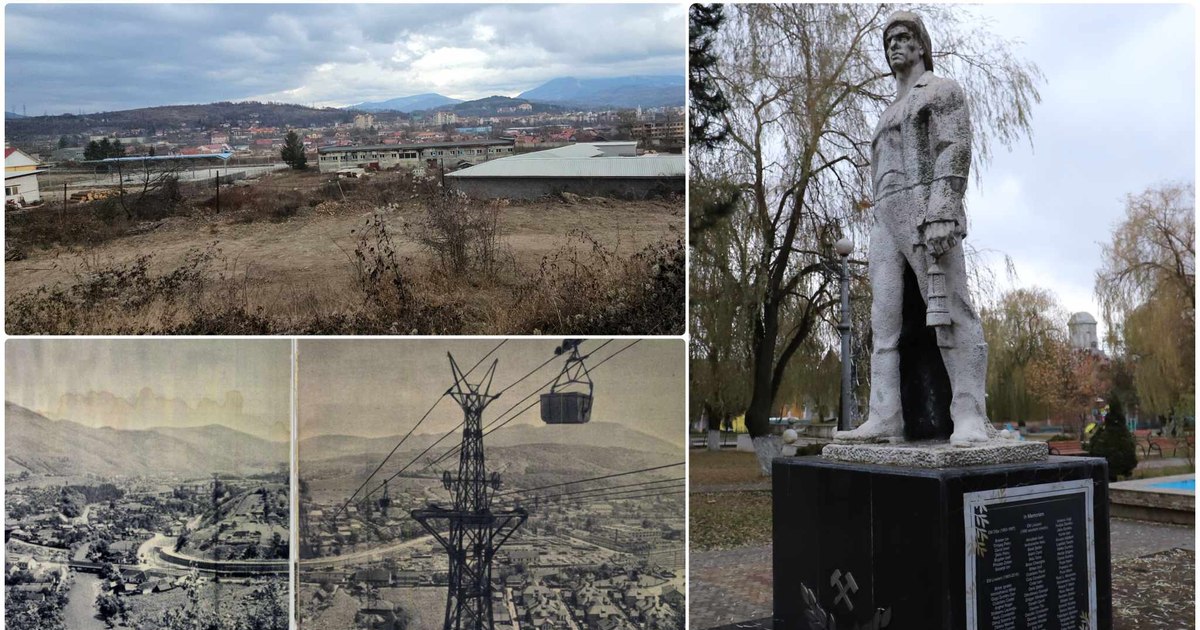
In January 1999, the announcement of the final closure of the Dâlja and Bărbăteni coal mines mobilized thousands of miners who marched towards Bucharest. 26 years after the last mining, Dâlja, the place where the spark of protests was ignited, remained a memory.
Dâlja mine, past and present. Photo: Adevărul / Flacăra magazine
The Dâlja mine in Valea Jiului has a history of over a century and a half, ended tragically with a series of mining accidents, but also with a bloody mining raid. 26 years after the closure of the coal mine and the last “mining”, the traces of the coal mine on the bank of the East Jiu have been almost completely erased.
At the beginning of the 1990s, almost 40,000 people worked in the 14 coal mines in Valea Jiului, Hunedoara, but their number would significantly decrease immediately after the Revolution. Working in the coal mines was among the most dangerous jobs in Romania in those years, but being better paid than the employees of other enterprises, many miners preferred to risk their lives in the coal underground.
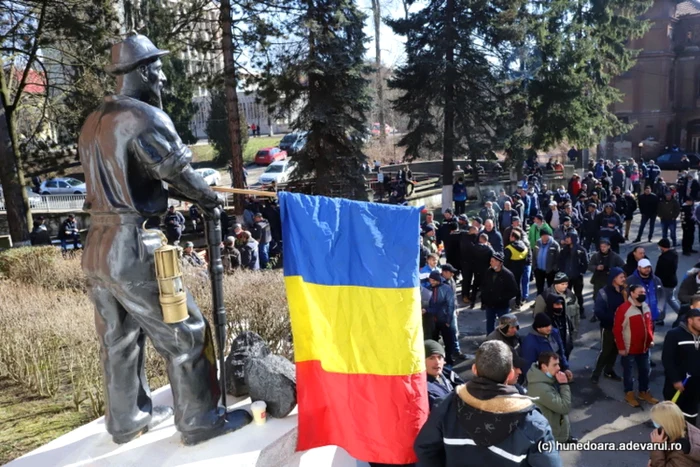
The statue of the miners in front of the headquarters of the mining company in Petroșani. Photo: Daniel Guță. TRUTH
“Through the narrow galleries, suffocated by abandoned machinery and hanging electrical cables, the equipment is transported by hand. It’s too dark to check methane levels, too hot and too much black coal dust to breathe normally, and often too cramped to stand. A miner stumbles past and murmurs “good luck” to his colleagues. 90 people lost their lives in the last year in the mines of Valea Jiului”British journalists from “The Observer” reported in 1990, in a report on coal mines.
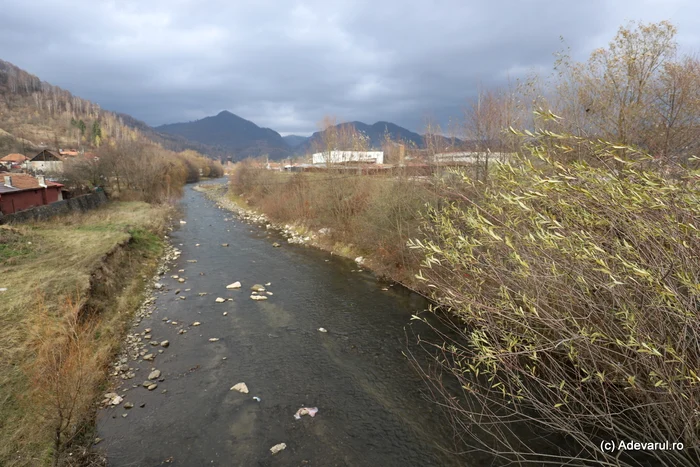
Jiu River, Dâlja area, Petroșani. Photo: Daniel Guță
Immediately after the Revolution of December 1989, the Romanian state decided to close the newest coal mines established in the Jiului Valley in 1986: the Iscroni Mine in Aninoasa, the Petrila Sud Mine, the Lonea Pilier Mine and the Neag Field Mine.
The restructuring and redundancies in Valea Jiului took place in a disturbing climate. In the 90s, Romanian society was shaken by the violent protest actions of the miners, called “mineriades”, which culminated in the invasion of the Capital by thousands of miners.
26 years since the last mining
The last “mining” took place in January 1999, after the announcement of the final closure of the Dâlja and Bărbăteni mines – the first of them opened since 1867, closed in 1931 and reopened in the 60s, in Petroșani.
The miners’ protest actions, frequent during 1998, against the background of the social problems faced by the residents of Valea Jiului, culminated on January 4, 1999, when the workers led by Miron Cozma launched a general strike, in the context of the announcement of the closure of the Dâlja Mines and Barabateni.
The famous trade union leader Miron Cozma demanded on behalf of the partners the dismissal of the minister Radu Berceanu who “is guilty of an attack on national security” and 10,000 dollars and two hectares of land for each dismissed employee. For the other miners, they claimed salaries equivalent to the sum of 500 US dollars per month.
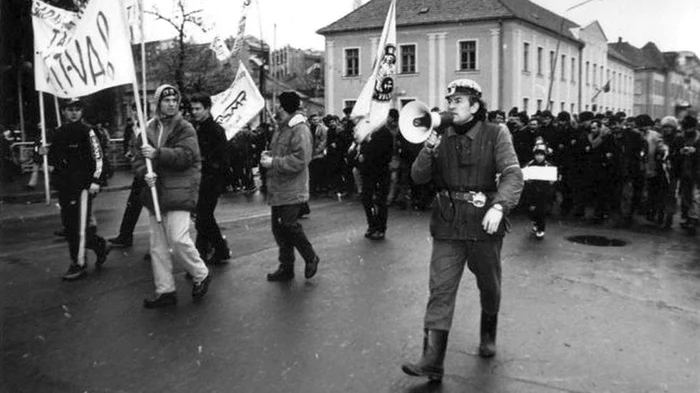
Protests in January 1999 in Petroșani. Photo: Traian Manu
The protests continued in the following days, and on January 11, 1999, a funeral march was organized in Petroşani, which caused many controversies. A coffin and crosses were made on which “Government” and “Radu Berceanu” were inscribed, and on a cross was placed the skin of a goat, sacrificed by unidentified persons, all of which were carried by the miners on the streets of the city.
“Defying the mysteries and Christian works, a funeral ritual was simulated, with Minister Radu Berceanu being declared enemy no. 1 of mining in Romania”. pointed out the prosecutors in the 1999 Mineriada criminal case, in which Miron Cozma was sentenced to ten years in prison, and other former leaders of the miners received lesser sentences.
In the morning of January 18, 1999, over 10,000 people from Valea Jiului, led by Miron Cozma, set off for Bucharest, most of them miners, some armed with shovels, pickaxes, clubs and gas masks. To prevent them, the law enforcement forces improvised dams in the Jiului Gorge, including displacing rocks over the road that connects Petroșani to Târgu Jiu, but they were crossed with ferocity.
In the following days, in the Jiului Gorge (video) and in Costeşti, in Vâlcea county, there were bloody confrontations between miners and law enforcement, resulting in numerous injuries and destruction. On the night of January 21 to 22, 1999, President Emil Constantinescu decreed a “state of emergency” throughout the country, immediately after the miners from Valea Jiului took 1,500 gendarmes and the prefect of Vâlcea to Costesti prisoner.
The conflicts ended with the Peace of Cozia, as the agreement signed on January 23, 1999 between Prime Minister Radu Vasile and Miron Cozma went down in history. The mining raid did not stop the closure of the Dâlja and Bărbăteni mines (from Lupeni). In Valea Jiului, with the closure of the two coal mines that together had 1,700 employees, the number of employees of the National Company of Huila, which managed the coal mines, had reached less than 20,000 for the first time after more than half a century.
The mine of tragedies, which the authorities wanted a museum
Praised during the years of communism, the Dâlja Mine had become one of the most dangerous mines in the Jiului Valley in the 1990s, and the series of mining accidents in its last years of operation hastened its closure.
In 1996, 125 work accidents were registered in Dâlja, and in the first part of 1997, almost 50, according to the officials of the Ministry of Labor and Social Protection. The worst occurred in April 1997, when an underground explosion killed six miners and injured five others.
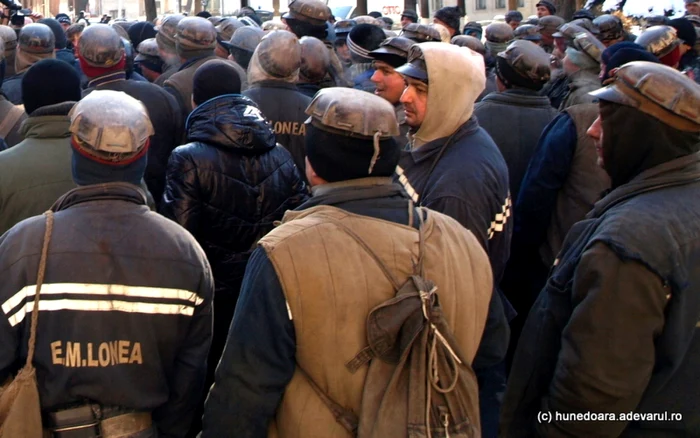
Miners. Photo: Daniel Guță
Shortly after, the Romanian state took the decision to close the mining operation, where around 900 people were still working in 1999. However, in order to sweeten the dramas experienced by the families who were to be laid off, the municipality of Petroşani (video) announced that the ruins of the Dâlja mine would be transformed into a tourist attraction, along with the neighboring Colonie district, in Petroşani – classified in those years as a historical complex.
The authorities proposed that the guests of the area could be accommodated in some of the period pavilions in the neighborhood, buildings that were to be redeveloped, and then be able to live the experience of being a miner in the preserved galleries of the over a century and a half old mine. The tourists were to enter the shaft and extract coal from the underground.
The project was abandoned, most of the old mine buildings were demolished or are currently used as company headquarters.
