
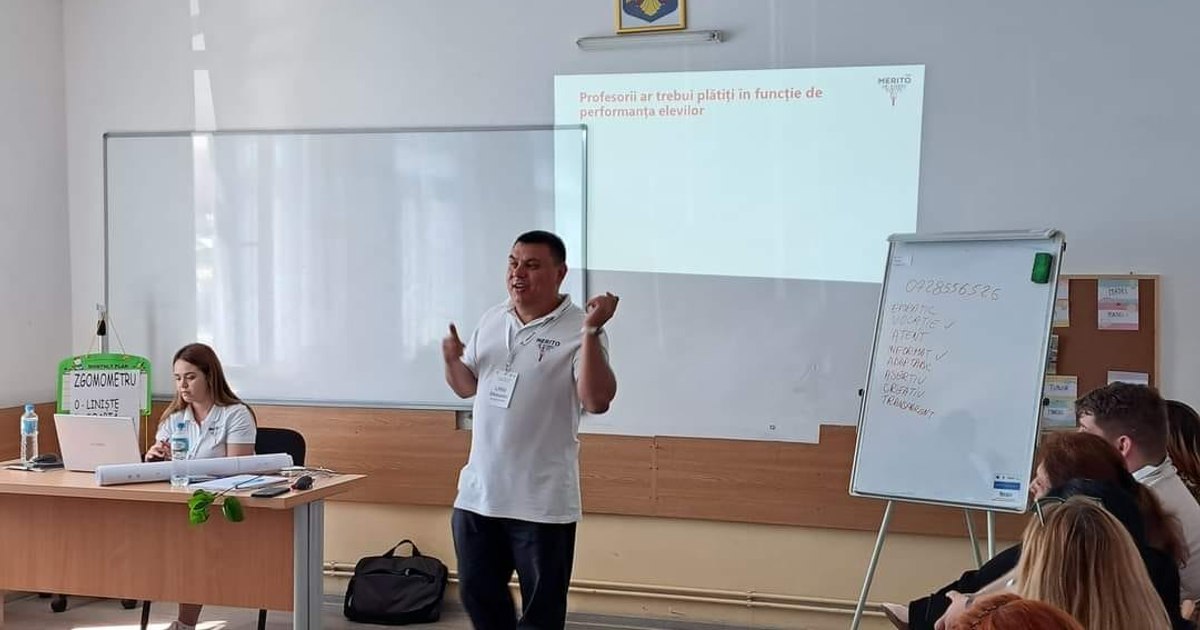
An economics lesson taught by a high school teacher has gone viral on the internet. It happened after the teacher told on Facebook how he explained political doctrines and ideologies to the children, but also how they are reflected in the economic activity of a country. The message garnered hundreds of likes and comments.
Liviu Drăghici was appointed MERITO professor in 2021. Source: facebook
Liviu Drăghici, economics teacher at the “Victor Slăvescu” Technological High School in Ploiesti, gave the children interactive and easy-to-understand examples using examples from sports. The unique way of teaching these concepts helped the children not only to understand, but also to never forget what communism, fascism, socialism, liberalism and authoritarian regimes mean.
To begin with, the teacher drew a line on the blackboard, along which he placed the political doctrines from extreme left to extreme right: communism, socialism, social democracy, classical liberalism, conservatism, nationalism, libertarianism and fascism. The teacher explained the communist regime by telling the students to put all the pens they have on their desks. Then, he informed them that at the beginning of each class they would receive other pens but that, at the end, they would have to return them. The teacher also explained what the fascist regime means through a symbolic gesture of granting privileges to students with blue eyes. The teacher also used examples from boxing, a sport practiced by one of his students, to explain the concept of a “coup d’état”:
The teacher’s Facebook message garnered hundreds of likes and comments
“Everybody pens on the desk. Starting today, everyone will receive a pen in accounting class to write with and bring it back to me at the end of the class”the teacher began his message on his Facebook page. Then he said that although they didn’t like the new rule at all, the students still complied. However, the teacher added: “Hands up who has blue eyes.” Four students raised their hands, and the teacher promised them a grade of ten each. So, only on beautiful eyes. Moment when the noise in the class turned into a riot. “And for the rest of you who don’t have blue eyes, I’ll take two points from you on the next grade. And whoever thinks it’s not right, come forward and I’ll listen to him, let’s see what he knows”.
Then, to explain in terms of political ideology the decisions he made, the teacher drew a line on the board along which he placed the political doctrines. “Political doctrines and ideologies are based on their positions on private property, state intervention in the economy, individual liberties, and other political and social issues,” he explained to the children.
The main political ideologies explained in the students’ understanding
Far left: communism. It proposes the abolition of private property and the establishment of collective ownership of the means of production. The economy is centrally planned, and economic equality is the central objective. Example: Soviet Union, Maoist China.
Left: socialism. It supports a mixed economy with a major role of the state in the distribution of resources and the reduction of social inequalities. Emphasis on free public services (health, education). Examples: social democratic parties in Europe.
Center-left: social democracy. It combines elements of capitalism with state intervention to ensure social justice. It promotes social programs and redistribution of wealth through progressive taxation. Example: Sweden, Norway.
Center: lclassical iberalism. It emphasizes individual freedoms, human rights and a free market economy. The role of the state is minimal, limited to guaranteeing rights and security. Example: USA during the founding period.
Center-right: moderate conservatism. It promotes traditions, cultural and religious values, but accepts the market economy and a limited state. Example: Conservative Party in Great Britain.
Right: economic nationalism. Emphasis on economic protectionism, supporting national industries and a stronger state in border control. Example: Contemporary populist movements.
Libertarianism: It promotes extreme economic freedom, reducing the role of the state to almost zero, and a strong emphasis on individual rights. Example: Libertarian parties in the USA.
Far right: fasciism. It supports an authoritarian, nationalist state with a state-controlled corporate economy and political repression. Example: Nazi Germany, Fascist Italy.
Ultranationalism: An extremist variant of nationalism, with xenophobic, racist and intolerant tendencies. Example: Contemporary neo-fascist groups.
The similarity between a coup and a boxing match
The teacher explained what a coup means with an example taken from sports, more precisely from boxing. He cheated a student practicing this sport in front of the class and began his demonstration:
“Even though I was heavier than him, I only reached his chest.
– I want you to imagine that there would be a boxing match between me and your colleague. But we are only imagining.
They burst out laughing and the colleague smiled narrowly. He had probably already punched me a few times in his imagination.
– Who do you think will win?
– The colleague clearly, they answered in chorus.
– And yet, after a close fight, with referees and professional observers, I beat him on points.
– Come on sir, there’s no way. Don’t look while he’s by your side?
– That’s what he says and requests a retrial. The referees review the match, analyze all the shots and come to the same conclusion. The score is correct and I am the winner. It’s just that in the anti-doping test it turns out that I consumed some prohibited substances that have the role of increasing performance. Is it normal to cancel the result?
– Absolute. Well, you cheated.
– How did I cheat? I had referees and observers in the ring saying that I boxed correctly.
– Yes, but before you created some advantages.
– And then why did you let me get in the ring? Why didn’t you stop me before the match? That people have also given money for nothing on tickets.
– Well, I didn’t know.
– Perfect. I consider that I have answered the question”.
Liviu Drăghici worked for eight years in a corporation before becoming a teacher in 2016. He studied Management and Pedagogy at the same time, at the Petrol – Gas University of Ploiești, then followed a master’s degree in Management and one in School Counseling and Career Development. He owns a café-library and is a co-founder of the Ai Carte Association. In 2021, he was appointed MERITO teacher at the gala for innovation in education.
