
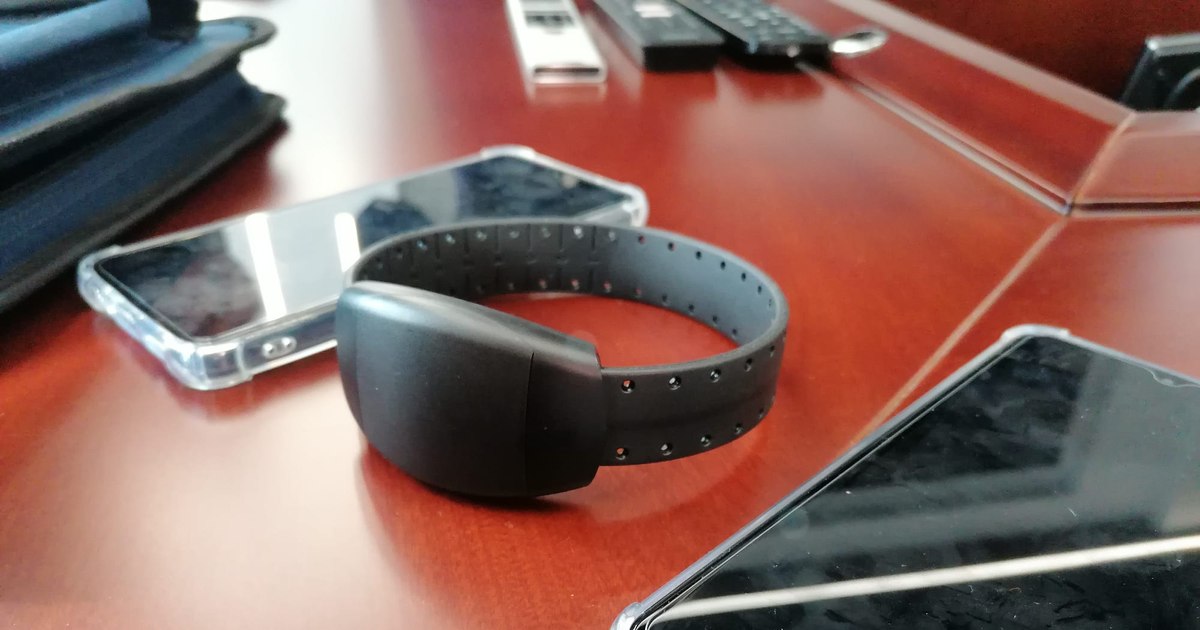
More criminal acts, from one year to the next, are registered in the field of domestic violence. And besides the numbers, it is very worrying that the victims refuse to accept the fitting of electronic bracelets to monitor the aggressors.
Electronic bracelets are available in all counties of the country. PHOTO: Alina Mitran
The number of criminal acts in the field of domestic violence increased by 5.3% in the first eight months of this month, compared to the same period last year, Police data show. “Hitting or other violence” is the crime with the highest share in total (61%, 24,743 acts), followed by “threat” (13%, 5,135 acts). Instead, there were several thousand violations of protection orders and temporary protection orders, and this in conditions where very few of the victims of violence still agree to the fitting of electronic bracelets to monitor the aggressors. Violations of protection orders, the data show, also occurred when abusers were being monitored electronically.
At the national level, most crimes were committed in urban areas – 21,760, compared to 18,482 in rural areas. Assaults take place especially at home, but thousands of acts also occur in the public space. Almost 20% (7,752 acts) of the crimes were committed, in the first eight months of this year, in the public space.
The police identified almost 41,000 aggressors who committed crimes during the mentioned period, 42,295 people falling victim to them.
In the same period, the courts issued 8,745 protection orders, 3,622 of which came from temporary protection orders. There was an enormous number of violations of protection orders – 3,439 offences.
Electronic bracelets, in only 11% of the cases for which a protection order was issued
Until October 1, 2024, when the use of electronic monitoring systems (SIME) was generalized throughout the country in the case of domestic violence, bracelets were used in the counties: Bacău, Brașov, Cluj, Călărași, Caraș – Severin, Constanța, Covasna, Galați , Giurgiu, Harghita, Ilfov, Iași, Mehedinți, Mureș, Neamț, Prahova, Sibiu, Sălaj, Satu Mare, Teleorman, Vâlcea, Vrancea and Vaslui. In all these counties, 9,564 protection instruments were issued for victims of domestic violence (including 5,193 provisional protection orders and 4,371 protection orders issued by the courts). In only 1,033 situations, however, the measure was implemented “obliging the aggressor to permanently wear an electronic surveillance device”representing approximately 11% of all temporary protection orders issued and court-issued protection orders.
More than half of the abusers monitored with an electronic bracelet either violated the 584 protection order/temporary protection order or actually destroyed the device – 59 cases. Following these crimes, 52 offenders were detained, 16 were remanded in custody, two were placed under house arrest, and 11 were placed under judicial control.
“Police officers issue temporary protection orders, in the exercise of their duties, when they find that there is an imminent risk that a person’s life, physical integrity or freedom will be endangered by an act of domestic violence, in order to reduce it”the police say.
Although it seems hard to believe, victims still refuse in large numbers to be fitted with electronic bracelets, and without their consent, the aggressors cannot be subjected to this measure.
This finding is, says the president of the Necuvinte Association, Simona Voicescu, a great disappointment and worries more than the increase in the number of crimes from one year to the next.
“I would not necessarily interpret that the phenomenon of violence is increasing. I would interpret these data to mean that we are more aware of forms of violence. If five years ago there were 20,000 cases reported to the police, now there are 60,000 – 80,000 per year. It is not an increase in violence, but the fact that the law has changed, these tools have been created, the protection orders, the electronic monitoring system has been implemented. That is, women are starting to see that there are measures to protect them and they are getting the courage to ask for help.” explains Simona Voicescu.
However, reports to the police are far from truly reflecting the phenomenon of domestic violence. International data, says Simona Voicescu, show that one in four women is a victim of some form of violence.
“What worries me is that, although a lot of work has gone into making these bracelets exist and implemented, so many women refuse to have them fitted. (…) It is a tool created mainly to protect and the fact that it is refused is for me a very big disappointment”, added Voicescu.
Why victims refuse electronic bracelets
In many cases, victims refuse to be fitted with electronic bracelets with which their aggressors can be monitored electronically because they think the punishment is too great. This is what the victims testify and this is what the investigations carried out by the police show, says Simona Voicescu.
“A fairly significant percentage believes that the punishment is too high for the aggressor. (…) The victims want to be released, but on the other hand they consider that the punishment, such as a criminal record, an electronic monitoring, is far too much. They tell us – “yes, but he also suffered when he was a child”, “yes, but he also had problems, “he is not a bad boy, he has moments”, “I don’t wish him harm, all I want is to I free myself from him”. I mean, they want a protection order, they want to keep him away from her and the kids, possibly, but they don’t necessarily want to punish him,” Voicescu explained.
Too few shelters for victims
If the establishment of the electronic monitoring system is a huge step forward in the fight to protect victims, other problems still remain to be solved, says the representative of the Necuvinte Association.
The centers for sheltering victims, although more than years ago, are still insufficient, and the situation seems to worsen with the amendment of the legislation and the tightening of the conditions of authorization of the providers of such social services. In order for a center to be authorized, one of the conditions, says Voicescu, is that the provider presents solutions so that the beneficiaries of that center can be transferred to another shelter in case they lose their license. Such restrictive conditions, on the one hand, prevent the authorization of new centers, and on the other hand, they also put existing ones at risk. Although in the case of issuing the protection order the one who leaves is the aggressor, and it does not happen so often that the victim looks for a shelter, the solution is a temporary one, says Voicescu. Often the problems regarding the division of common assets drag on between the aggressor and the victim long after the criminal situation has ended, also because the fees imposed for the division are considerable and most of the victims cannot afford them.
Another unresolved issue is the trial of certain cases involving victims and perpetrators without regard to protective orders issued. It is the situation where an abuser is granted, by sentence, the right to visit his children, for example, but by the protection order he is prohibited from approaching the mother of the children (and the mother and the children live together). Such situations are clearly regulated in other states, says the president of the Necuvinte Association, with priority being given to compliance with the protection order.
