
The number of West Nile virus cases is increasing. Another infected patient was confirmed, on Wednesday, at the Suceava County Hospital. It is about a 69-year-old person, hospitalized 9 days ago, initially with the suspicion of meningitis. “Fortunately, the patient suffers from a mild form of the disease, his condition is favorable and he will be discharged tomorrow,” stated, for Adevărul, the spokesperson of the medical unit.
Two patients infected with West Nile are admitted to the hospital in Suceava. Photo source: archive
Dr. Dan Teodorovici, an emergency medicine doctor at the hospital in Suceava, told Adevărul that from July until now, four patients have presented themselves at the hospital, later conforming to West Nile. “An 81-year-old who did well after treatment and was discharged. He was not left with any sequelae, he was completely cured. It is also the one that responded best to treatment. There is nothing specific, he was given antivirals and antithermics. Then we had an 83-year-old patient who, unfortunately, passed away but against the background of other health problems. These were complicated by the virus infection. His initial condition, already precarious, has worsened a lot. That person, who had suffered several cerebrovascular accidents, died suddenly, and the event happened a few days ago. We also have an 88-year-old patient, likewise, with other pathologies, who is now in a septic state, in Intensive Care, also in serious condition. And one more person confirmed on Wednesday, also almost cured.” the doctor explained the current situation.
Symptoms of West Nile, confused with those of meningitis
These patients presented themselves at the hospital in mid-July with symptoms of meningitis, said Dr. Dan Teodorovici. “They presented to the UPU with symptoms of meningitis: headache, fever, confusion. They were hospitalized, and then, for the identification of the pathogen, a puncture is made with the collection of cerebrospinal fluid. The analysis was sent to the laboratory for identification of the pathogen. Among the pathogens being looked for is West Nile virus. But, in the case of these patients, instead of discovering meningitis, we discovered the mosquito-borne virus”doctor Teodorovici detailed the protocol.
These people hospitalized in Suceava come from the countryside. “Mosquitoes are everywhere, but especially in rural areas, in the village, and the people admitted to us live in these areas. However, we expect that patients who live in the city will also appear. It is possible to appear especially in the case of the elderly, immunocompromised, but also children”. Dr. Teodorovici also specified.
Why do we experience such cases of West Nile virus disease year after year? Epidemiologist Emilian Popovici has an extremely simple explanation: the local authorities do not take measures to eliminate mosquitoes in time. “The higher the level of civilization and development of a region or country, the less noticeable is the presence of flies, mosquitoes or rodents, and this is because correct and permanent disinsection and deratization measures are taken. As the mentioned level of development decreases, the opposite situation is noted, and instead of measures, excuses are generally presented“, is the opinion of the specialist. Abroad, he continues, these insects are extremely few and far between. The reason? “The authorities there are taking measures to prevent their spread throughout the hot season. That is why they do not face the risk of West Nile and any other virus transmitted by these insects. It’s a different story here. We take measures only after the first cases of disease appear, only after the mosquito populations are present and very present. Obviously, the result of these disinsection measures is now limited“, believes the specialist.
People from rural areas, the most exposed to the risk of illness. A biologist’s explanations
Starting from these statements, we tried to find out what is, concretely, the disinsection protocol carried out by the Capital City Hall, how the procedure is carried out and what are the immediate effects.
Aurelian Pintiliescu, a biologist at the Municipal Eco Sanitation Company, told Adevărul that the virus can be transmitted to humans by the common mosquito, the one that buzzes our ears at night. “We are not talking about any specific species here. Any mosquito it can make us sick”.
The problem of the West Nile virus in Romania arises with the uncontrolled multiplication of the mosquito population, continues the specialist. “Everything starts from the biology of this insect, from the way it develops and reproduces. For the laying of eggs and the development of larval nests, mosquitoes need a suitable environment, namely stagnant water, from puddles and lakes to various water containers forgotten by people in yards or gardens. The water would have to sit there for about a week for a mosquito population to develop.” explains the biologist.
Why do cases of illness occur especially among people who live at home, in rural areas? “These people live and work outdoors more than someone who lives on the block in big cities. Then, the people who live in the house water their gardens, forget various containers with water, do not solve the problem of puddles that appear after rain, standing water in different areas of the garden, yard, orchard, etc.“, says Aurelian Pintiliescu.
A mosquito, the biologist said, can fly up to one kilometer, and if the wind blows, it travels even greater distances. Basically, it has a fairly extensive area to find an environment conducive to reproduction. “It also lays 200 eggs at a time. And in seven, ten days the next generation of insects appears. Mosquitoes live for about a month, during which time they can lay eggs up to five times. Practically, from a single mosquito in a month you can reach 1,000 insects”.
Why do mosquitoes actually bite us?
It should be known that male mosquitoes do not sting, explains the biologist. “They don’t need blood. They feed on the sap of flowers and juices from fruits or plants. Females do not feed on blood either. They sting, however, for a different reason. The blood helps to mature the eggs which the insect then lays. They simply need certain proteins in the blood for their eggs to develop.”
We must therefore beware of stings if we want to prevent West Nile infection, warns the specialist. “The virus is circulating throughout the warm season. There were also confirmed cases in Bucharest and I expect more to appear. Obviously, people in the city, who do not live at home, should buy repellent products: sprays, solutions, wristbands, indoor devices that plug into the socket, mosquito nets on the windows. And to have appropriate clothing, especially in the evening when we go for a walk in the parks: pants and blouses with long sleeves, made of a thin material that allows the skin to breathe”.
The reason why we have mosquitoes in Bucharest, even though the city hall carries out disinsection
In Bucharest, Aurelian Pintiliescu also specified, the treatments administered against mosquito populations may have a much reduced effect due to the heat wave during this period. “Green space spraying solutions lose their effectiveness, become less effective due to heat, UV rays and dust in the atmosphere. Likewise, treatments are not performed in rain and strong wind “. Then, the biologist states, let’s not forget the city’s sewers, which, if clogged, become an environment conducive to the development of mosquito colonies.
This year, the disinsection in Bucharest started in the spring, at the beginning of May. “We started earlier than in other years precisely because we faced higher temperatures and the mosquitoes also appeared earlier. We started spraying in parks, gardens, green spaces between blocks and street vegetation. In principle, insects die about 5 minutes after contact with the substances, but it is not enough to spray only once. The operation must be repeated. Among the reasons is the fact that the insecticide we use to spray the vegetation cannot be applied to the water, where the eggs are laid and the larvae develop. There are environmental restrictions. Another substance is used for water. There are larvicide treatments that are done at the shores of the lake”.
Then, the biologist states, disinsection is not done anytime and anyway: “There are people who ask why we don’t spray more often or why we don’t use a higher concentration of insecticide. Here is the answer: because these active substances kill not only mosquitoes, but also other beneficial insects. That’s why you can’t give every day. And this must be taken into account. Everything must be done with a head. The manufacturer’s recommendations, the respective product’s advice must be taken into account. You have to adjust the concentration of the solution in such a way that you only neutralize the species of interest.”
The biologist also draws attention to one aspect: “If they persist with these insecticides, the mosquitoes will develop resistance, and the solutions will no longer have their effect.”
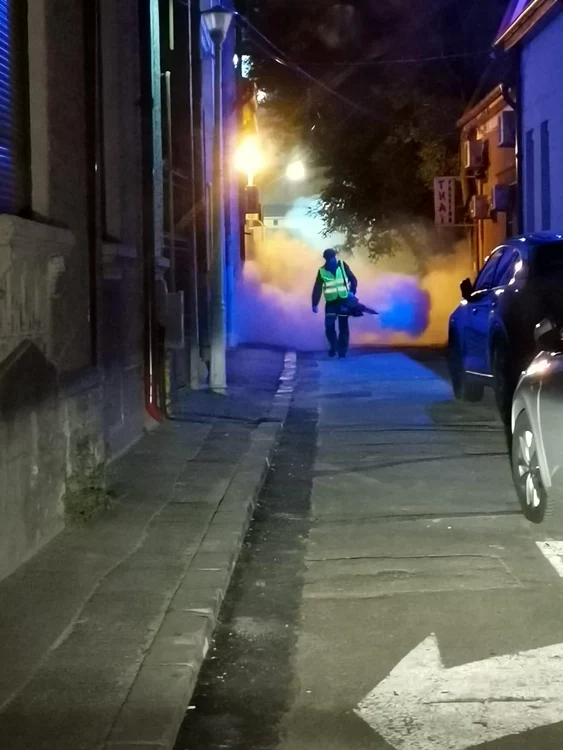
Disinsection is done at night after 22.00. Photo source: CMEIB SA
The Capital City Hall has approved 14 treatments for this year
Alina Ion, communication specialist at the Eco Sanitation Municipal Company, told Adevărul that for this year the Capital City Hall approved 14 treatments, but their number could increase if the specialists consider it necessary. “This very evening we begin the eleventh. The treatments are only done at night from 10:00 p.m. to 5:00 a.m. and all green spaces in Bucharest are targeted. I mean to public spaces. On Thursday, for example, the parks are made, and on the other days of the week everything that means green space belonging to the municipality is sprinkled“. An intervention can last five, six or even seven days, depending on the weather forecast. “If it rains, for example, that evening’s action is postponed“, says the head of communication.
The monitoring of the areas where these treatments are insisted on is done randomly, explains Alina Ion. “Some traps are placed in various areas of the city to catch insects. Then, they arrive at the Cantacuzino Institute, where they are analyzed in the laboratory. If mosquitoes carrying West Nile are discovered, the area where they were caught intervenes with a more rigorous disinsection. Additional treatment is applied. It happened some time ago in Berceni and București Noi”, Alina Ion also told us.
