
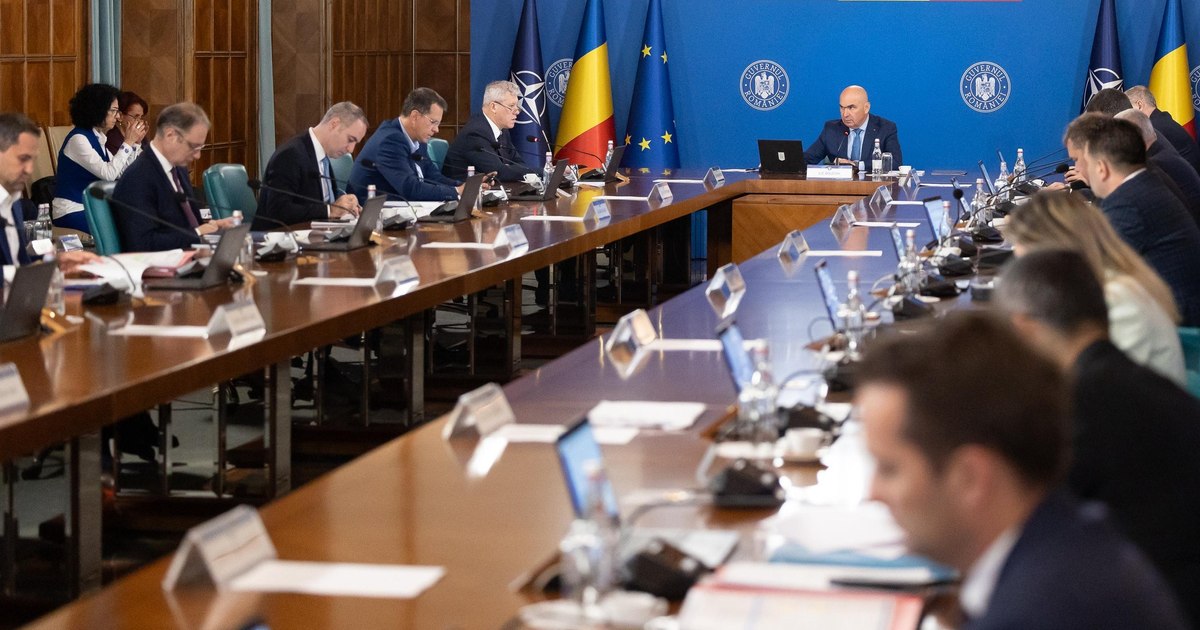
The subject of combining the pension with the state salary has been the subject of several CCR decisions in recent years. One by one, the Tăriceanu Government, led by Boc, as well as the Cabinet of Marcel Ciolacu I, tried, either through a project or through an emergency ordinance, to limit this practice. Now, the Government led by Ilie Bolojan is starting on the same path with another bill.
PHOTO Facebook / Government of Romania
“It will be interesting to see to what extent the Constitutional Court will decide that the accumulation of the salary with the non-contributory pension is constitutional. It will be a strong blow for those who have such special pensions, if the CCR gives the green light to this measure, because it will practically find that these non-contributory pensions do not represent a property right. So the state can always reduce them depending on the economic problems it faces and the interests it has. That is why I think the decision of the Constitutional Court it will be an extremely important one, especially since this is a manhas a problem that Romanians face from the perspective of the frustrations they have in front of those who, through various laws, through various legal artifices, increased their incomes, even after retirement, to some amounts that are higher than the salaries from the pension activity.
So it will be a decisive moment from this perspective, which probably, if this reform gets the green light, the state will use it in the attempt to reduce special pensions, considering that they will no longer be considered as an earned right”points out economic analyst Adrian Negrescu for “Adevărul”.
On the other hand, the current project provides for some exceptions, something that can stop his chances from the start, the economic analyst emphasizes: “I am afraid, however, that the whole effort of the government will hit like a wall in front of the Constitutional Court because the introduction of exceptions related to the functions of representation in the Romanian state, practically, sabotages this law, establishing some regulations that have the character of violating fundamental rights. You cannot establish such limits when it comes to the application of a law that must have general considerations, to apply to everyone”.
What the project provides
The new initiative provides that the pensioner will collect only 15% of the pension during the employment, the salary being collected in full. The project that modifies the regime of the accumulation of the special pension with the salary in the public system will apply for “the staff paid from public funds in accordance with the provisions of Law – Framework No. 153/2017 on the remuneration of staff paid from public funds, with subsequent amendments and additions, as well as the staff of autonomous agencies established by the state, of national companies/companies, of companies in which the state is the sole shareholder or holds a majority stake, of autonomous agencies established by administrative-territorial units, of companies where the units administrative-territorial entities are sole shareholders or have a majority stake, as well as regulatory authorities, to whom the decision to retire from the public pension system was issued, in accordance with the principle of contribution, the decision regarding the granting of a service pension or a decision to retire from the military pension system, granted under the conditions provided by the specific legislation, may continue the activity with the annual agreement of the credit officer/employer, until reaching the age of 70”.
However, the discussions are not finalized. The project provides several exceptions: “With the exception of the provisions of paragraphs (1) – (3), persons elected to public positions and persons appointed to positions in public institutions/authorities by Decision of the Chamber of Deputies, the Senate or the joint Chambers of the Parliament, persons holding mandates whose duration is provided for in the Constitution during the exercise of the mandate, as well as persons appointed to the position by the President of Romania pursuant to the decisions of the Supreme Council of National Defense, may accumulate the pension with the salary during the exercise of the mandate”.
Thus, mayors, vice-mayors, presidents and vice-presidents of county councils, as well as MEPs, would benefit from exceptions. The list also includes managements of several institutions, such as CCR, BNR, the Court of Accounts, the People’s Advocate, as well as CNA, ANRE, ASF, but also dignitaries appointed by CSAT decisions.
The Minister of Labor specified that the leaders of the Coalition do not currently have a decision regarding the inclusion of contributory pensions and the exceptions provided. “The normative act is now in decisional transparency. Indeed, there are discussions about whether these exceptions should remain or not. All I can tell you yet is that the discussion continues. I mean, I couldn’t tell you that it was a decision made in the Coalition. There are different themes that have been re-discussed. One of them is the theme, to give you an example, the theme of pension-salary cumulation in relation to non-contributory pensions. In the initial version, the pensions that were contributory were also subject to this project. In the current version, pensioners from the systems for example Education, Health, who have exclusively contributory pension do not have any change in their status”explained Florin Manole.
The problem of exceptions
“The Romanian Constitution says that people in equal situations must be treated equally. Any deviation from this constitutional principle is unconstitutional. And we have countless Court decisions”confirms former CCR president Augustin Zegrean, regarding the exceptions that could hinder the initiative. So the exceptions bring with them the problems of unconstitutionality.
If the project will only provide for non-contributory pensions, this could represent a difference in the Court’s decision, says the former CCR president. “The salary is received by a man for the payment of the work performed. And the pension is received for the period of work and for the period in which he worked and contributed to the Pension House. So it has nothing to do with each other. If the man has the right to a pension, you give him a pension, and if he wants to work and works, you give him a salary”explains the former CCR president.
Previous decisions of the CCR
However, the declaration of unconstitutionality can also come on the basis of previous decisions, with the CCR looking primarily, as a rule, at its previous jurisprudence. And the Court has had several decisions over the years.
2005
In 2005, Monica Macovei, Minister of Justice at the time, proposed in the reform package of the judicial system and the amendment of the law 303/2004, of the Statute of prosecutors and judges so that they can no longer accumulate the pension with the state salary.
The amendment was challenged at the CCR by the PSD parliamentarians, and the Constitutional Court accepted the exception of unconstitutionality, establishing that judges and prosecutors can accumulate the pension with the salary. Only the judge Constantin Doldur had a different opinion, showing that the amendment proposed by Macovei does not violate the fundamental text, since compared to the other beneficiaries of the right to pension provided for by Law no. 19/2000, judges and prosecutors have a special situation, their rights being established in a different amount and under different conditions than those provided for in this law.
At that time, the decision of the Constitutional Court no. 375/2005 specified that “no constitutional provision prevents the legislator from suppressing the cumulation of the pension with the salary, provided that such a measure applies equally to all citizens, and the possible differences in treatment between the various professional categories have a legitimate rationale“.
2009
In 2008, the Boc Government adopted GEO no. 230/2008, and in January 2009, upon referral to the People’s Advocate, it was declared unconstitutional, by decision 82/2009 of the CCR.
“With a majority of votes, the Court admitted the exception, finding that the Government’s Emergency Ordinance is unconstitutional, as it affects the fundamental rights provided by the Constitution, regarding the right to work and the right to pension, it contravenes art. 115 paragraph (6) of the Basic Law”, the Court showed at the time.
The ordinance stipulated that no one can receive a pension and a salary from a state institution at the same time, in that context even the people’s advocate is in question.
2023
In 2023, the subject of combining the pension with the salary came back to the CCR table. This time at the trial of the PSD-PNL Government led by Marcel Ciolacu, after referral to the ÎCCJ. And this time the violation of the right to work was emphasized.
“With unanimity of votes, the Court accepted the objection of unconstitutionality formulated by the High Court of Cassation and Justice and found that the provisions of articles 2 to 11 of the law regarding some measures for the continuation of the activity by the persons who meet the retirement conditions, as well as for the modification and completion of some normative acts, are unconstitutional. The Court, in essence, considered that the criticized provisions regarding the prohibition of the accumulation of the pension with the salary contravene the fundamental right to work, guaranteed by the Constitution”announced Marian Enache, president of CCR at that time.
Decision no. 521/2023 also noted the violation of the right to property, guaranteed by Article 44 of the Constitution, also reasoning that “conditioning the exercise of the right to work on the non-exercise of the right to pension is equivalent to the exclusion of a socio-economic category from the possibility of holding a position in the public sector, which is inadmissible. A fundamental right or its exercise cannot exclude the benefit of another fundamental right, also regulated in the Constitution, since parallel legal regimes would be created depending on the rights in question”.
However, the current initiative does not present data on the impact of the regulation. The government does not explain either in the draft decision-making transparency, or in the statement of reasons, how many people with special pensions who continue to work for the state would fall under the scope of this law. There is no centralized record, but according to an analysis carried out by Europa Liberă Romania, there are approximately 10,000 people who accumulate the pension with the salary in public institutions.
Economic analyst Adrian Negrescu specifies that “special pensions, at the moment, have ended up costing us around 17 billion lei every year. There are almost 11,500 civilians, we are not talking about the military, those from the Ministry of the Interior, but civilians, including magistrates, clerks, parliamentary pilots, who have collected service pensions during 2024. And for these special civilian pensions, the government has allocated 1.7 billion lei from the budget. In other words, 75% of the total amount paid for service pensions was transferred from the state budget”.
