
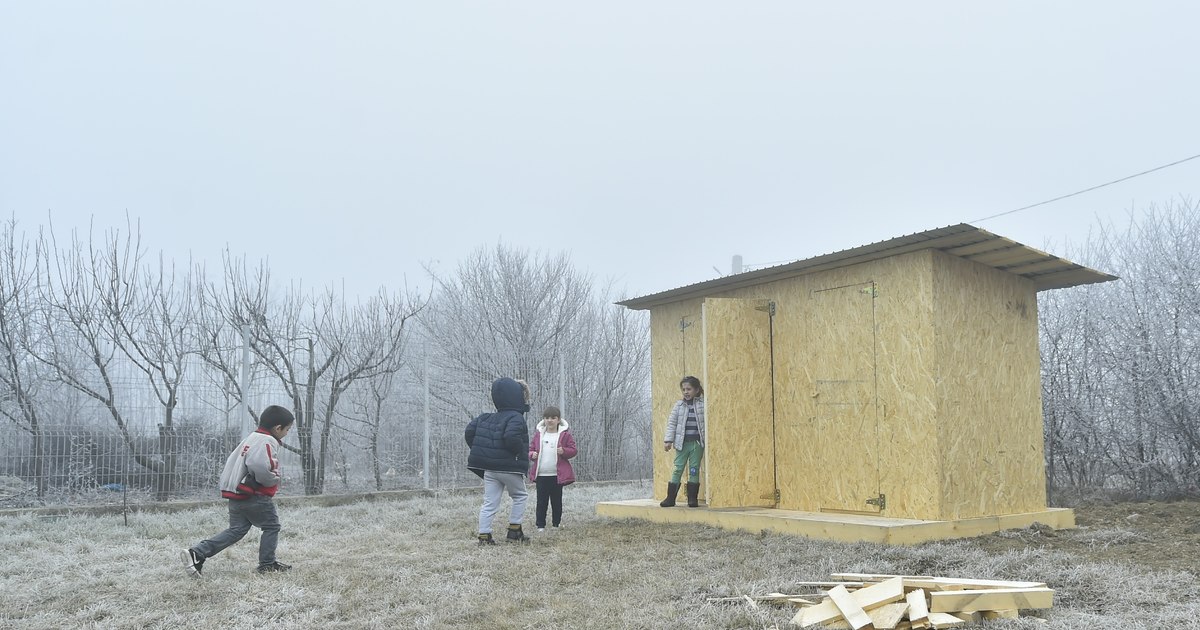
From 2019 until now, the Government of Romania has allocated over 120 million lei for the construction of 21st century toilets in schools that had toilets in the courtyard. The money, say the representatives of the Funky Citizens organization, was distributed to dozens of rural educational institutions. But how many of these schools have actually solved their problems? How effectively were these amounts used? It is not known. It is also the reason why the representatives of the organization decided to check these things by asking for people’s help. The Adevărul reporters responded to the request and here is what we discovered.
According to the authorities, in Romania there are 70 schools with non-compliant toilets. Photo source: archive
I consulted the interactive map provided by Funky Citizens and randomly chose two schools in the country: Maxenu secondary school, from Buzău, and Ungureni secondary school, from Bacău county. The bottom line? The two educational units that received money to renovate the toilets did their job well. So we can cross them off the list because we’ve checked them.
“We have 21st century toilets equipped with everything you need”
“Indeed, we received money for the renovation of the sanitary units and used it for this purpose”, told Adevărul Mihai Stănescu, the director of the secondary school in Maxenu, Buzău county. “Construction started and was completed about four, five years ago I think. The municipality was involved in the construction of a building that was attached to our school building. It is about an external body that can be entered from inside the school, from the access hall to the classes. The sanitary group was erected on the sports field, so that area was reduced a little more. And we have toilets for girls, boys and teachers equipped with toilet bowls and sinks supplied with running water. The drinking water comes from a well that we drilled. However, there is a project started by the Buzău town hall that will ensure the supply of drinking water at the municipal level”the director explained to us.
The old toilet, built from prefabs, remained standing. “We didn’t demolish it, we use it less often although it is also supplied with drinking water.”
At the Pogonele secondary school, one of the school structures in Maxenu, the toilet for the preparatory class students is in a separate building, located in the school yard. Inside the educational unit there is also a sanitary group intended for teachers and older students. “We have an outdoor toilet, but we don’t really have a way to make a bigger indoor toilet for the main body of the building. That’s the problem. It would need some containers or a new body glued on, but it would shrink from the football field. We have an indoor toilet, it’s true, but it doesn’t serve everyone, it’s small. But both sanitary groups have drinking water, toilet bowls and everything you need”.
394 students study at the school in Maxenu and in its structures. “The secondary school in Maxenu has legal personality. Then, the structures are Pogonele secondary school, Șintesti primary school, Maxenu kindergarten with normal program and Pogonele kindergarten with normal program. Kindergartens have toilets inside, as does the school in Șintești. As for hot water, we have some instant devices that heat it up”.
“We had a toilet with a Turkish toilet”
We tried to see how the situation is at the Ungureni secondary school, from Bacău county, which also has several structures. We spoke with Viorel Dobraniș, the school’s secretary, who told us that four years ago the first money was invested to restore the sanitary facilities. “A sum of money came, but the City Hall took care of it. The builder modified a bigger room, we had an office there. Three-quarters remained chancellery, one-quarter sanitary group”. The school in Ungureni comprises two buildings, both with modernized toilets “We have new sanitary groups in the A body where the secondary school students study and in the B body where the primary and preschool students study. A total of 79 students study in the school, which benefits from two toilets equipped with toilet bowls, sinks and running water”.
Before the renovation, the school in Ungureni was among the Romanian schools with a toilet in the yard. “We had a toilet with a Turkish toilet. There were two cabins for girls, two for boys, one cabin for teachers, and one cabin for female teachers. No sinks, no drinking water.”
The secretary of the school in Ungureni told us that at the moment there is no school belonging to the one in Ungureni that does not have modernized toilets. “We have four structures: the schools in Bibiresti, Gârla Anei, Viforeni and Bărtășești. All have toilets with running water and an instant water heater. But we are used to cold water. It invigorates us.”
10 years ago, the schools in Ungureni, Bacău county, gave up heating with a stove and switched to heating with a wood-fired central heating system. “And then it was a won battle, because we were still struggling”, the secretary also said.
How dangerous schoolyard latrines are for children
“Because they have no way to follow basic rules of hygiene, i.e. wash their hands with soap and water, children who use the latrine in the schoolyard are at risk of digestive diseases, first of all. Inclusive viral hepatitis Awhich is also with digestive transmission. In our country, most of the children get this disease precisely because they use non-compliant sanitary facilities and do not follow basic hygiene rules. Hepatitis A is transmitted through the fecal-oral route. The good thing is that the virus is self-limiting, it does not become chronic, and the disease heals itself even without treatment if the person does not also suffer from other conditions. If it develops on an already diseased liver, then things get complicated. Basically, the original disease worsens”, Prof. Dr. Emilian Popovici, the vice-president of the Romanian Society of Epidemiology, explained to us.
Solutions
The two schools are living proof that if you want, you can. However, there is still a long way to go, because in Romania there are still so-called latrines, which children are forced to use. “There should be better involvement of local authorities. Funds can certainly be found, I think they are European funds which can be accessed. Some work can be started. There is the problem that there is no drinking water, but we did some drilling and solved it that way. I believe that if there is a desire, it can be done”, the director of the school from Maxenu town, Buzău county also declared.
How to check schools on the interactive map
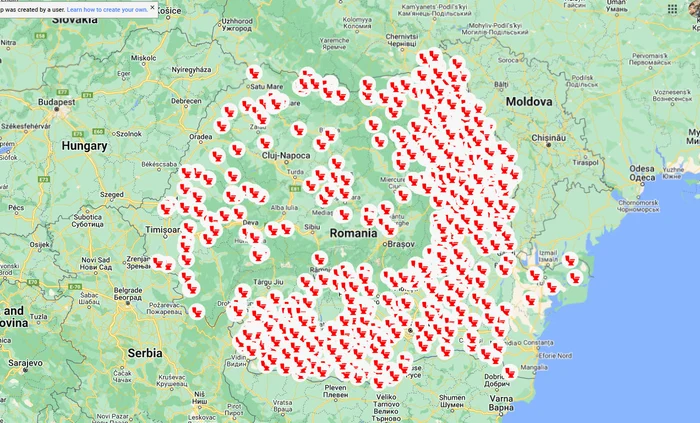
“1. Go to our map and identify the schools in your area. 2. Visit these schools to observe the condition of the sanitary facilities. It is important to note that we do not encourage access to institutions, for this purpose, to people who are not students, teachers, parents or journalists. 3. Complete our questionnaire and upload relevant photos. 4. Share this campaign with friends and family to expand the impact,” Funky Citizens announced.
In 2017, in Romania there were 2,219 educational units with toilets in the courtyard, according to the Ministry of Education. Three years later, ministry officials say, there were 800 schools. Last year, Minister Ligia Deca announced that their number had decreased even more, reaching 189. Moreover, this year it seems that we have only 70 schools with non-compliant sanitary facilities.
