
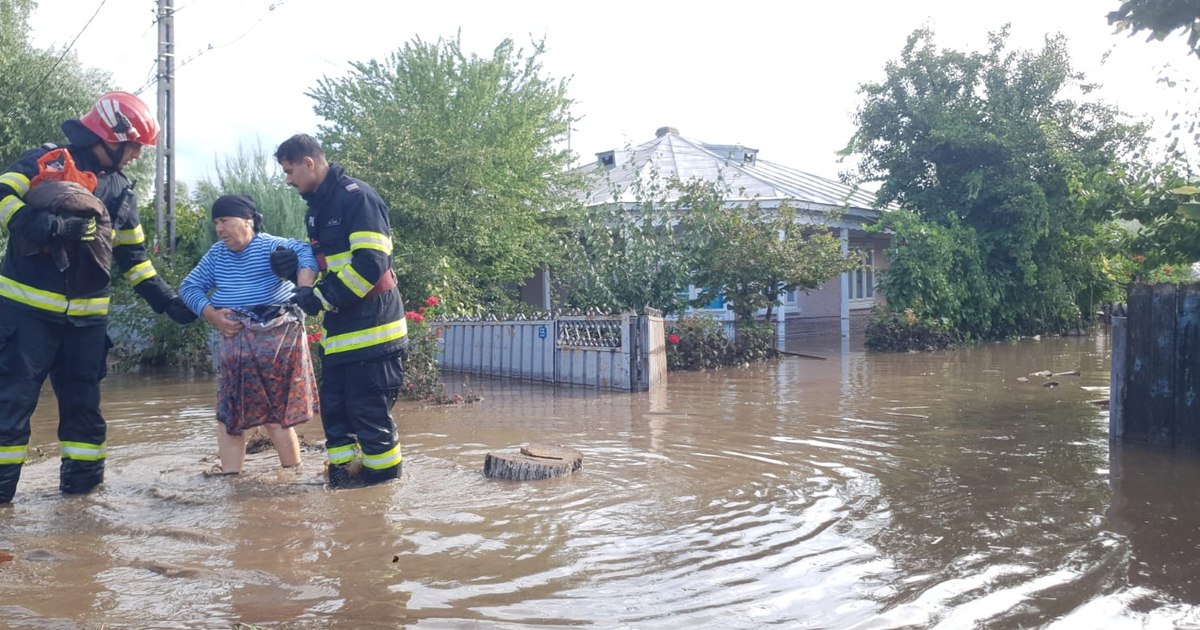
Five dead, thousands of houses destroyed and hundreds of people evacuated from the path of the blizzards, is the result of the heavy rains of the weekend. The disaster produced by cyclone Boris, which caused historic floods in Galati and Vaslui, could trigger epidemics of diseases in the area mainly with digestive-water transmission, such as, for example, dysentery and hepatitis A, draw the attention of specialists. This risk has also been reported by the authorities. The Ministry of Health recommends that the population in disaster areas boil the water from the network before consumption.
Flooding from Hurricane Boris has killed five people. Source: archive
Epidemiologist Emilian Popovici explained to Adevărul how serious the situation is in the area. The specialist stated that, in addition to digestive diseases, the population could also face another danger, which no one is thinking about now.
Ministry of Health: “Boil water before consumption”
In the context of the floods that hit Galati and Vaslui counties, the Ministry of Health sent several recommendations to the population of the affected areas. Officials consider the risk that the water in the public network may be contaminated, which is why they recommend boiling it beforehand. “For greater safety, tap water can be consumed boiled and chilled – the water must be allowed to cool on its own, without the addition of ice. If boiling water is not possible, chemical disinfection of contaminated water is effective in eliminating bacteria and most viruses. Chlorine preparations are used for chemical disinfection. In rural areas, where the water is considered undrinkable, consume only bottled water or drinking water provided by representatives of public authorities. Prevent contamination of water during its storage. Use water that is below drinking water quality only for cleaning, laundry and sanitation. In this sense, it is used only in combination with detergents”, it is shown in the press release.
Prof. Dr. Emilian Popovici, the vice-president of the National Society of Epidemiology stated that “when we are faced with massive floods, it is absolutely normal for the authorities to come to the aid of the population with a set of measures to prevent possible diseases that may occur. If there is a risk or suspicion that the water may be contaminated, then of course you think that the microbial load may be higher than allowed and recommend boiling the water. Until things calm down, the rains stop and you can do the water quality checks again.”
At the same time, to avoid getting sick, the Ministry of Health recommends constantly washing hands and kitchen utensils, using chlorinated water for preparing food and washing utensils, preparing milk and baby food only with microbiologically safe water and separating unprocessed food of the cooked ones. It is also recommended that food be prepared properly from a thermal point of view, that it be kept at a safe temperature for refrigeration if it has not been fully consumed after preparation and in closed containers.
Flooding in Galați can trigger dysentery and hepatitis A
Floods in Galați can trigger, if preventive measures are not followed, a series of digestive diseases such as dysentery and viral hepatitis A. In general, all over the world, following massive floods, various diseases can occur caused by water infested with bacteria and viruses. “First of all, it is about digestive ailments, such as dysentery and viral hepatitis A, then typhoid fever, leptospirosis and even cholera, depending on the germs circulating in the area. In certain areas – this is not the case here – yellow fever can occur”explains Dr. Emilian Popovici.
In our case, dysentery and hepatitis A would present the greatest risks. “However, several aspects matter. It depends on how the contamination occurred, how massive it is, what pathogens exist in that area at that time,” says the expert. Dysentery, he continues, is manifested by very frequent diarrheal stools, and often the presence of blood in the stool can be noted. If diarrheal stools are not kept under control, it can lead to severe dehydration which, in turn, can even lead to death: “It depends a lot on the age of the patient and his initial state of health. For example, if he suffers from chronic diseases, especially chronic digestive diseases, the risks are higher. The same goes for children and the elderly“.
As for hepatitis A, this condition is also known as dirty hands disease. “The transmission mechanism is fecal-oral. But the virus is transmitted through dirty hands or even by washing food, fruits and vegetables with contaminated water”, the epidemiologist specified.
Beware of infections, but also of rat bites
Floods can bring other problems with them. “Ppeople who come into contact with contaminated water can suffer, in addition to digestive infections, various eye infections, various skin infections if they hit or injure themselves in sharp objects located under the dirty water. Let’s not forget that there are many dead animals in these waters. However, in case of floods, not only diseases can occur, but also cases of death by electrocution. Great attention, therefore, to electrical cables that come into contact with water”, attracts the attention of the specialist.
The doctor also warns about the attack of certain animals which, panicked, can become very aggressive: “Rat bite – generally rodent bite – is very dangerous. As well as insects, which can produce a series of shortcomings”.
Let’s not forget that in certain flooded areas we could even face a possible chemical contamination of the water: “There are situations when water overflows into certain agricultural areas, “washes” them of the chemicals with which the plants were sprayed, and then floods residential areas, potentially contaminating the water in the network chemically. Obviously, there are also those situations in which the so-called poisoned waters are resorbed into the ground and do not present any danger to the population”.
Mold, the danger from flooded homes
Epidemiologist Emilian Popovici draws attention to an aspect that most of us don’t think about now: “Another very big danger that could befall the victims is represented by the igresi and the spores of mold. As the waters recede, people will return to their homes. However, the humidity that exists in flooded homes becomes an ideal environment for the development of mold that leads to respiratory infections, allergies or hypersensitivity reactions of the respiratory tract. Homes don’t dry out overnight, mold will continue to spread unless action is taken quickly. Basically, people, most of them, will return to some houses already invaded by mold“.
In case of large-scale floods, the outbreak of dysentery, hepatitis or other infectious diseases can be prevented by evacuating the population from the risk area. “Which is what happened. Then people should consume only drinking water, clean water, boiled and cooled water. What the Minister recommended. As a general rule, to destroy the micro-organisms present, the water should be boiled for between three minutes and ten minutes. This water should be drunk, used for cooking, washing vegetables, fruits and clothing. If the water cannot be boiled, it must be disinfected with chloramine tablets. They can be found at any store, they can be bought and used at home by everyone. Or they could be distributed even by the authorities according to the indications on the prospectus or on the packaging. Or they could be distributed even by the authorities if the situation requires this approach”, the epidemiologist also specified.
