
After the culinary abuses of Easter, we need to return to a balanced lifestyle. How many times do we eat a day? How much meat do we eat? Do we fast intermittently? What should breakfast, lunch and dinner look like? – these are questions answered by nutritionist Nicolae Hâncu
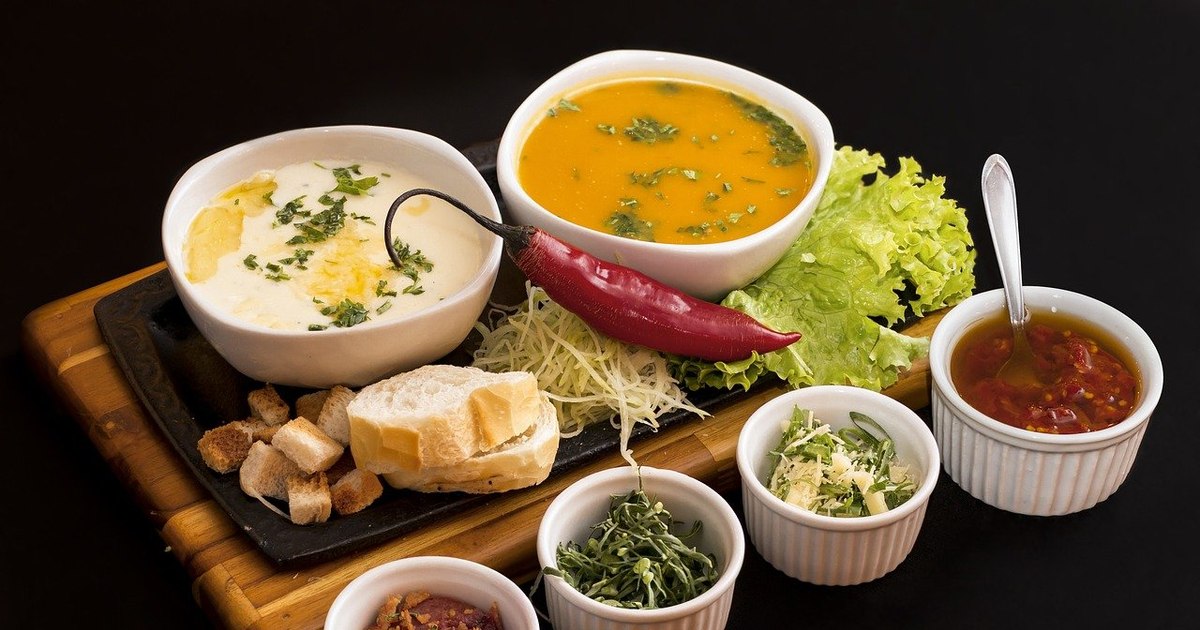
Soup is considered by many Romanians as a healthy food. PHOTO: Pixabay
Nutritionist Nicolae Hâncu, co-coordinator of the National Competence Center in Healthy Lifestyle, established by the Babeș-Bolyai University in Cluj-Napoca and the Romanian Academy, explains to us, in a way that everyone can understand, what a healthy diet means and what we should eat for breakfast, lunch and dinner.
Breakfast
For the first meal of the day, Professor Hâncu recommends cereals: “It is important not to choose refined corn grains, but to go towards oats and barley, which are much more recommended”.
Second – dairy. “Milk can be consumed as it is, the fat intake does not matter. Yogurt is more important than milk because it has some proven nutritional values: it protects against diabetes, it helps with weight loss”says the doctor.
Fruit and egg salads can also be consumed in the morning. “Two-three, maximum four eggs per week, whole, can be consumed in the morning boiled, soft-boiled eggs or Romanian eggs. You can consume the egg white, every day, from two to three eggs”says Dr. Hâncu.
The lunch
For lunch, the nutritionist recommends vegetable soups “with all the vegetables that are possible”. Now we have the protein food of animal or plant origin.
“Everyone expects for lunch to have a steak, a piece of meat of 150-200 grams, or at the moment, international calculations show that the meat ration per day should be 30-50 grams, and per week would be 210-250 grams. If you want to eat meat every day, yes, consume 30-40 grams in a mixture of vegetables of all categories”Dr. Hâncu teaches us.
The professor states that he will introduce the concept of meat dishes that are eaten with a spoon in a nutrition book: “You don't need a fork and a knife, what to cut because you have little meat”. What kind of meat? “Quality white: chicken, turkey, domestic rabbit”. For red meat lovers, the doctor specifies that it can be consumed once – twice a month.
Fish and seafood are not included in the limit of 250 grams of meat per week. “If you want a steak, you can eat one of 150-200 grams, plus two to three times a week you eat fish/seafood or you have days when you eat vegetable protein. Peas, lentils, beans, soy – cooked in extremely different ways known in Romania”says the doctor.
Dinner
Regarding the last meal of the day, the teacher states: “As a rule, dinner is based on cereals and many vegetables. If you didn't have protein at lunch, move it to the evening. If you didn't have soup for lunch, you can eat it in the evening and many prefer it that way”.
Attention, we are not talking about soup, which Dr. Hâncu does not recommend, although Romanians consider it a healthy dish. “It's an extremely tasty, extremely calorically dense food. But how can it be considered healthy when you boil very fatty pieces of meat, with a large amount of potatoes or rice, and then pour half a kilo of cream, with 15% fat, and add many spices, a lot of salt, a lot smokiness within the meat that is there and then gives an absolutely sensational taste. But what is the healthy element there?'the nutritionist asks.
Instead, the soup recommended by Hâncu is a clear liquid based on the vegetable broth. “From time to time, we can put in beef, usually with a lot of bone, and it results in an extremely high concentration of protein. It is possible, but from time to time. Not as a rule”he warns.

Doctor Nicolae Hâncu recommends three meals a day. PHOTO: The truth
No intermittent fasting
Professor Nicolae Hâncu draws attention to a basic principle of nutrition: “The healthiest proven food that exists, if it is not well prepared or well prepared but in excess, it becomes an unfriendly food”.
He recommends, in addition to the three main meals a day, two snacks – one mid-morning and one mid-afternoon. The period in which we eat should be approximately 12 hours, and the period in which we do not eat should also be 12 hours.
“It's common sense eating. We don't have very clear evidence that intermittent fasting is good for the long term. In the short term there are countless proofs, but you don't do a diet for Easter to Christmas and vice versa. Food is for life”explains the nutritionist.
