
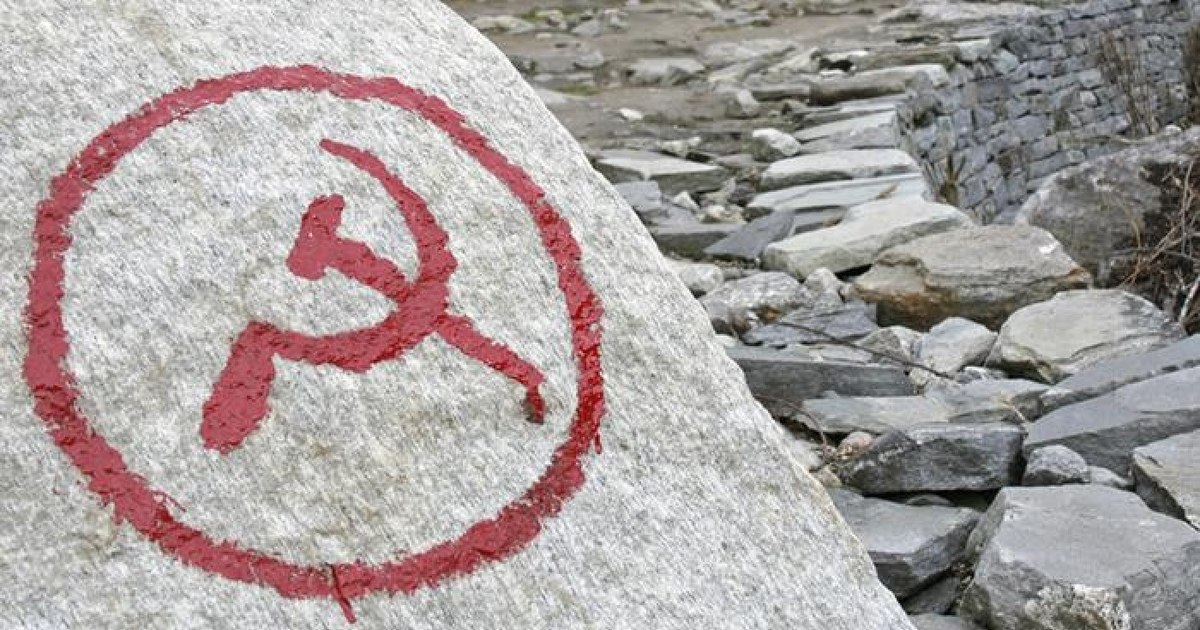
Starting with the next school year, students in the twelfth grade will study a new subject: History of Communism in Romania. The program was launched in a political context that fit like a glove: the November 24 vote of young people who, many of them, chose a pro-Russian and neo-Nazi presidential candidate without knowing what communism or legionnaires really mean. Three specialists in education analyzed for “Adevărul” the necessity of such a subject, but also how it could be implemented. Because the framework plans for high school education are still kept in the drawer.
Communism enters the Baccalaureate curriculum. Archive
“We tried to include all the aspects related to the history of communism: institutional, state policy, state institutions, the Constitutions. The students will learn what a communist regime means, then what the communist regime in Romania entailed with all its dynamics”, explained History professor Aurel Constantin Soare, one of the authors of the program.
The history of communism, continues the expert, will start with the year 1921 and end with the Revolution of December 1989. “The children will learn about the period 1921-1924 when communism was legal, about the period 1924-1944 when the regime operated illegally, then the period 1944-1989. They will learn about the Falcons of the homeland, about the pioneers, the Utecists, they will learn about the sovietization of Romania after 1944, about the regime of Gheorghe Gheorghiu-Dej and Nicolae Ceaușescu. They will receive information about repressive legislation and institutions: prisons and camps”explained professor Aurel Soare, who is also one of the authors of history textbooks for middle school and high school.
Education expert: “I hope this subject reproduces authentic history”
Marian Staș, an expert in education, believes that this matter is a welcome one only if the information presented will, indeed, be true to reality. “If we talk about the authentic history of Communism, it must be said that some things are still hidden under the rug and others unresolved. I am very curious, for example, to see how the history of the Greek Catholic Church will be treated.” The specialist refers to the period when Greek Catholic bishops were tortured in communist prisons, and then forced to serve in Orthodox places of worship. Then, another topic that should be treated very carefully concerns the Mineriadel file and that of the 1989 Revolution. “Ion Iliescu is accused of crimes against humanity. If these things are going to be swept under the rug or touched on in passing, just so as not to upset anyone, then we have a big problem in education on this extremely sensitive topic. As uncomfortable as it may seem, as harsh as it may seem, and as much as we would like to deny it, the history of communism is still not over until cases like this are over.”the expert believes.
Unfortunately, however, the issues raised by the specialist may not be found in the pages of the new manual. Corneliu Riegler, professor of History at the “George Coșbuc” National College, stated that the history of the Revolution of 1989 and that of the Mineriades could only be authentically reproduced after the archives are opened: “Many documents detailing the 1989 Revolution are still classified. And a history without archival documents is pure speculation. Very often, after the archives are opened, you discover that things were completely different from what you knew or thought before”. Then the professor is of the opinion that in order to write a truly objective history, “the generations that were involved must disappear, and some generations less emotionally involved and less interested in the falsification of the truth should come. And the archives should also be open, obviously”.
“Only an independent matter can truly enter the depths of History”
I asked Professor Aurel Soare why students would need a separate subject dealing with the History of Communism when this information could find its place in the classic History textbook. The answer came straight and unequivocal: “History, as an educational discipline, is currently allocated one hour per week. All the information a student would need for a solid culture regarding the communist period cannot be contained in this hour. If there had been more history lessons in the timetable, then we could probably have thought of a more comprehensive textbook, which would include, in addition to the History of Communism, the History of the Holocaust and the History of Legionnaires’.
Then, the professor continues, Romanian society should focus more on what it wants to achieve at the end of the years of study, assumed citizens, who will vote in elections with knowledge of the case: “One of the Romanians voted in November with extremism. I am terrified, I almost run out of oxygen when I think about the fact that I have dedicated my whole life to education, and now one of the Romanians wants to take away my freedom to think about the past of my nation”. The specialist is of the opinion that investing four hours in Mathematics, three hours in Computer Science or other subjects, but without a clear awareness of human, civic, historical, national, religious and cultural identity, means superficiality. Therefore, education should allocate a special place to those subjects that strengthen us as citizens of this country.
History: “The Study of Communism Needs More Time”
Bogdan Bucur, a professor at the Faculty of Political Sciences within SNSPA, specialized in the historical sociology of interwar Romania, compares the History of Communism as an independent subject to the administration of an anti-neural pill when we have an acute pain: “In itself this is a good thing, as it relieves you of pain for a limited period of time. But the problem is solved by treating the medical condition that generated that pain”. The specialist refers to the fact that young people do not know their history for at least two big reasons: one hour a week is not enough for in-depth study, and the teachers are, many of them, not properly trained. “History does not enjoy the number of hours necessary for students to really get to know their past. Then, teachers are demotivated due to the underfunding in which the entire education system is struggling. What should have been done? Communism should be covered extensively in the General History course. But for that you need maybe 3 hours a week and a manual that treats this period in a complex way”, sput this one
Otherwise, for the same reason, says Professor Bucur, there should be separate subjects that touch on other Romanian historical stages: “Why not also make a mandatory history of the fascist and legionary movements and a history of Romanian democracy? Because we cannot have one subject depending on the historical periods we have passed through. Instead, we need to have a single discipline thought of but totally differently and to which more time should be allocated”. A broad history, which will teach us concepts, paradigms, theories, which will teach us to recognize political regimes, political currents, profiles of political people. “How can we not recognize a candidate profile that introduces into a formidable electoral mixer legionary ideas, communist ideas, isolationist ideas, historical falsifications about antiquity and the Middle Ages? How not to detect him as a political criminal? That is the task of the education system: to teach us to detect the political fake, with direct reference to Calin Georgescu. The answer? History was taught poorly, children did not understand, and at the polls, on November 24, young people did not have the ability to recognize the vile ideas in history and avoid them.”
Specialist: “Without framework plans for high school, it’s just a project done on the knees”
Marian Staș believes that without framework plans for the high school, this project is one made on the knees and conjunctural. “You can’t help but suspect the issue of a conjunctural connotation, which can be either political, or they actually woke up with a gun to their temple because neo-legionarism exploded. From the point of view of the overall construction, the Ministry of Education is in a serious technical error. A specific particular piece is put in the absence of the big construction which is called framework plan and curriculum model. It’s putting the cart before the ox because you don’t really know what the frame plan is going to look like. The logic is as follows: I first build a curriculum model, then build the contents and school programs. Otherwise, it may not fit this subject from the point of view of the number of hours, it may need other correlations with other socio-human areas for example, philosophy, sociology etc. And then in the absence of such constructions obviously the approach seems hasty and incompletely tailored”, consider the specialist.
