
A massive volcanic eruption is predicted by scientists this century and would have a devastating impact amid climate change already affecting the planet.
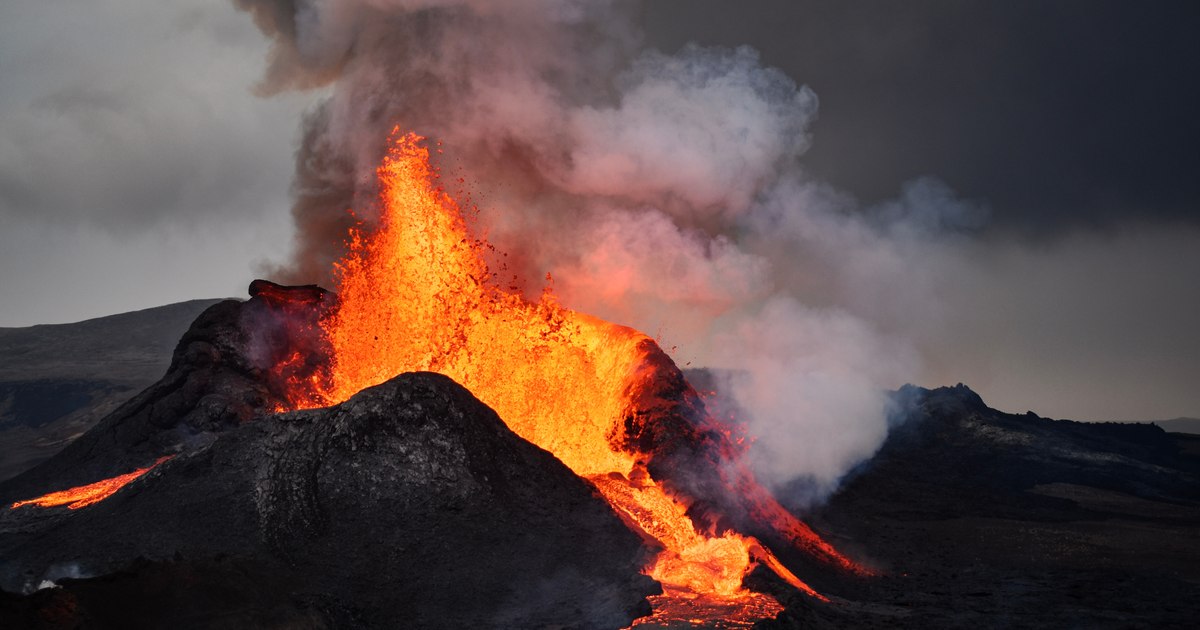
Volcanic eruption in Iceland PHOTO SHUTTERSTOCK
The eruption of the Indonesian volcano Mount Tambora in 1815, the most powerful in history, changed the world after it sent a huge volume of tiny particles into the atmosphere that deflect sunlight, cooling the planet. The effects were disastrous, reports CNN.
What followed was what was dubbed the “year without a summer”: global temperatures dropped, crops were destroyed, people starved, and a cholera pandemic spread, killing tens of thousands of people.
Many eruptions have occurred in 200 years, but none have been comparable to that of Tambora, the planet’s most recent massive eruption.
The question is not if, but when the next one will come, said Markus Stoffel, a climate professor at the University of Geneva, adding that geological evidence shows a 16.7 percent probability of that.
This time, however, it would happen in a world in which great changes have taken place and which is not only more populated, but also affected by the climate crisis.
The next massive eruption will “cause climate chaos. Mankind has no plan,” warns Stoffel.
Volcanoes shaped our world – they helped create the continents, built the atmosphere and have the power to change the climate.
During an eruption, a cocktail of lava, ash and gases are released, including carbon dioxide that warms the planet, although in much smaller quantities than fossil fuels.
But when it comes to climate impacts, scientists are interested in another gas: sulfur dioxide.
A massive volcanic eruption can propel sulfur dioxide into the troposphere – the lower atmospheric layer where meteorological phenomena occur – but also into the stratosphere, the upper layer located approximately 11 km from the Earth’s surface, the altitude at which airplanes fly.
Here, they form tiny aerosol particles that scatter sunlight, reflecting it back into space and cooling the planet. These particles “will explode around the world and last for several years,” explains Rutgers University climate professor Alan Robock, who has spent decades studying volcanoes.
For modern volcanoes, satellite data shows how much sulfur dioxide is released this way. When Mount Pinatubo in the Philippines erupted in 1991, it propelled about 15 million tons into the stratosphere. It wasn’t a massive eruption, but it still cooled the planet by about 0.5 degrees Celsius over several years.
“We have very poor data” on earlier eruptions, Stoffel said.
Scientists are trying to reconstruct them using information from ice cores and tree rings, which are like time capsules that store the secrets of the atmosphere from long ago.
According to this data, the massive eruptions of the past several thousand years have temporarily cooled the planet by 1 to 1.5 degrees Celsius.
Tambora, for example, lowered global average temperatures by at least one degree Celsius. There is also evidence that the huge Samalas eruption in Indonesia in 1257 may have helped trigger the “Little Ice Age”, a period that lasted hundreds of years.
There are also indications that massive eruptions can affect rainfall, drying up monsoon systems, including those in Africa and Asia. “The monsoon occurs in the summer because the land warms faster than the ocean,” Robock said. A huge volcanic eruption can disrupt the temperature difference between the two.
“A more unstable world,” scientists say
Understanding the impact of past massive eruptions is vital, but what is certain is that the next one will occur in a much warmer world than in the days when humanity did not consume such large amounts of oil, coal and gas.
“It’s a more unstable world now,” said Michael Rampino, a professor at NYU who investigates the link between volcanic eruptions and climate change. “The effects could be even worse than we saw in 1815.”
In what may seem counterintuitive, a warmer world may mean that massive volcanic eruptions have a much larger cooling effect.
That’s because the formation of aerosol particles and their movement are “climate-dependent,” said Thomas Aubry, a scientist in physical volcanology at the University of Exeter.
As the world warms, the speed at which air circulates in the atmosphere increases, which means aerosol particles are dispersed faster and have less time to grow larger, Aubry said. Smaller aerosols can scatter sunlight more efficiently than large ones, meaning the cooling effect will be greater.
Oceans can also play a role. As the ocean surface warms, a layer of lighter, warmer water sits on top, acting as a barrier to mixing between the shallow and deep layers. This may mean that eruptions disproportionately cool the upper layer of the ocean and the atmosphere above it, Stoffel said.
Climate change could also affect the volcanic systems themselves. Melting ice can lead to increased eruptions because its disappearance lowers pressure, which can allow magma to rise faster.. Scientists have also found that extreme rainfall – caused by climate change – can seep deep into the ground, where they can react with magma to trigger an eruption, Aubry said.
The impact of a massive eruption on the world
As the world grapples with global warming, a cooling period might sound positive. But scientists say the opposite is true.
First, there would be the immediate impact. An estimated 800 million people live within about 60 miles of an active volcano; or, a massive eruption could wipe out an entire city. Campi Flegrei, for example, has shown signs of unrest and is just west of the Italian city of Naples, home to about a million people.
In the longer term, the impact could be cataclysmic. A temperature drop of one degree Celsius may seem minor, but it is an average. “If we look at specific regions, the impact will be much larger,” said May Chim, who specializes in Earth science at the University of Cambridge.
Okmok in Alaska, which erupted in 43 BC. – the year after Julius Caesar was assassinated – could have cooled parts of southern Europe and northern Africa by up to 7 degrees Celsius.
Colder weather, less sunlight and shifting rains could affect several grain baskets at once, including the US, China and Russia, hitting global food security and possibly sparking political tensions or even war, according to a recent analysis by insurer Lloyd’s.
The human and economic toll would be significant. In an extreme scenario, similar to Tambora, economic losses could reach more than $3.6 trillion in the first year alone, Lloyd’s calculated.
Furthermore, cooling would not provide insurance against climate change; in a few years, the planet would return to its original state.
The next eruption could happen anywhere. There are areas scientists are watching, including Indonesia, one of the most volcanically active regions on the planet, and Yellowstone in the western US, which hasn’t had a major eruption in hundreds of thousands of years .
“But where it’s next and when — it’s still impossible to predict,” Stoffel said.
Massive volcanic eruptions can’t be prevented, but there are ways to prepare, added Stoffel, who asked experts to assess worst-case scenarios, conduct stress tests and come up with plans: everything from evacuations to relief efforts and ensuring food reserves.
While some might say the likelihood of a massive eruption is still low, it’s still not zero, Stoffel said, and the world is currently unprepared for the consequences it would unleash. “We’re just beginning to get an idea of what might happen.”
