
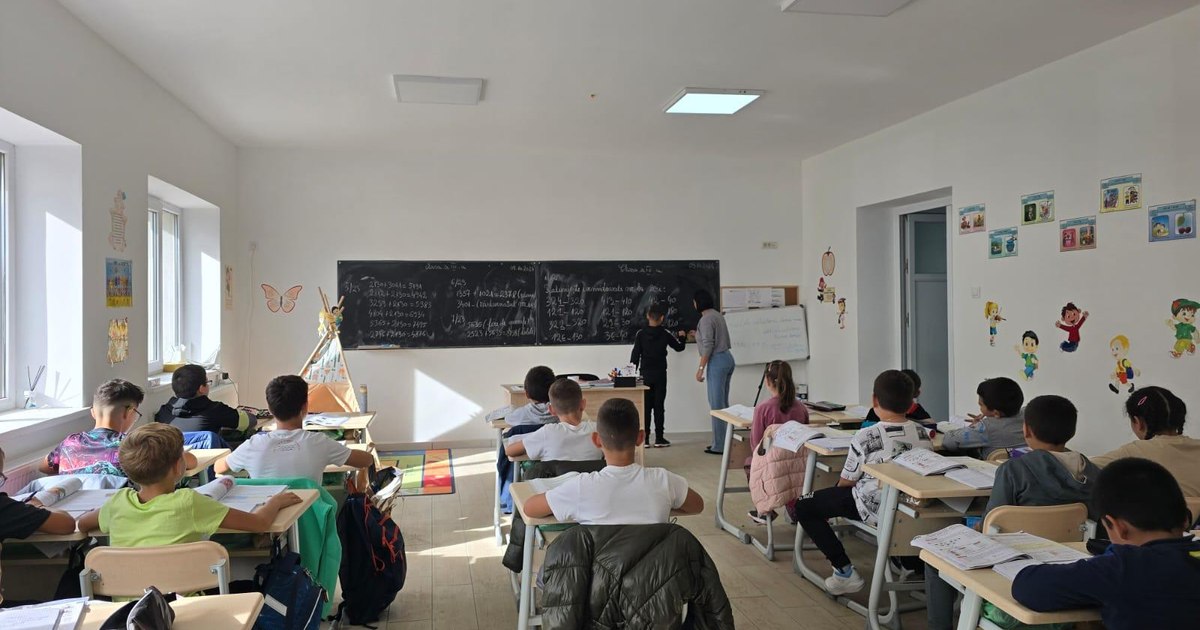
In the Romania of 2024, there are schools where children learn together, the little ones together with the big ones in the same classrooms. And teachers and teachers, like real directors, have to adapt their teaching method in such a way that it covers the educational needs of everyone. But, even so, miracles cannot be done. And the result, more often than not, is higher school dropout rates and poorer access to education.
The students of the school in Peștişani, two classes in one. Photo source: Alin Dobromirescu
More than 150 students study at the general school in Peștișani, Gorj county. “We have simultaneous education only in primary classes, i.e. in grades I-IV. Students in the preparatory class learn in the classic system, alone, only them with their teacher. As well as those in secondary school”, the director of the unit, professor Alin Dobromirescu, stated for “Adevărul”. “This thing has been with us since the world and the earth. Unfortunately. But we have nothing to do”, continued the teacher.
The principal told us that the students were grouped in such a way that they were close in age but also in knowledge level. “First graders learn together with second graders, and third graders learn with their older, fourth graders. In each class we have around 8, 9 students. So, a single teacher could take care of up to 20 children”. Students from three neighboring villages come to the school in Peștișani. “The birth rate decreased. There are not so many children anymore. We would have space to organize classes. The problem is that we don’t have that many studentsi”, the director explained to us the situation in his school. The teachers who teach at the school in Peștişani have adapted to the situation: “They had nowhere to go. They organized themselves in such a way that they managed to work with all the students at the same time. Indeed, our children’s schedule also coincides. For example, both 1st and 2nd graders work on math at the same time. Only the textbooks differ and, obviously, the degree of difficulty of the exercises.” Fourth grade students, who in addition to Romanian language and mathematics also have other subjects, study the latter separately. “History and Geography for example. The last hours are scheduled in such a way that the students from the 3rd grade go home, and those from the 4th grade stay alone with the teacher”, explains the director.
Teacher: “We’re used to it”
If at the school in Peștişani the students in one classroom study the same subject at the same time, in other schools the teachers are forced to divide themselves into four. “The time allocated to each student is longer. Then, it is quite difficult to teach four subjects in one class hour, but experience has taught us this too, and the students do not suffer”. said the teacher Lavinia Cernătoiu, from the school in Văcarea commune, near Târgu Jiu.
A similar situation can be found at the secondary school in the town of Cârcea, Dolj county, where the teacher Sebastian-Radu Pirpilică teaches students two subjects at the same time. The teacher admitted that it is quite difficult because the time is halved: “Half of the time with one class, half with the other, but I organized my teaching activity in a specific way. For example, when I’m working with 3rd grade on math, 4th grade is working on civics or other subjects they can work on on their own, with just a few pointers from me.”
There are two ways in which the teacher can work in the classroom. He can adopt a synchronous teaching model, presenting students with similar topics and adapting the work requirements to the methodical particularities of the discipline and the age of the children. Or, he can divide his time by addressing each group separately.
Simultaneous education, “a misfortune”
This simultaneous education system forced the teachers to resort to all sorts of “artifices” that would allow them to juggle time, subjects, and the curriculum. And to help them be there, present in the classroom, for all the children. However, it is very difficult to achieve performance in such conditions. However, there are teachers who see the glass half full. “The biggest plus of simultaneous education is socialization, it is the development of behaviors to support and help the youngest or to collaborate between children of different ages”. teacher Lavinia Cernătoiu believes.
Although they do not share the same opinion, the authorities have not come up with a solution to solve this “bug” in the system. At the beginning of 2021, the then Minister of Education, Sorin Cîmpeanu, categorized education in the simultaneous system as “a misfortune” and argued that it must disappear. “Simultaneous education is a misfortune, but it is a chronic problem of Romanian education. I don’t know of any situations in which, in times of crisis, reforms can be made in a favorable environment. And yet, this must be done. Simultaneous education must disappear, I say it with all responsibility”said Sorin Cîmpeanu. Last year, the minister Ligia Deca also pointed out the problem. “Unfortunately, we still have simultaneous education and where we need to make more efforts to ensure the right to education”the minister said during a visit to a school in a mountain area. However, everything remained only at the declarative level.
The teachers are not trained, and everyone does as they can
Some of the disadvantages of simultaneous education were identified by teacher Roxana Acatrinei, teacher at Cornu Luncii Secondary School, in Suceava. She stated that the teachers are not prepared for such an education model, and the possibilities for their improvement are extremely limited. The reason? The education system in Romania does not provide teachers with specialized methodical works. Therefore, teachers who work in simultaneous education use the same methods as those in classical education.
In Romania, 111,755 primary and secondary school students were studying in the education system simultaneously, in the 2021-2022 school year, according to data from the Ministry of Education. On study cycles, 10% of primary school students learn simultaneously (87,835 students out of 870,341), and 3.4% of secondary school students (23,920 students out of 702,754) are in the same situation. Almost 100,000 children learn in the system simultaneously in Romania in 2024.
