
“Ponytail” syndrome is a condition of a bundle of nerves located in the lower part of the spinal cord. The condition consists in compressing this bundle of nerves responsible for transmitting electrical signals throughout the body.
Back pain PHOTO Pixabay
It is, basically, a neurological condition caused by an obstacle that compresses the roots of some nerves that form what doctors also call the “horsetail”. The nerves are mainly responsible for urinary, defecation and lower limb functions, so symptoms will be specific to these organs.
Specifically, these nerves help us feel sensations in our lower limbs (legs), move our legs, and also have bladder control. When these nerves are compressed, some symptoms occur.
Doctor Răzvan Darea, specialist in medical recovery, explains in an article on his social media page what the symptoms of this condition are and what we should pay attention to. Surgical treatment is essential, and the sooner it is performed, the better the prognosis.
The syndrome that makes our lives difficult
Although, he says, it is not a life-threatening syndrome, it can make life difficult. “Cauda equina syndrome can be classified according to two main criteria, resulting in several types of syndrome: acute or chronic, complete or incomplete. Acute syndrome is manifested by symptoms that appear quickly and suddenly, requiring surgical intervention within 24-48 hours. Chronic cauda equina refers to a long, slowly evolving syndrome. It must be treated surgically to prevent permanent damage“, he explains.
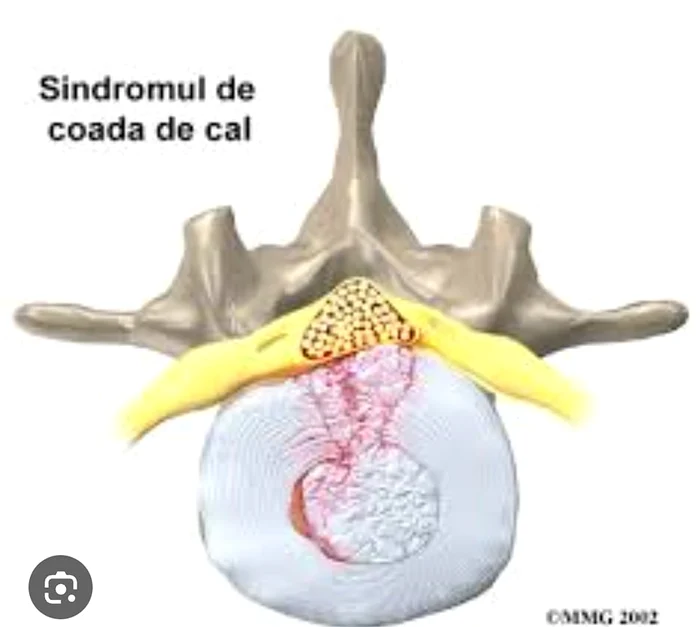
Pony tail syndrome PHOTO Facebook Răzvan Darea
If the syndrome is complete, the doctor also points out, patients experience urinary or rectal retention or incontinence. “About 60% of patients have this type of syndrome. On the other hand, patients with incomplete syndrome have urinary and bowel symptoms, but they do not reach retention or incontinence”, says doctor Răzvan Darea from Bucharest.
According to statistical data, cauda equina affects 1 in 65,000 people, with equal incidence between the two sexes.
The causes that lead to the appearance of this condition are multiple and can be some congenital anomalies, stenosis (narrowing) of the lumbar cord, trauma to the lower spine, but the most common cause is lumbar disc herniation.
The symptoms are easy to recognize
Also, post-operative complications following interventions on the spine can also lead to the appearance of this condition, or spinal arteriovenous malformations, as well as spinal hemorrhages, infections such as meningitis or spinal tumors.
The doctor then explains the symptoms that lead to the appearance of this condition.
“There are some specific signs that should raise an alarm. These include numbness or unusual sensations in the back of the legs, buttocks, inner thighs and hips; back pain that radiates to the lower limbs (sciatica); problems in sexual intercourse; andurinary or rectal incontinence; Rurinary incontinence (inability to urinate); Sclumsiness, paresthesias or paralysis of the lower limbs; Areflex illness“, he also shows.
The doctor also says that it is important to see a doctor if the patient complains of any of these symptoms. “They will be investigated by the neurologist, the neurosurgeon and the orthopedist. Symptoms can start slowly, appearing one by one, or they can have a more brutal and rapid onset“, says the doctor.
Diagnosis, complex
Once at the doctor, the patient will be consulted by a multidisciplinary team. “The doctors will ask you some questions and later evaluate some physical, sensory and motor capacities. Thus they can direct the diagnosis towards a neurological (related to the spinal cord) or orthopedic (related to the vertebral column) problem. They will ask you to do some movements like standing upssit downto mstand on your heelsto mstand on your toesto have yougo aheadto have youstep back or to the side, on both sidesto youstretch and lift only the lower limbs. Thus, doctors will evaluate functions of the locomotor system and the nervous system such as stability, sensitivity, muscle strength, mobility, alignment and reflexes“, explains the doctor Răzvan Darea.
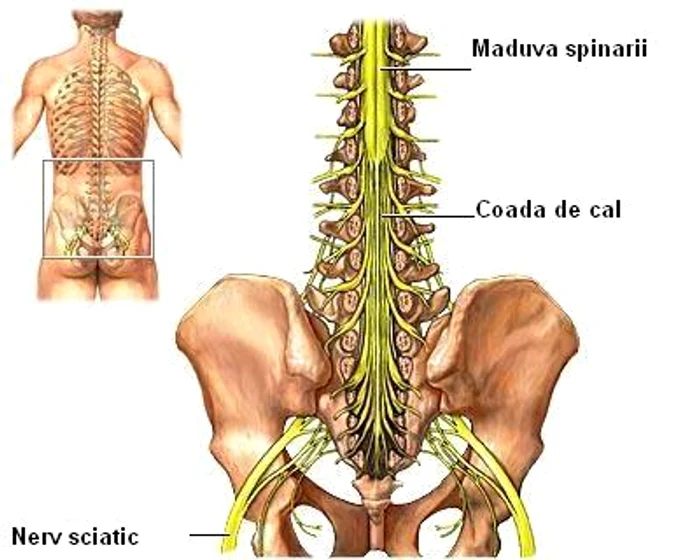
The “horsetail” bundle of nerves PHOTO Sfatulmedicului.ro
After this assessment, follows that of the urinary and digestive system. The doctor may perform a rectal exam and imaging tests such as CT or MRI to visualize the large intestine and bladder. With the help of imaging tests, the bone structure, nerve roots, appearance of the marrow, possible disc herniations will also be highlighted.
The treatment is surgical
The doctor also says that the condition is treated surgically. “Cauda equina, in its acute form, is a medical emergency. If the diagnosis is confirmed, you will undergo surgery within the first 24 hours“, the doctor also points out and says that in general the intervention has a curative role, that is, it will cure the patient.
The surgery is called a lumbar laminectomy. The neurosurgeon performing the procedure will remove anything that is compressing the nerve roots.
“In the chronic form of the syndrome, the same surgical intervention is applied, and the faster it is performed, the better the patient's prognosis. Medicines for urinary or fecal incontinence may also be given. After surgery it is ideal to work with a physical therapist to regain muscle strength, mobility and balance“, he says.
Prevention is better than cure
But, as any disease is easier to prevent than to treat, he makes some recommendations to avoid the occurrence of this condition. Although it is impossible to avoid all the factors that can lead to this disease, we can at least reduce the risk.
Thus, the doctor recommends:
• Avoid high-heeled shoes. These shoes can alter the alignment of your spine;
• Avoid smoking. Tobacco products can weaken your intervertebral discs;
• Do sports. There are special physical exercises to strengthen the muscles of the back and abdomen, for a stable and strong trunk;
• Be careful when lifting a weight. Always lift using your leg muscles, not your lower back. For this, take the “squatting” position and keep your back straight when lifting an object;
• Maintain an optimal weight. The extra weight of the body puts pressure on the spine;
• Practice correct posture;
• Do regular stretching exercises, especially after long periods of sitting down in a chair.
