

An assortment of French cheese, made from raw milk, was withdrawn from Carrefour stores after ANSVSA inspectors found that the product was infected with e-coli. However, until it was removed from the shelf, the cheese was bought and consumed by people. Are they in danger now? Two doctors, an epidemiologist and an infectionist, explained for the “truth” what the people in this situation have to do.
E.coli cheese was sold in five major cities in the country, including Bucharest. Archive
The infectious doctor Adrian Marinescu stated for “Adevărul” that the withdrawal of certain foods from the shelf is made as a prevention measure: “In other words, in case of God forbid, not to get sick, not to deal with a public health problem. The fact that the authorities withdraw from the shelf certain food, this is only an additional safety measure. Therefore does not mean that if we consumed that food we will make mandatory food poisoning”.
Microorganisms, continues the doctor, who are in the order of billions around us, do not do us all. “Even so, however, when referring to foods for human consumption, we must go on a safest version. Let’s blow in yogurt, as they say. Because, however, although we live surrounded by these bacteria, in a higher concentration they could get us sick ”, the infectious said.
People who bought and consumed withdrawn cheese from Carrefour stores, a food containing raw milk, are not in an imminent danger of illness. But there is no 100% safe: “There is a probability of making food poisoning, but the risks are low. What should these people do now? For now, nothing. They have little more to do at this time than to watch carefully if they have digestive symptoms. They or those with whom they came into contact: especially the elderly, young children and chronic patients. Because these bacteria are transmitted quickly ”.
Epidemiologist: “Sterile foods do not exist”
“In principle, food should not contain pathogens. This would mean that in the process of manufacture and or manipulation the hygiene rules were not respected ”explained for “Adevărul” and epidemiologist Mihai Negrea.
Regarding the assortment of cheese withdrawn from marketing, the product contains raw milk, and from this point of view the risks are even higher, the specialist considers: “Always when you use raw milk you will find intestinal bacteria. Because when you milk the animal, it is not perfectly clean. And you don’t have much to control this, regardless of the measures taken. A risk will always exist. That is why raw milk is not used in the public food, but only processed. ”
The doctor does not explain, therefore, how a product containing raw milk can be sold in stores in Romania. Most likely, explains the specialist, the cheese has been subjected to processing: however: processing: “If we find foods containing raw milk in shops, we must know that they have gone through a fermentation process. At the end, there is still a pasteurization process. This is the law ”.
In Romania it is tested all the time, the expert continues: “Any food product that is placed on the market is tested, they take samples from several lots, they go to the laboratory. It is a matter of public health that you do not play with. And when bacteria are discovered in quantities above the allowed limit, the product is withdrawn from the market. It is a prevention measure. Sterile foods do not exist. And then why risk it? ”
What are e.coli pathogens and how we get sick
E.colii are bacteria that are found in the digestive tract. They are saprophytic and pathogens, and the pathogens, who become ill, are of five types. These are practically mutations of an e.coli saprofit (non -hazardous, which is naturally found in our digestive system) and which begin to produce toxins in the body. “The people who are at risk of illness are especially the children, the elderly and the chronic patients. This poisoning can give digestive bleeding, vomiting, diarrheal chairs. We are talking about a violent diarrheic disease with abdominal pain and bad mood. These symptoms lead to dehydration ”, explains Dr. Negrea.
E.coli are transmitted in two ways: through contaminated foods, insufficiently washed or insufficiently thermally prepared, and dirty hands. “You go to the toilet, touch different contaminated surfaces, do not wash your hands, and then get your hands dirty. Here’s how you got sick. As for foods, they are contaminated with feces from their lives with which they came in contact or even from people not in their hands ”, the epidemiologist continues.
And well water can be dangerous, which is why it is indicated that before consumption it is boiled. Especially if we use it for the preparation of baby powder milk. “It is not advisable to give young children, especially those under one year, raw milk, raw eggs, raw milk cheese, fermented in the house. They should only be fed with pasteurized products. ”
Each organism is different in infections. And then why risk?
E.coli food poisoning is treated with antibiotics, but this treatment should be prescribed by a doctor. Until microbiological analyzes are done, from the chair, we have no place to know what has become ill. “It can be e.coli, Salmonella, Norovirus.. We don’t know. This is why, if the little one has acute diarrhea that lasts more than two days, he must be taken to the hospital ”, warns Dr. Negrea.
If we talk about food poisoning, they take on a very wide palette, the infectious doctor Adrian Marinescu considers. “We can talk about a mild digestive symptomatology, which is solved in a few hours or even from one day to another. However, we can also talk about more serious symptoms, which mainly affect people with a vulnerable immune system. So, lthe ucils They should be treated seriously because food poisoning is transmitted quite easily to family members. For example, an infected young man may not suffer, but his grandfather could have quite big problems. This is why E.coli is identified in food, it goes on the safe option to withdraw that lot so that we take no risk. ”
What do we do? Do we eat or not tiramisu from the confectionery?
I asked the doctor Adrian Marinescu if, under these conditions, it would be advisable to avoid everything that means food containing raw ingredients. Tiramisu, for example, is prepared with raw egg. Should we buy this cake from the confectionery? “I do not think we can completely give up these products that contain traces of raw ingredients because they exist to a large extent. There are foods that contain raw milk, raw eggs, meat, for example, sell raw. But we must know that there is a higher risk in these products and be cautious. Let us follow, for example the product label, the term of validity, more precisely, but also the way foods are stored. There are situations where they stand in the heat, especially in summer, or next to and not in the fridge. It is clear that they present a higher risk and then you are cautious. ” Regarding the protection of the authorities, obviously it is very important but at the same time, we must protect ourselves, the infectionist said.
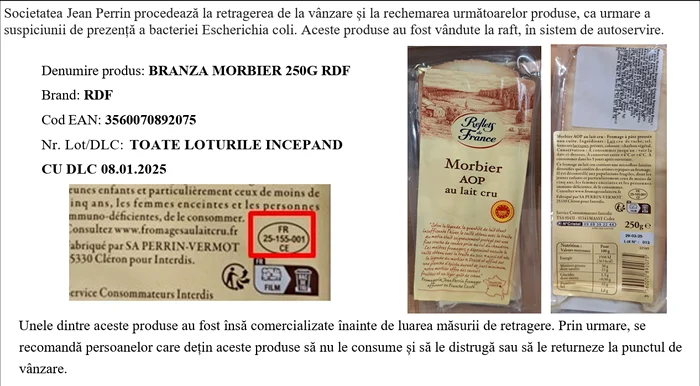
The cheese with E, sheets, sold in five big cities in the country. ASVSA warning
Carrefour announced the withdrawal from the marketing of a cheese assortment – Morbier 250g RDF – as a result of the suspicion of the presence of the Escherichia Coli bacteria, according to an announcement transmitted by ANSVSA. “The company Jean Perrin proceeds to withdrawal from sale And when recalling the following products, as a result of the suspicion of presence of the Escherichia coli bacteria – CHEESE MORBIER 250G RDF. These products were sold at the shelf, in the self -service system ”shows the announcement transmitted on the ANSVSA website.
According to the announcement, some of these products were marketed before taking the withdrawal measure. “Therefore, it is recommended for people who own these products not to consume them and to destroy or return them to the point of sale. Escherichia coli bacteria SHIGA (STAC) toxins manufacturers can cause, following the consumption of contaminated products, diarrhea, sometimes with blood, abdominal pain and vomiting, or not by fever. These symptoms can be followed, in 5-8% of cases, by severe renal complications, especially in children ”the announcement shows.
The persons who have consumed the products mentioned above and who present the mentioned symptoms are asked to consult the doctor. “In the absence of symptoms in the 15 days after the consumption of the products concerned, you do not need to worry or consult a doctor. In general, the health authorities recall that, from caution, raw milk and raw milk cheeses should not be consumed by young children; It is preferable to choose cheeses with baked pressed paste, molten tartful cheeses or pasteurized cheeses. The same recommendation must be followed by pregnant women, immunocomprimmed and elderly ”, the specialists have also transmitted. According to ANSVSA announcement, the product was sold in stores in Bucharest, Brasov, Cluj, Timişoara and Pitesti.
