
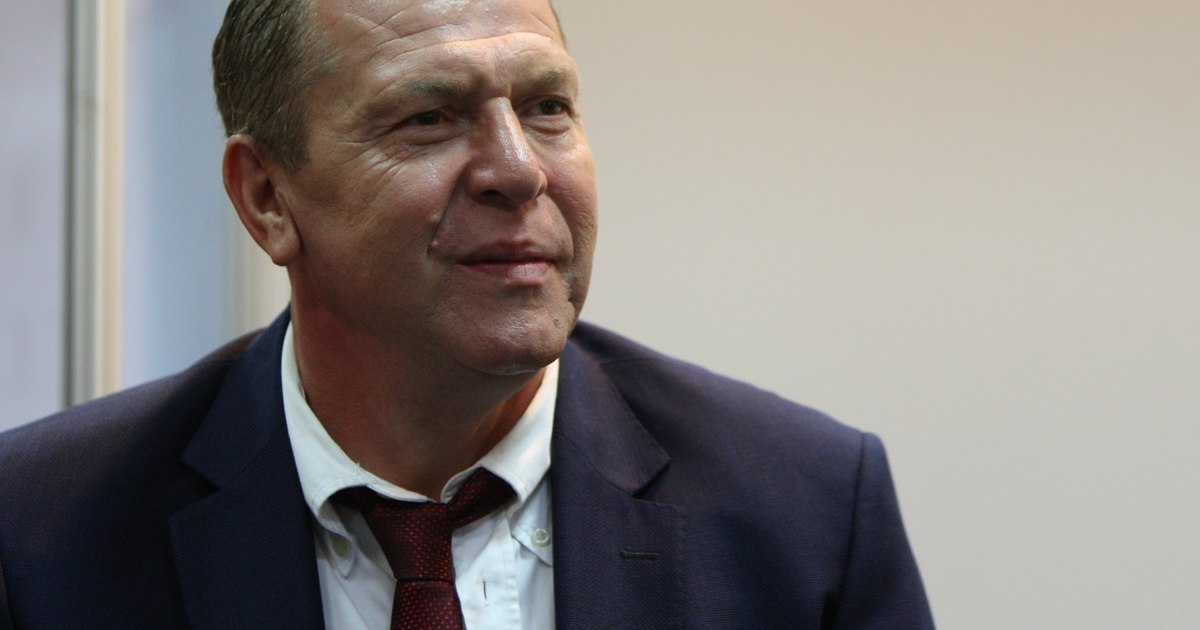
Helmut Duckadam chose to convert to Orthodoxy, while his mother, Elisabeta, was baptized in the evangelical cult.
Helmut was born on April 1st, April Fool’s Day, and this upset the one who gave him life. “He came into the world after midnight, three hours after, on April 1st. I prayed to the midwife: “Don’t put it in the documents on March 1, but on March 31. How could he be born on April 1, on April Fools’ Day?”
“He was my first child. It was my soul. Well, it was the first… So it is with the first…. There is something there that remains forever, even if it is old too. I’m his mother, friend, we were talking. But he went to Bucharest. I reordered relations when he returned to Arad and worked at customs”, says Elisabeta, mother of Helmuth (56 years old), who has two younger brothers: Norbert (59 years old and Renata (48 years old). Elisabeta is baptized in the evangelical cult, as well as her daughter, settled in Germany, in Munich, and Helmuth converted to Orthodoxy (No. – so he can get married)”, said his mother, 85 years old, present on Tuesday at the National Arena, to kiss her firstborn for the last time.
“Cremation is not an alternative”
In his will, Helmut willingly left to be cremated. But, is cremation accepted or not by the Orthodox Church?
The funeral is the main and most well-known ceremony in terms of funeral processes and for this reason, not many people think about cremation. In addition, there are many contradictory discussions regarding the choice of cremation over traditional burial, writes funero.ro.
“For religious reasons, people prefer to be buried in the usual way, with the well-known wake and burial services. That’s why, for people who are guided by Orthodox spiritual values, cremation is not an alternative”, writes the mentioned portal.
What is written in the Bible
The Bible, the holy book of Christianity, spiritually promotes the creationist theory that man was created by God from the earth. Regarding passing away, the Holy Books mention the well-known verse: “earth you are and to earth you will return” (Genesis 3, 19).
In other words, the Bible suggests that the only way to end the cycle of worldly life is by returning to spiritual origins, that is, by burial. The Bible also says that after death “the body should return to the earth, as it was, and the soul should return to God, who gave it.”
In the Orthodox religion, earthly life is a gift given by divinity through the reception of the soul. And in order for the soul to return to Heaven, life on earth must be lived cleanly and with dignity. Likewise, death must be marked in a Christian way, according to God’s will.
The communion of body and soul is blessed by divinity through life. And because the soul is considered in Orthodoxy as a holy entity, the body must be honored at the end of the spiritual journey by commemorating the life lived and laying it to rest. The Bible considers cremation or burning the body as an act of disrespect to God and his creation.
Christian rituals are cancelled
The Holy Book of Orthodoxy names Jesus Christ as an example to follow in life. Since He lived on Earth among men and died, the Bible suggests living a life according to the principles of the Son of God, who was buried after death.
There are many customs and rituals specific to the funeral in the Orthodox religion. Because the Church celebrates the events of a person’s life through prayers, death is also marked by a series of specific events.
The Orthodox Church supports, according to the Bible, the communion of the spiritual part of man with divinity. Thus, the representatives of the Church support and believe above all in the connection between body and soul. Thus, the body is considered to be the temple of the Holy Spirit and the abode of the soul. Since the Bible does not accept cremation as a form of ending life, the Church cannot hold services or support these practices.
In addition, the funeral ceremony involves various rituals that must be observed. The priest who officiates the funeral service must read special prayers for the deceased. For example, on the way from the chapel to the eternal place, a series of prayers are read for the passage of the soul through the Customs of the Air.
Also, according to the Orthodox faith, after death, the deceased is remembered and various prayers are read to him for his passage into eternal life. These prayers are said 3 days after death, at the 9th and at the 40th. They spiritually mark, in turn, the ascension to Heaven before God, the descent to Hell, and the return for the Last Judgment.
In the case of cremation, prayers for the soul of the deceased no longer take place, and Christian rituals are omitted. In addition, the Orthodox Church considers cremation to be a violation of biblical canons and implicitly a denial of divinity, which is why no kind of service can be held.
Which religions accept cremation
The most famous religions that adopt the cremation process are Asian ones, such as Buddhism and Hinduism. Among those that do not support or accept cremation as a funeral process are Christianity, Judaism and Islam.
Today, cremation is a fairly widespread practice, supported by sanitary reasons or space considerations in terms of burial places. In Romania, many of the relatives who choose cremation for their deceased loved ones either respect their last wish or choose the process for reasons related to costs.
For those who are no longer with us, Funero has created the first virtual Memorial where you can light a candle in their memory. We are at your side with advice and help, but also with complete funeral services for you to spend the last moments with your deceased loved ones.
The discussion was also launched on doxologia.ro. The question “Why is it a sin to cremate the body of an Orthodox Christian passed into eternity?” received a response from priest Andrei Atudori in 2016:
“Valeriu, your question requires a very broad answer. In essence, the Church does not accept cremation because it is a form of contempt for human nature. God said we are dust and to dust we must return“.
Seven years ago, also in January, Romanian society sold itself because of a decision that gave rise to multiple controversies: the cremation of the actor Sergiu Nicolaescu. Here we are in the same situation, now provoked by the decision of the family of a well-known public figure, recently deceased, to burn her body in the fire of the crematorium, even though her lifeless body was deposited in an Orthodox church, where her loved ones could rest good from the well-known journalist.
The contradictory discussions on the topic of “burial versus cremation” are not recent in the Romanian space, because there have been several situations in which personalities known and appreciated by Romanians chose to settle their accounts with this world by being consumed by fire: Garabet Ibrăileanu, Eugen, Monica and Nadia Lovinescu, Mircea Eliade, the painters Octav Băncilă, Steriadi, along with numerous other teachers, artists, politicians or “mere mortals”. Last known name, actor Sergiu Nicolaescu.
