
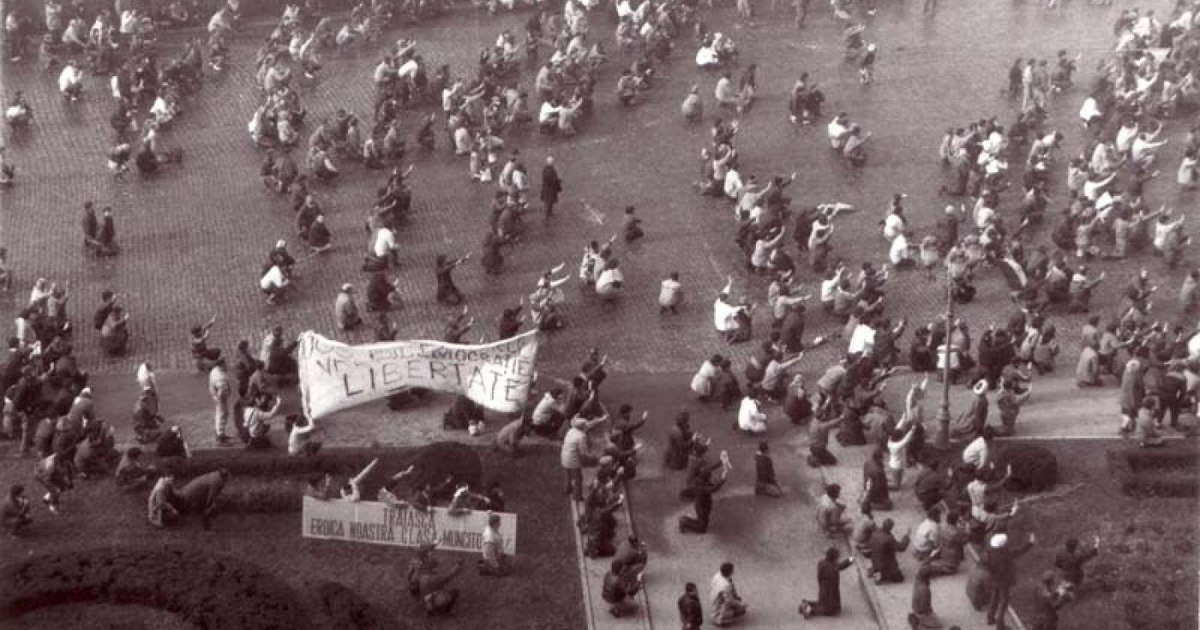
Who were the terrorists of the 1989 Revolution? Those people who fired into the crowd in Bucharest, but also in other localities in the country. It is a question to which there is still no unequivocal and uncontroversial answer. There are specialists who come with their own hypotheses.
The revolution of 1989 PHOTO wikipedia
According to the 2005 report of the State Secretariat for the Problems of Revolutionaries (SSPR), an institution of the Romanian Government, during the December 1989 Revolution, 1142 people died. Another 3,138 were injured, many of them maimed and with life-long consequences. According to official data, the number of those who were shot after December 22, 1989, i.e. the moment when Nicolae Ceaușescu was fleeing Bucharest by helicopter, was seven times higher than the number of victims recorded previously, i.e. between December 16-22, 1989. A paradox , considering that the communist regime had collapsed once the dictator had left the CCR headquarters. Who fired at the Romanians after December 22, 1989? It is a question that has remained even today without an unequivocal answer, with many controversies and hypotheses.
The “terrorists” everyone was talking about in those fiery days were made scapegoats. Including on television, people learned about the ferocity of terrorists and their movements on Romanian territory. Who were these “terrorists” who sowed death? More and more specialists in history and especially in the history of the events of December 1989 say that, in fact, the terrorists did not even exist. That is, they were neither Arabs nor Ceaușescu’s children trained in secret camps, no other external forces. The Romanians shot each other, driven by a lot of contradictory information, by a general psychosis that arose against the background of the power vacuum and of the chaos installed. It is assumed that the Army and the Security have fought causing casualties among the civilian population. There are those who believe that anyone who had laid hands on a possible terrorist, in his opinion, did not hesitate to shoot hunting terrorists, with many collateral casualties. A fratricide war that lasted until December 25, 1989.
The terrorists were “born” in the city controlled by Nicu Ceaușescu
Besides Timișoara and Bucharest, Sibiu had a central role in the story of the events of December 1989. For several reasons. Sibiu was the fiefdom of the “crown prince” Nicu Ceaușescu, the one who was said to be taking over the position of president of Communist Romania from his father, who was seriously ill and whom the doctors said would not make it to 1991. Nicu Ceaușescu was first secretary of Sibiu since 1987.
On the streets of Sibiu, during the Revolution, there were enough people chanting: “Leave daddy, we want Nicu to come!”. In addition, in Sibiu, as historians say, the psychosis of “terrorists” was born in Romania, the one that will makes the most victims of the Revolution, about 100 dead. The terrorist psychosis that claimed so many victims was either a controlled and deliberate diversion or the product of confusion and chance. There are still quite a few conflicting opinions on this. What everyone recognizes is that the ground zero of the “revolutionary terrorism” of December 1989 was Sibiu.
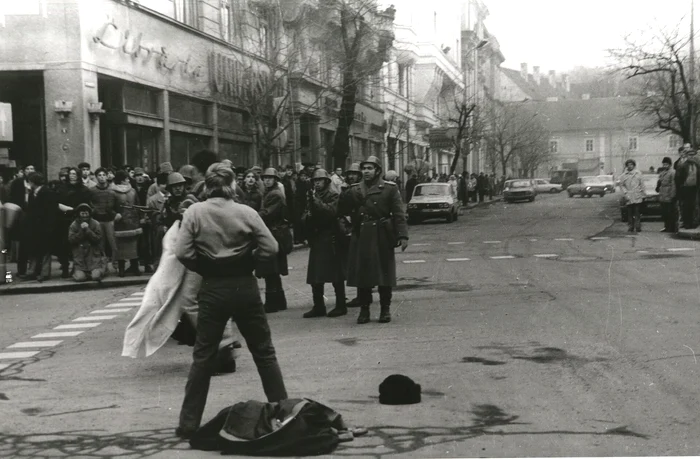
Young man unbuttoning his shirt in front of soldiers in Cluj PHOTO wikipedia
Simplified things look something like this: either because of a diversion or because of chaos, a real war broke out in Sibiu between the Security forces and those of the Army. The security guards ended up being categorized as terrorists and hunted all over the country, but especially in Bucharest. In addition, the psychosis of “terrorists” was born who could be anywhere and could disguise themselves in anything. The hunt for terrorists made many victims, including innocent ones. It all started with the demonstrations in Sibiu on December 22. They were a continuation of more than 30,000 people gather in front of the House of Culture. Several demonstrators speak to the crowd. Several thousand people gather in front of the headquarters of the Militia and the Security. I take it by storm.
Unknown people in black overalls and a diversion as in the book
From the point where the crowd stormed the headquarters of the Militia and the Security, the truth regarding the emergence of “terrorist” psychosis among Romanians, in December 1989, is divided into several points of view. There is a current of opinion, based on a series of testimony, which indicates that everything was a well-planned diversion. More specifically, there were unknown persons on the roof of the House of Culture and that of the Militia and Security in Sibiu black overalls that would have fired into the crowd, including the military unit, from across the street. In this context, Colonel Aurel Dragomir believes that he is being attacked by the Security forces and retaliates, that is, he orders the soldiers to fire on the headquarters of the Security and the Militia birth a real slaughter.
More than 25 Militia and Security officers are killed, and their headquarters is turned into a ruin. Another 500 militiamen and security guards were caught and put into a pool emptied of water. They were kept there without food or medicine. In addition, Colonel Dragomir announced in Bucharest that the Securitate had attacked the Army. A hunt for “security-terrorists” follows, which will degenerate into a general psychosis. The world imagines Libyan commandos or secret troops of the Ceaușescu regime killing people in the street. The diversion was also fueled by the Free Romanian Television. Through the voice of Teodor All kinds of rumors were being thrown around Brateș: “The security is pulling in the Army” is the most significant for everything that happened in Sibiu.
“It was the result of confusion and a state of chaos”
There are more and more historians who believe that what actually happened in Sibiu and the triggering of the terrorist psychosis has its origins in the chaos and confusion after Ceaușescu’s escape. Historian Mădălin Hodor from the National Council for the Study of the Security Archive says that, paradoxically, the communist regime is also to blame. After Ceaușescu’s escape, no one knew what to do anymore, being constantly dependent on orders from the center, taught not to think for themselves, but only to follow clear orders on which not to comment. When the demonstrators stormed the headquarters of the Militia and the Security, the cadres inside opened fire and probably some of the cartridges ricocheted towards the military unit.
At that moment, Colonel Dragomir believed that the Security was firing at the Army. “I too have had many hypotheses over time that I have followed and researched. Now, my conclusion is that it was simply the result of confusion and a state of chaos, which paradoxically is also the fault of the Ceaușescu regime, because once Ceaușescu left the CC building, the entire scaffolding of decision-makers was left without a leader. Nobody knew what to do anymore. Ceaușescu did not leave any order, he left, there was a state of confusion. The Army folded faster than the Securitate, because, normally, the Army was not as bad as the Securitate. And there was that episode from Sibiu. I made a chronology of the events by hours and I can say with certainty that this concept of terrorist, which was actually the concept of security guard-terrorist, was not launched from Bucharest, but was launched in Sibiu, by commander Dragomir. At the moment when people in Bucharest were celebrating the victory of the Revolution, in Sibiu they had started shooting. It was 12.10. After the escape of Ceaușescu. There some revolutionaries broke into the yard of the County Inspectorate of Militia and Security. The fire was opened. Dragomir thought that the Security and Militia were shooting at the military unit, and ordered the soldiers to shoot at the headquarters of the Militia and Security”says Mădălin Hodor for “Adevărul”.
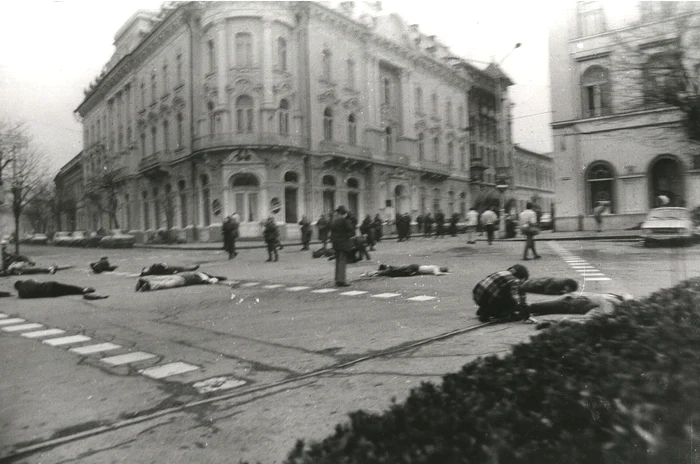
People injured or killed in Cluj PHOTO wikipedia
Later, Colonel Dragomir, says Mădălin Hodor, forwards to Bucharest the story of the Security attack on the Army. At that moment, the idea of ”security-terrorist” appears. The army responded better, having a much more positive image of the Securitate in the eyes of ordinary Romanians, and went over to the side of the people. On the other side was the Securitate, and the security guards were becoming “terrorists” . General psychosis spread and Romanians from different structures started shooting each other. In the middle fell the population gathered in the streets to make the Revolution. They were the collateral victims of a fratricide war born of chaos and confusion. Practically, the terrorists did not exist, two structures of the Romanian state fought in the streets, many civilians becoming collateral victims.
“Dragomir reported to Bucharest that he was being attacked by the Security and Militia. And you can look at the recordings, Brateș says at 12.30 that, >. And this is where the narrative that terrorists are security started. That psychosis against Security was created, after which this psychosis was amplified in all directions. Because they were Arabs, because they were Ceaușescu’s trained children who lived in the basement. The point is that she got this psychosis and she was all fighting and shooting these non-existent terrorists. Each identifying the others as possible terrorists“, says Mădălin Hodor.
Psychosis fueled by bizarre orders, but mostly by false information
The prosecutors who investigated the crimes of the Revolution reached the same conclusion. The theorists were just a psychosis that haunted Romanian society in those days after Ceaușescu’s escape. In fact, it was a fratricide war. But the prosecutors nuance and say that this psychosis of the “terrorists” would have been fueled in a bizarre way by various characters, including from TVR. “The terrorist psychosis that reached paroxysmal levels among the military and armed civilians, corroborated with many military orders that presented a diversionary character (troop movements of some military units, generally ordered during the night), resulted in numerous situations of fratricidal fire and opening fire on people who were not carrying out activities against the revolutionary movement”stated the military prosecutors.
Among those suspected and accused of diversionary actions were Cico Dumitrescu, navy captain, rank I, part of the military command from TVRL, on December 22, 1989, but also Iosif Rus, commander of the Romanian Military Aviation, on the same date. Iosif Rus allegedly gave, on December 22, “orders of a diversionary character”. More precisely, he would have requested that a subunit of the Security forces be sent to support the garrison at Otopeni Airport. Prosecutors say Rus had no right to issue such an order, especially since the airport had its own defense plan. In the conditions in which there were all kinds of rumors about “security-terrorists”, rumors started from Sibiu, but also of confusion and chaos, between the military at Otopeni Airport and the Security troops sent there, as support, a fight broke out in all fairness.
In addition, Teodor Brateș, from TVRL, announced on the night of December 22 to 23, that “three trucks of terrorists are heading towards Otopeni”. In other words, the Security forces sent in support were identified as terrorists, and the military from Otopeni tried to defend themselves based on this false information. As a result of the exchange of fire, 48 people were killed and another 15 injured, the General Prosecutor’s Office said. Terrorist psychosis has led to abuses, numerous collateral casualties, mutilations, deprivation of liberty and more. Despite the investigations and the trials, the problem of the “terrorists”, but also of the punishment of the culprits for the disinformation, chaos and crimes of December 1989, is far from being solved.
