
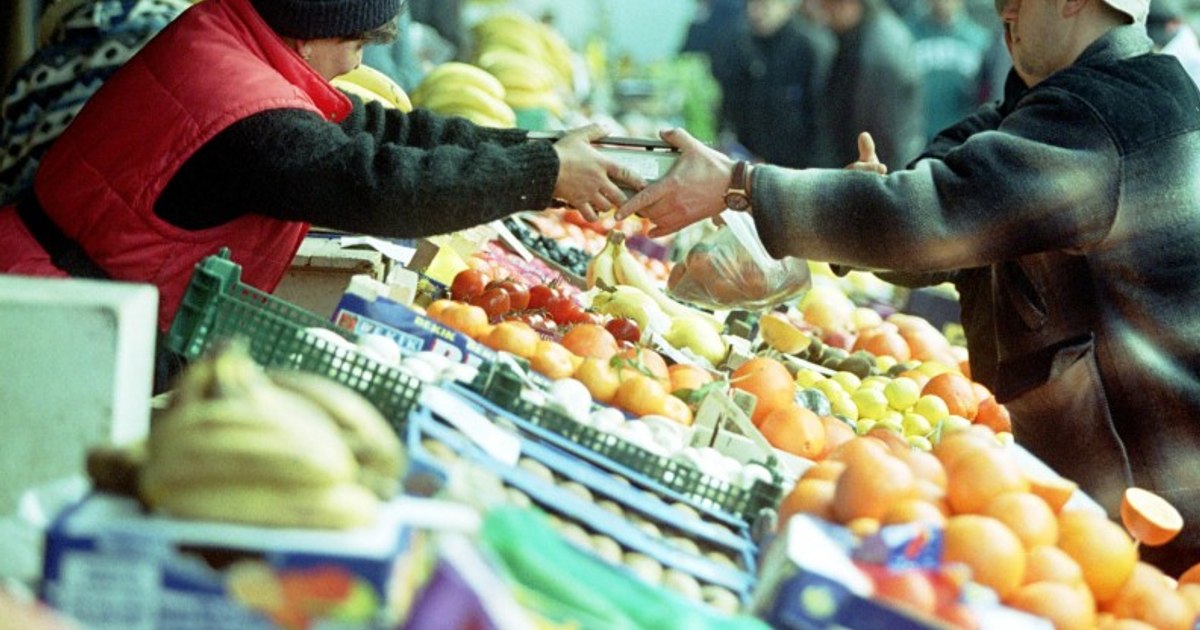
They are more expensive, but at least they are ours. We are talking about domestic food products which, according to an INSCOP study, are preferred by almost three quarters of Romanians, to the detriment of imported ones. The reason? They are healthier. But these are not often found in stores.
According to an INSCOP survey, almost three quarters of Romanians, 72.2% to be exact, prefer to buy Romanian products even if they are more expensive. These are PSD, PNL and ADU voters, people over 45 years old, the inactive, blue-collar workers, rural residents and those who do not have an account on social networks.
Among the reasons is that they would contain a much smaller amount of pesticides. In other words, they would be healthier. Which is, however, not always true. An analysis by the National Phytosanitary Authority, recently published, shows that over 40% of Romanian vegetables contain traces of pesticides, and in some products the amounts of dangerous substances detected were far above the maximum allowed level. Dill, lettuce and tomatoes are the most treated vegetables, the report shows. Moreover, let's not forget last year's scandal, when several vegetable growers from Buzău and Ilfov put up for sale vegetables sprayed with toxic substances with a concentration up to eight times higher than the allowed limit.
On the other hand, imported fruits and vegetables also contain large amounts of chemicals. Sometimes, even higher than the Romanian ones, according to family doctor Mihai Mara. “Imported fruits and vegetables are sometimes even picked raw, they are treated so that they last on the road, do not spoil, are not attacked by insects or other pests, contain chemicals so that they do not ripen too quickly. The more distant the country where they come from, the more treated the products are”, explains the specialist.
Nutritionist Cristina Catlabuga reinforces the statement saying that “we should focus on small local producers and avoid commercial products, whether Romanian or foreign. Fruits and vegetables should be bought in season, from small producers who can tell us how they grew them”.
Economic analyst: “Romanians buy cheap and less and less”
The INSCOP survey also comes with other figures: 26.3% of the Romanians surveyed declared that they choose the cheapest products, regardless of whether they are Romanian or not. These are the AUR voters, the young people under 30 and the potentially active inactives. Economic analyst Adrian Negrescu declared for “Adevărul” that “sthe wave should be seen, rather, from the perspective of Romanians' wishes: to support the Romanian agro-food industry, to support Romanian products. But, beyond our wishes, if we look in the stores, we will see that the best-selling products are also the cheapest. The ones that come with discounts, on promotion, in 2-in-1 gender packages“, specified the specialist. “Purchasing power has fallen dramatically in the last two years and we have ended up with the highest inflation in the European Union. For many Romanians, unfortunately, the visit to the hypermarket ended up like visiting a museum. They go to admire the products, but they cannot afford them“, is the opinion of the analyst.
According to the same INSCOP statistics, 62.7% of the respondents are of the opinion that fruits, vegetables and greens from us are less often found in large commercial chains. Why? Hypermarkets would prefer products from abroad. These are ADU voters, people between the ages of 30 and 45, those with medium education, the inactive potentially active, blue or gray collar workers and rural residents. Adrian Negrescu explained, however, that we are talking about a natural practice in a market economy.
“During this period, Romanian food products are more expensive than imported ones. Because production in Romania has become more and more expensive. We have the most expensive electricity for companies in Europe. The price of gas is very high. Excise duties and other taxes increased from January 1st have led to increased costs for all Romanian companies. Given that it costs you more to produce in Romania, we have done nothing but stimulate imports. The shops, therefore, make a very simple calculation. Where do I buy cheaper to sell to my customers? Just don't put high prices in stores so that no one buys anything”comments Adrian Negrescu.
The INSCOP survey also says that 33.4% of Romanians believe that domestic agricultural products are rarer in large commercial networks due to very small local production. This is what PSD-PNL voters, people over 45 years old, passive inactives and those who do not have an account on social networks believe. Indeed, a Romanian vegetable grower cannot produce in such large quantities as the hypermarkets demand in order to conclude a contract. They would only have the resources if they organized themselves into associations to set up warehouses. But this is not really desired. The Minister of Economy, Radu Oprea, declared at the end of January that “one of the issues we must learn in Romania and overcome is the spirit of association. We probably have a country from the past, until '89, when cooperativeization had a more than emotional, hard impact on the Romanian, especially on the soil worker. We should ask ourselves what we gain together, not who is the boss, because that's why some associations don't work”.
On the other side of the barricade, agricultural producers complain about the fact that they have to pay very high fees to stores in order to be able to sell their products. In some cases, producers claim that these taxes reach up to 90% of the final price of the food in the store.
Romania has the highest inflation in Europe
Romania recorded the highest inflation in the European Union in February: 7.1%, followed by Croatia, with an inflation of 4.8%, and Estonia, with 4.4%, according to data published by Eurostat. Consumer prices also increased by 0.98% in February this year, compared to January 2023.In February, we saw the largest price increases for the second month in a row. Unfortunately, the fact that we have the highest inflation in the European Union proves that all the ceilings, compensations and artifices intensively promoted by the authorities were and are friction on a wooden leg. The reality shows that when you go with your shopping cart to the store, most of the time you pay at least double the prices compared to a year ago. We are talking about an economic reality that is not accompanied by some effective measures to reduce the prices of basic food products as other countries do. In Poland, for example, reducing VAT on food to zero worked perfectly. Basically, the state no longer collected money from the prices of food products specifically to help the population. We used the capping idea, which did not bear fruit”, analyst Adrian Negrescu also explained.
According to INS data, in February this year compared to January, the most expensive vegetables and canned vegetables (6.35%), fresh fruit (4.88%), potatoes (4.61%), fresh fish (2.78%), cheese (2.26%). Price increases were also recorded for eggs (1.33%), sugar (1.23%), milk (1.01%), poultry meat (1.2%), milling and bakery products (1.13% ), but also beer (1.63%). According to INS statistics, food prices rose by 5.64% in January 2024 compared to January 2023, and by 1.34% compared to December 2023.
