
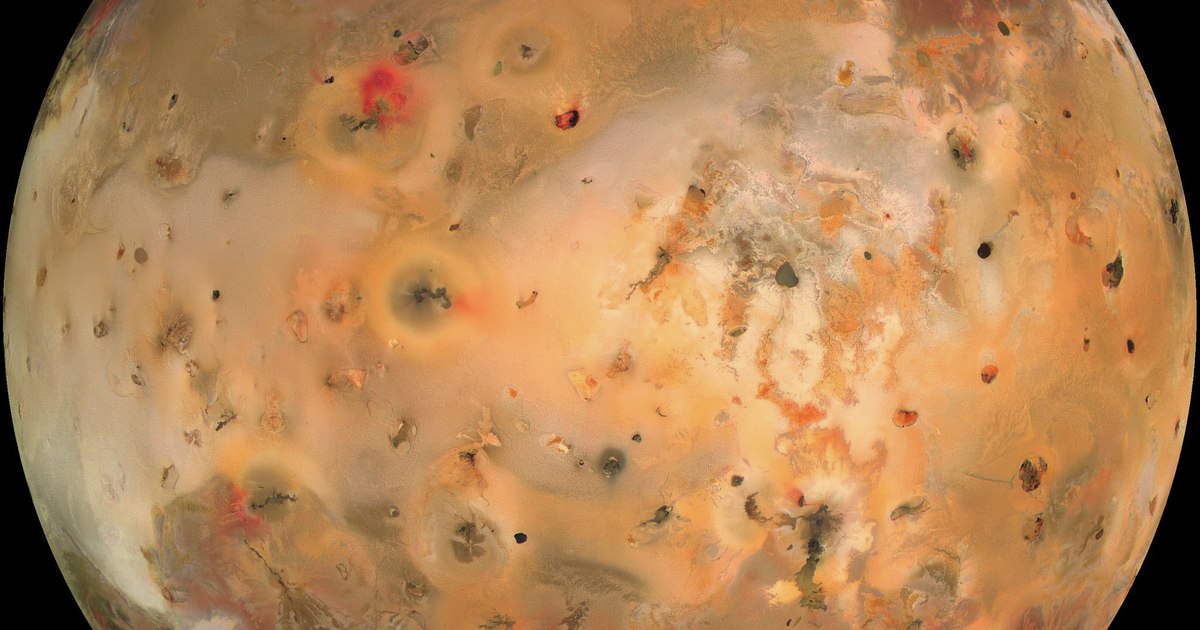
NASA’s Juno spacecraft has made new discoveries about Jupiter’s fiery moon Io, the most volcanically active body in our solar system, solving a problem that has long puzzled scientists, CNN reports.
Jupiter’s moon Io has continuous volcanic eruptions PHOTO SHUTTERSTOCK
About the size of the Moon, Io is home to approximately 400 volcanoes that continuously emit smoke and lava that covers its surface.
The Juno mission, which has been orbiting and observing Jupiter and its moons since July 2016, flew very close to Io last year in December and February. The spacecraft came within 1,500 kilometers of the moon’s surface, capturing images and data. Juno’s flybys have provided an unprecedented look at the moon, including, for the first time, observations of its poles.
The researchers presented some of the findings of an analysis of the data Wednesday at the annual meeting of the American Geophysical Union in Washington. A paper detailing some of the findings was also published Thursday in the journal Nature.
“Io is one of the most curious objects in the entire solar system,” said study co-author Scott Bolton, Juno’s principal investigator and associate vice president at the Southwest Research Institute in San Antonio. “We see that this body is covered with volcanoes, at both poles and in the middle, (exploding) continuously.”
The new data suggests that Io’s multitude of volcanoes are likely fueled by their own reservoir of hot magma, rather than an underground global ocean, as previously assumed by astronomers.
The discovery could change the way astronomers look at subsurface global ocean-dominated moons in our solar system, such as Jupiter’s moon Europa, and planets outside our solar system.
A Cosmic Pepperoni Pizza
The father of modern astronomy Galileo Galilei discovered Io on January 8, 1610.
But its frenetic volcanic activity wasn’t detected until Voyager 1 flew past Jupiter and its moons in 1979, revealing Io’s dynamic surface that resembled a pepperoni pizza, Bolton said.
Linda Morabito, a scientist at NASA’s Jet Propulsion Laboratory in Pasadena, California, became the first person to identify volcanic smoke while studying an image of Io captured by Voyager 1.
The revelation sparked astronomers’ attempts to unravel the mystery.
“Since Morabito’s discovery, scientists have wondered how volcanoes are fueled from the lava below the surface,” Bolton explained. “Was it a shallow ocean of hot magma feeding the volcanoes, or was their source more local? We suspected that the data from Juno’s two very close flybys might give us some insight into how this hot moon actually works.”
Io orbits Jupiter, the largest planet in our solar system. The moon’s orbit is imperfect, meaning that sometimes it moves closer to Jupiter, and sometimes it moves further away. Io completely orbits Jupiter every 42.5 hours.
Jupiter’s massive gravitational influence creates a squeezing effect on Io, like a hand squeezing a rubber ball, warming the moon.
“That’s what happens in Io,” Bolton said. “That squeeze generates heat and it gets so hot that (Io’s) interior melts and comes to the surface. Eruptions are constant. It’s like a non-stop storm. It keeps erupting everywhere.”
The forces exerted by Jupiter on Io generate immense energy, which melts some of the moon’s interior, Bolton said.
During its passes, Juno captured high-precision Doppler data that measured Io’s gravity based on how its approach affected the spacecraft’s acceleration. The data were compared with observations from previous missions that have flown past Jupiter and its moons, such as NASA’s Galileo spacecraft, as well as ground-based telescopes.
New perspectives on the moons
Together, the observations point to a rigid, mostly solid interior beneath Io’s surface rather than a magma ocean—solving a 45-year-old mystery raised by Voyager 1 observations. Instead, the volcanoes are fed by several local sources and each has its own underground magma pocket
“Juno’s discovery that forces do not always create global magma oceans not only forces us to rethink what we know about Io’s interior,” said lead study author Ryan Park, Juno co-investigator and supervisor of the Dynamics Group of the solar system at JPL. , in a statement. “It has implications for our understanding of other moons, such as Enceladus and (Saturn’s) Europa, and even exoplanets and super-Earths. Our new findings provide an opportunity to revise what we know about planetary formation and evolution.”
The mission also helped capture a range of images showing Io’s “imagined primordial surface,” said Heidi Becker, a JPL scientist who was not involved in the study. The images bring different features on Io into focus like never before, including islands on massive lava lakes such as Loki Patera, which is so large that astronomers compare it to a sea of lava on Io’s surface.
The Juno spacecraft is bringing new insights into Jupiter and its moons after it recently completed a flyby of Jupiter’s swirling cloud tops on November 24. Next, Juno will reach 3,500 kilometers above Jupiter’s center on December 27.
