
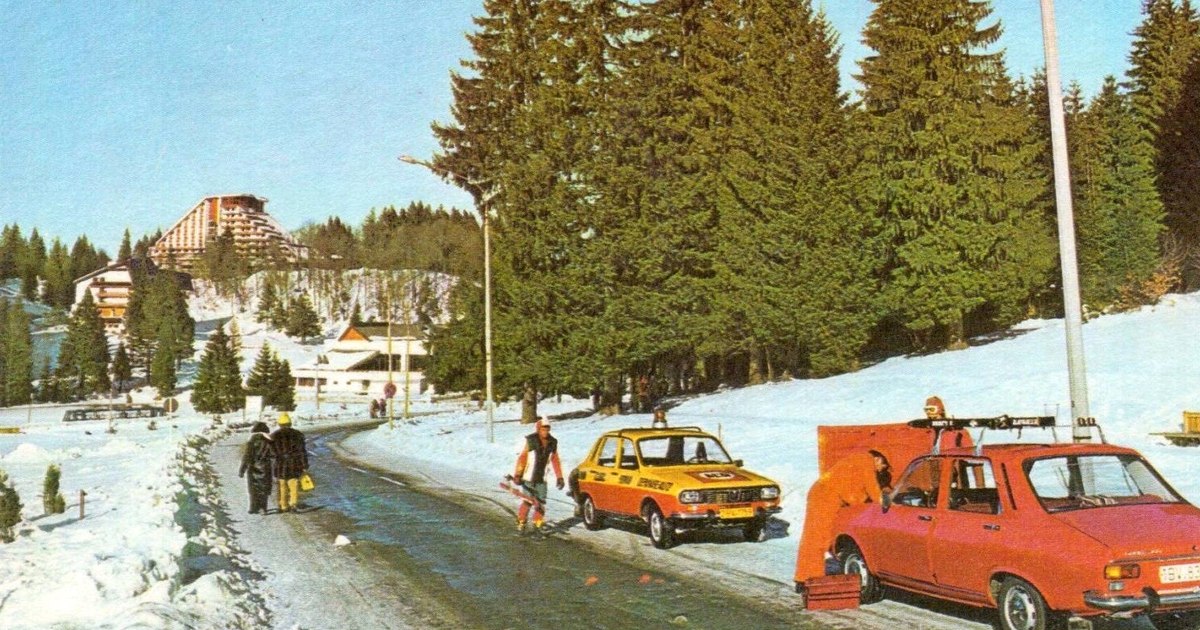
Driving personal cars in the winter on Romanian roads in the 1980s had become a luxury for many Romanians. They faced shortages and restrictions and were encouraged “for practical reasons” to give up the use of automobiles for at least three months of the year.
The roads in the mountain resorts were almost deserted in the 80s. Source: Quora.com
The 80s brought the Romanians some of the hardest winters in the country’s history, both because of the weather and especially the shortages and economic problems of the last years of the Ceaușescu regime.
The austerity was also visible on the country’s roads, almost deserted during the winters, as the authorities imposed traffic restrictions.
Winter, closed season for cars
One of the most terrible winters in Romania was that of 1985. Romanians spoke of the months of January and February with amazement mixed with the relief of survival, some remembering that, since the war years, they had not endured such a hard winter, the Western press reported.
“The winter of 1985 was the worst in 30 years, gas and electricity went out or were cut off for days, while temperatures in the city dropped to minus 19 degrees Celsius. To save energy, street lighting was switched off in most of the country, the use of private cars was banned for three months, and electric indoor heaters were completely banned.”the Los Angeles Times reported in 1985.
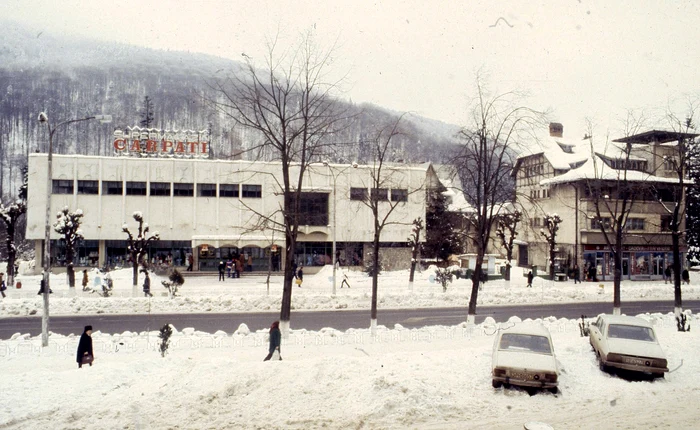
Winter in Sinaia 1986. Photo Urban Tamas. Fortepan.hu
The US press mentioned that the communist regime decreed unimaginable energy saving actions in other European states, which affected both the physical health and the psyche of many Romanians. The streets of the cities had become deserted, due to restrictions and shortages, many Romanians having no choice but to “preserve” their cars during the winter.
“The streets were unreal strange, a doctor recalled. Unlit, almost without cars, flanked by Trojans and very sinister. The crowds coming from work made the city look like a huge slush, with dark figures running in all directions. From March 25, after a three-month ban, private cars were allowed on the roads again, although traffic was limited to one day, one day no.” informed the correspondent of The Washington Post, in a report made in Romania in 1985.
At night, the streets of the capital plunged into darkness, with public lighting remaining in operation on only a few boulevards. Western journalists described Bucharest as the darkest capital in Europe, but provincial cities like Brasov were even darker.
Cars, almost forbidden in winter
Romania, with just over 100 kilometers of highway at the end of the 80s, had a deficient road infrastructure compared to most European states, but Romanians had no reason to complain about the congestion on the roads. In winter, even the busiest roads remained deserted.
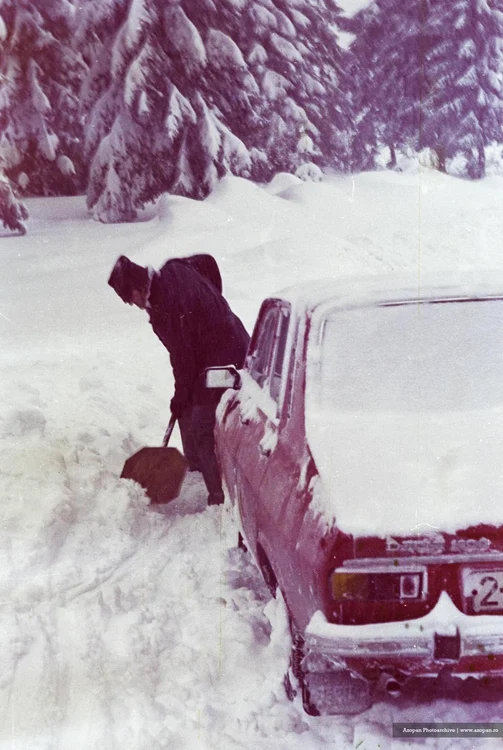
Winter in the mountains in the 80s. Source Azopan.ro
“Car traffic before 1989 was a kind of joke. In my village, I could play football-tennis on the Brașov-Pitesti national road. I could play without problems for 20 minutes without a single car passing by. There were cars, but the ration of 20 liters of gasoline per month was a major impediment to any form of car traffic. In addition, every Sunday only cars with even or odd numbers (alternatively) were allowed to drive. In winter, for three months per year, the circulation of private cars was prohibited because of the heavy snow. It didn’t matter if it was snowing outside or not.”a Romanian recalled, on the Quora platform.
However, Romania surpassed Albania, where the restrictions of communism were much more radical.
“Romania and Albania were in very similar conditions at that time; in fact, Albania was even worse. Most of the things you mention also happened in Albania. The difference was that there was no car traffic allowed at all, Albanians were not allowed to have cars, while Romanians still had Dacians”recalled an Albanian, on the same platform.
Car improvisations, winter
On social media platforms, Romanians reported on the “tricks” they used to maintain their cars during the winter.
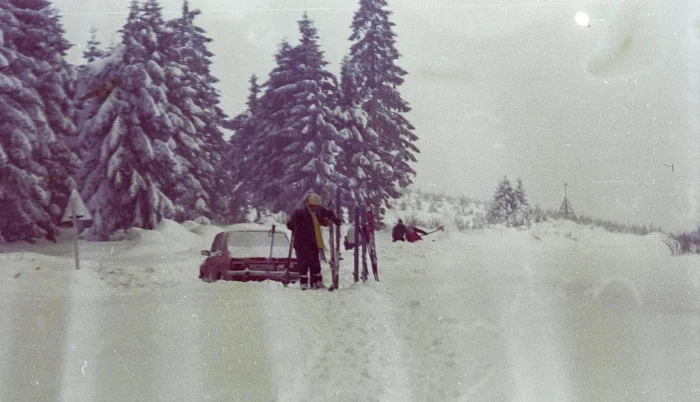
Winter in the mountains in the 80s. Source Azopan.ro
They had to resort to improvisations, as spare parts were hard to come by, and the quality of car installations and their wear and tear were often poor. Some remember removing the car battery to shelter it in their homes, in the heat, at night, then putting it back in place in the morning.
Other Romanians say that the antifreeze was sometimes made at home, based on spirit or sanitary alcohol, and sometimes they emptied the radiator and refilled it with hot water at start-up – something not recommended by specialists.
Some heated the parts of the cars with burning newspapers, covered the hood with blankets, and to get out of the mud, they called for the help of neighbors and the indispensable shovels in the trunk.
On mountain roads, driving was a real adventure, with winter tires often difficult to procure, despite several tire factories operating in Romania. Thus, going to the mountains during holidays, shorter in winter, was conditioned by the movement of trains.
Romanians took out their cars “for the winter”
For three to four months a year, many Romanians gave up driving and took their cars out “for the winter”, reported Auto Almanac in 1985.
“The car, like a living being, is extremely sensitive to… cold. If in the period with positive temperatures it offers us the most correct and economical services, the cold does not “suit” it, it becomes recalcitrant, sometimes annoying its owner to the point of despair. Snowfall, skidding and sliding of the car off the road, as well as the cold endured by the driver in the event of a breakdown are only some of the difficulties of driving a car in winter”a car engineer explained then.
On this occasion, the cars no longer had to be equipped with winter equipment, the oil no longer had to be changed, and the engine was spared from advanced wear, the publication reported in 1985.
“It was found experimentally that a cold start of the engine, when the air temperature is -20°C, is equivalent to the wear of the engine parts by friction, as if the car had traveled about 200 kilometers in the summer”, noted engineer Ion Mănoiu in the Auto Almanac.
Those who preferred to take the cars out of use for three to four months a year argued that this way avoids damage to the battery, but also the risk of accidents and breakdowns, which are much more frequent in winter.
“We avoid the unpleasantness or even the “horror” of driving the car on ice, snow, in fog, etc. and especially at night. Taking the car out of circulation for 3-4 months means saving fuel and oil, which also results in a significant saving in the personal budget.” informs the engineer.
How Romanians took care of their cars in winter
The publication also offered several reasons why the cars should still be used in the winter, one being that the tires don’t wear out and can’t overheat in the snow.
“We have the opportunity and the autonomy to see picturesque regions, of great charm, enveloped in the blanket of winter, to practice winter sports and we can travel on roads incomparably less crowded than in summer”, the magazine notes.
The advice received by Romanians was to rarely travel by car in winter, but to drive it from time to time, this season. In this case, the battery became an extremely valuable part.
“It must be perfectly charged, with the level checked every two to three weeks and, very importantly, with the prescribed acid concentration. Prepared in this way, it does not freeze and serves us promptly at the start. Even if you do not necessarily have a road to do in good weather, it is good to travel at short intervals on a road, 80-100 km: the battery is recharged, and the whole car assembly will feel beneficial.” the specialists informed.
The electrical system, brakes, lubricants, radiator and body also had to be checked and serviced as often as possible.
Tips for those who kept their cars on hubs
For those who gave up on their own initiative the use of cars for four to five months a year, the specialists recommended them to take some precautions.
“If we still want to immobilize the vehicle, it must be placed on jacks and the wheels removed, with the tires maintained at normal pressure. The gas tank must be emptied and cleaned, the radiator also, if it is not sealed. The nickel-plated parts will be greased to prevent rust, even if the immobilization is done in a garage or shed. Moisture is a great enemy of the body, and all its metal parts must be controlled and covered with a layer of protective paint, regardless of whether they are visible or not. The battery must be disassembled and kept in a warm place, having previously checked its charge, level and acid concentration.” auto mechanics informed, according to the 1967 Almanac Sânteia.
