
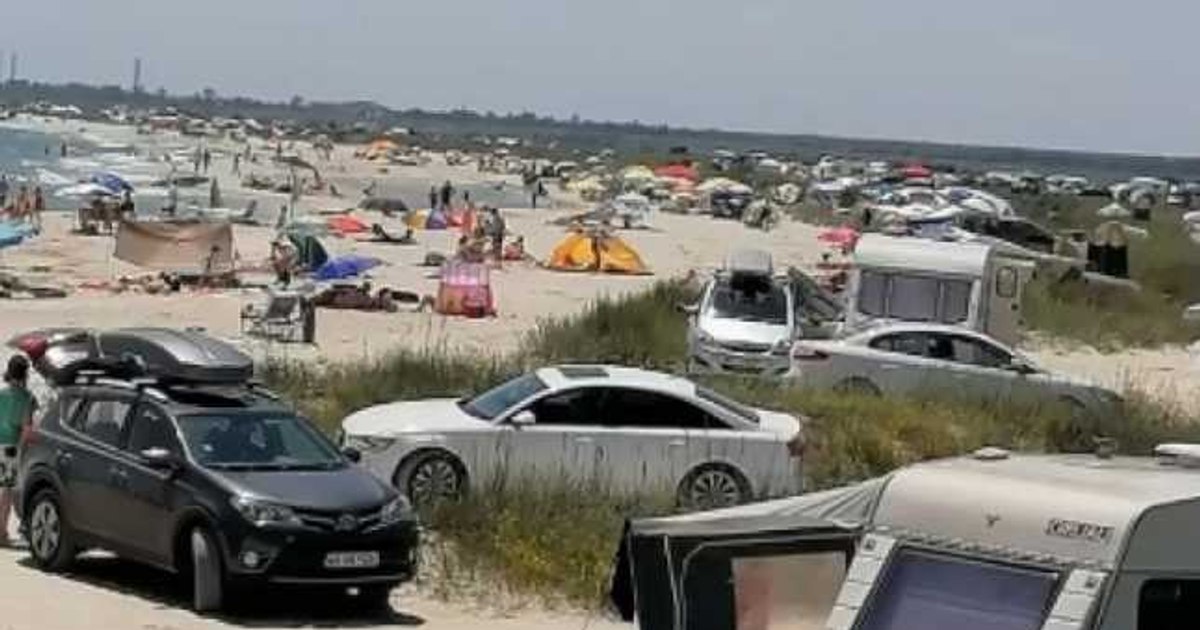
There was an alert on the coast, in the area of undeveloped beaches in the localities of Vadu and Corbu, where amounts of E.coli above the permitted limit were recorded. A biologist explains why we ended up in such a situation.
Tourists camp on undeveloped beaches. Photo source: archive
Biologist Adrian Bâlbă explains two of the most plausible reasons why the sea water in the undeveloped areas of Corbu and Vadu is infested with E-coli: a natural phenomenon, but also the ignorance of tourists who turned the sea into a public toilet. “In the north of the coast, the water is less salty, rich in nutrients, the depth is quite low and the benthos (water bottom) is often muddy. Hence the possibility that the number of bacteria is naturally higher”, the specialist explains a natural phenomenon that cannot be fought. “The same can be said about the lack of organization of the beaches, which do not have public toilets in the conditions where they camp, that is, they also stay at night. In the absence of vegetation, nature-loving tourists defecate in the sea,” stated the biologist in a message posted on his Facebook page.
Although the authorities advise people not to bathe in the sea during this period, they completely ignored the warning and stormed the beaches. However, how dangerous this pastime could be, explained for “Adevărul” the infectious disease doctor Adrian Marinescu, from the “Matei Balș” Hospital for Infectious Diseases
“In the area of undeveloped beaches in Vadu and Corbu localities, in Constanţa county, the seawater samples are non-compliant, containing an amount of coliform bacteria (Escherichia Coli) above the permitted limits. Considering this situation, we recommend avoiding bathing in the beach areas near the two towns, until the situation normalizes“, DSP Constanța announced.
How alarmed should we be and what do we risk if we do venture into the waters of the sea in these contaminated areas? “We have to make a difference between what is the real risk given by Escherichia Coli – we could get urinary infection, digestive, even generalized infection and have a reserved prognosis – and what is meant by accidental contact with contaminated water. Of course, when we are talking about contaminated water, the ideal would be not to enter, to be cautious and avoid”, said Dr. Adrian Marinescu.
E-coli infection would occur when we drink infested water, and this sort of thing happens when we swim or just splash around “Things go proportionally: a small amount of water swallowed, less risk of contamination,” continued the doctor.
Biologist on viruses in water: “So many that their string would reach the moon”
“The sea, natural water bodies, have more bacteria than algae, even more viruses than bacteria”, biologist Adrian Bâlbă also completes the idea. “They are bacteriophage viruses, which if they were put together, although they are very small, their string would reach the moon. The water health index is measured in the total number of germs and the number of coliform bacteria. Escherichia coli is one of them, not the only one. And even if this were indeed E. coli, not all strains are pathogenic to humans. Many are symbionts of the large intestine – hence the name – coli (colon). Infections, in general, depend on the amount of germs – the so-called infectious dose or inoculum. So it is normal to establish some limits, which once exceeded only means the possibility of infection, i.e. risk – and hence the recommendation to avoid bathing. The biologist warns that this is not a ban by the authorities, but a recommendation by public health specialists.
Microorganisms in seawater are and will be everywhere, not only in Corbu, explains the infectious disease doctor Adrian Marinescu.. “They are in any water. There is no sterile water. And in a plastic bottle they can develop. In all seaside resorts there are microorganisms of all kinds in the water. And not only E-coli. The problem arises when these microorganisms exceed the allowed limit, when they develop in a very large amount. It is inevitable, at some point, from time to time, that they reach a concentration that exceeds the permissible limit. It is important that when we are warned about this we take into account the warning and recommendations of the authorities” Dr. Marinescu also said.
Infectious disease doctor: “It is difficult to find out the source of contamination. The virus can be taken from anywhere”
Doctors do not expect the hospitals in Constanța to be stormed by tourists infected with E-coli. And even if this were to happen, no one will know exactly how, from where people came into contact with the bacteria. “In general, summer is the season of digestive diseases. That person who got a digestive infection will not know where they contacted the bacteria. Maybe he got it from contaminated food. It’s hard to find out especially if the person ate at the terraces, restaurants, if he bought food from the merchants on the beach”.
But the risk exists. And the most exposed people are children and the elderly. “Elderly people, who suffer from various chronic conditions or who have a weakened immune system are at a higher risk of becoming infected and experiencing digestive symptoms. We can think of a digestive infection that comes with different complications.
The results of the analyzes carried out by the Directorate of Public Health in Constanţa for the sea water in the Corbu and Vadu area are now within the normal parameters for Escherichia coli and enterococci, the authorities announced yesterday. Last week, DSP Constanța representatives had warned that there were high values for Escherichia coli in the seawater of Corbu and Vadu, which is why they did not recommend bathing.
