
According to a study carried out by Reveal Marketing Research, 55% of Romanians are little or not at all worried about the fact that they might get sick from Covid. As for the preventive measures that they should take in the future, Romanians do not give them much importance: only 14% of them strictly respect them.
Despite the increase in the number of illnesses, Covid no longer scares Romanians. Photo source: archive
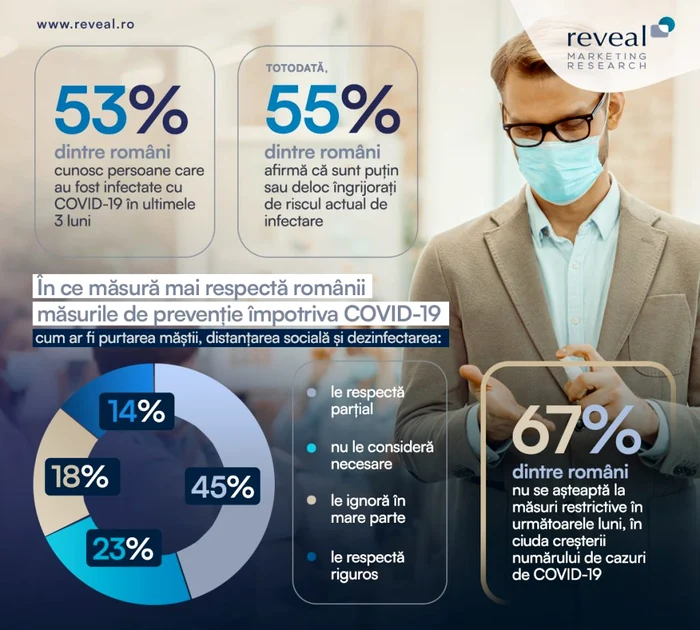
According to the research, 29% of Romanians declared that they had symptoms that could have indicated a Covid-19 illness in the last 3 months, but they were not tested for confirmation. In contrast, 9% of respondents are certain that they have been infected, having confirmed a positive test. 53% of Romanians know people who have been infected in the last three months, most cases being in the circle of friends and colleagues (40%) or in the family (32%). 55% of Romanians declare that they are little or not at all worried about the current risk of infection, and this attitude is more frequent among men (59% compared to 52% women), among young people from Generation Z aged 18-24 ( 61%) and of those without children under 18 (58% versus 52% in the case of people with children under 18). As a comparison, only 34% of those surveyed are moderately worried, and 11% say they are very worried that they could be infected with SARS-CoV-2. In relation to the preventive measures against Covid-19, such as wearing a mask, social distancing, disinfection, etc., the majority of Romanians say that they partially respect them (45%). 23% consider these measures unnecessary, 18% mostly ignore them, and 14% strictly follow them.
Source: Reveal Marketing Research
In the current context, 67% of Romanians do not expect restrictive measures in the coming months, despite the increase in the number of Covid-19 cases. This opinion is more common among people aged 45-55 (75%) and those without children under 18 (71% versus 63% for people with children under 18). At the same time, 7 out of 10 Romanians state that they do not consider preventive vaccination to avoid infection with the virus that causes Covid-19.
Romanians no longer trust the media and “ran” on TikTok
It seems that the virus that we feared so much during the pandemic has become for many of us a normality that we have learned to live with. Others, on the other hand, completely ignore the risks. What are the reasons? Why are we no longer afraid of Covid at all? “The fact that a third of Romanians showed symptoms of COVID-19 in the last three months, but chose not to get tested, reflects a decrease in the perception of the threat posed by the coronavirus. This can be driven by a number of reasons, such as reduced risk perception in mild or moderate symptoms, or fear of positive outcomes that could lead to restrictions and isolation”said Marius Luican, CEO of Reveal Marketing Research.
But the reasons don’t stop here, according to psychologist Radu Leca. He believes that we are dealing with a behavioral reorganization of the entire people, and this phenomenon happened for several reasons. “Because they no longer trust traditional media, Romanians have moved online and get their information from there. TikTok is the platform of choice, as there seem to be no rules here. This network allows swiping twice as fast as Facebook, Instagram or Youtube, allows picture-in-picture close-up in real-time and, most importantly, is the only platform that does not censor information. Basically, any ill-intentioned person can assemble a piece of information and upload it to TikTok. This is where the Romanians learned, totally erroneously, that the pandemic, the virus, is just a world conspiracy, a conspiracy that in reality does not exist. The consequence of this belief is their reality-denying behavior. Many are actually fighting an invisible enemy that doesn’t exist.”
Trust in state institutions collapsed
On the other hand, those who did not fall prey to the influence of social media slipped down a different slope. “When Romanians refuse official information, they do it because they no longer trust the authorities and the institutions of the Romanian state”, explains Radu Leca. The specialist refers to the scandals in which the Ministry of Health was involved over time, the last being the story from the Saint Pantelimon Hospital. “Qn a month ago, we all learned about the existence of the scandal at Saint Pantelimon. After a month, things have changed so radically that the Romanians do not understand what happened. Are the two female doctors criminals or not? And then, as long as everyone is throwing themselves into scandals, people will not trust any type of ministry. Instead, they will believe in any kind of conspiracy. Romanians daydream about the tons of gold and diamonds hidden in the secret tunnels of the Bucegi Mountains. Romanians daydream about the famous wine cellars full of old wines, already transformed into marmalade, from 1700 to the present, hidden under Calea Victoriei. These types of conspiracies, which have nothing to do with reality, represent the true spirit of the Romanian people”.
Moreover, the psychologist says that there are extremely many people in Romania who are vehemently opposed to everything that the European Union means. “Everything that comes from that side is rejected from the start”.
“Social media has lowered our IQ”
The Romanian, continues the specialist, is no longer interested in anything serious, as if he doesn’t want to evolve anymore. “When we observe a national cognitive distancing of Romanians from everything that is good, normal, natural, everything that brings well-being, we understand that Romanians have decreased in terms of intelligence quotient from what it was in 1970, in 1990, in 2000 , to date. If we ask why, we have only one answer: because virtual space exists. Basically, the brain was no longer used at the level at which it was used 60 years ago, and everything that means the structure of poor cognition was established”.
