
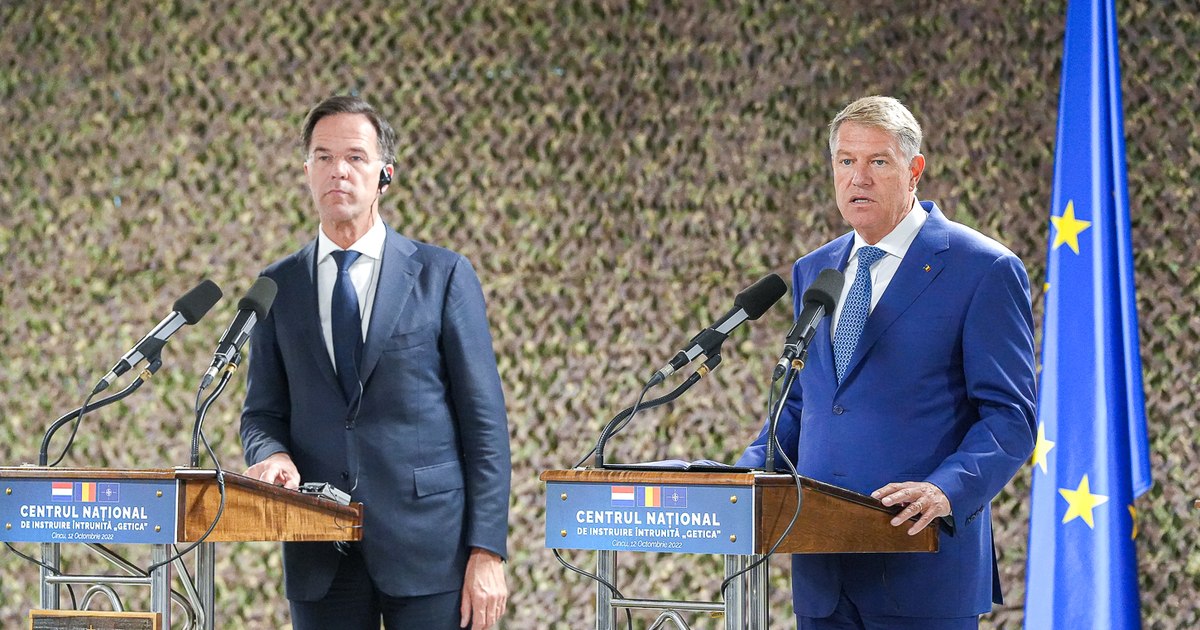
Why was Mark Rutte appointed to head NATO, despite his contempt for the situation in Central and Eastern Europe, his conciliatory attitude towards Russia and his failure to allocate 2% for Defence? Security expert Iulia Joja answers the question and explains why “Rutte does not suit us”.
Rutte was also supported by Romania, although he humiliated us by entering Schengen. PHOTO: presidency.ro
Last Wednesday – June 26 – the 32 member states of NATO appointed the acting Dutch Prime Minister Mark Rutte as NATO Secretary General, at a crucial moment for the Alliance.
Rutte’s relationship with Central and Eastern Europe, the conciliatory attitude towards Russia, the fact that the Netherlands did not allocate 2% of its GDP for Defense, as NATO demands – do not make him a good head of NATO from the perspective of Romania and Central Europe and East, but they make him better suited than his predecessors to “send” Ukraine to negotiations with Russia.
Regardless of who becomes president of the White House, he will suggest Ukraine, more or less politely, to negotiate peace with Russia, says Iulia Joja, who teaches European Security at two universities in Washington and at the US Diplomatic Institute.
“The situation is extremely difficult, if it comes to that. And really, if that’s what a Mark Rutte, as he’s shaping up to be at the moment, is going to come to, he’s more useful than a Jens Stoltenberg” – concludes the expert.
European security expert Iulia Joja explained, for Adevărul, what this means for the war in Ukraine, but also for the situation in Central and Eastern Europe.
“Until recently he looked down quite disdainfully on the situation in Central and Eastern Europe”
“Of course we can hope for some pleasant surprises, but there are some reasons why the states of Central and Eastern Europe, including Romania, leaving aside the candidacy of Iohannis, were reluctant to face Mark Rutte“, claims Joja.
The reasons are as follows:
In terms of Defence, Holland is not doing well. “Mark Rutteduring the years in which he was prime minister, he did not even have the ambition to come close to allocating 2% of GDP to Defense, as required by NATO”explains the expert.
“Then, Rutte does not have the best reputation in the relationship with many states in Central and Eastern Europe. The Netherlands, until recently, looked quite contemptuously at the situation in Central and Eastern Europe and after 2014, when Russia attacked Ukraine, it did not radically change its view and say: “sir, you were right to keep insisting with security in the Black Sea and with Russia, that’s it, now we have to defend and help Ukraine. It’s not necessary.“
The 3rd reason is related to bilateral relations within the European Union. “Rutte does not have a very positive image neither in the relationship with Romania, nor in the relationship with many others. And we all remember very well how the Netherlands blocked us from entering Schengen for many years, until recently. And he did that for political reasons and discrimination against Romania, not for technical reasons, because we had met the technical criteria for some time. Holland was finding all kinds of excuses, and now it was replaced by Austria. So even within the European Union, the Netherlands did not shine.”
Supporting Rutte – “Trump proofing” operation
Why was it so unreservedly supported by Western states and the US?
“Because this ‘Trump proofing’ (an assurance of Donald Trump’s return to the White House-no) is taking place.” Again we are taking steps to protect ourselves from a possible Trump 2 administration, which we know has a few obsessions, one being 2% of GDP for Defense and we know the Europeans are not contributing enough. Mr. Trump is right from this point of view, but, as we well know, Mr. Trump does not differentiate between Central and Eastern Europe, on the one hand, and Western Europe, on the other. Because if we look at defense contributions, Central and Eastern Europe is mostly doing very well. Obviously, Russia is on our coast, not theirs”Joja explains.
As for Western Europe, from Spain to Belgium and the Netherlands, the situation is much worse: “And then, Mark Rutte in the spirit of old-fashioned transatlantic solidarity, where the emphasis is on Western Europe, not on Central and Eastern Europe, is the NATO Secretary General who, the Western states, plus the United States, hope that he convinces Trump, on their behalf, forgive them for not contributing 2% and not pull the United States out of NATO or say, ‘we’re not helping you because you’re not contributing enough'”.
The fact that Rutte met Trump also helps, but it is not a decisive argument, the expert elaborates.
“Mark Rutte does not suit us”
“In this context, both from the point of view of the national interest of Romania and from the point of view of the regional interest and in relation to the NATO-Russia relationship, Rutte does not suit us, from any point of view”, concludes Joja.
To secure his candidacy, Rutte made all kinds of efforts, including that initiative to deliver F16 jets to Ukraine. “We have to read this initiative as part of his campaign.”
In addition to this, Joja claims that Rutte a “had, at least so far, a much more conciliatory tone towards Russia than former secretaries-general Stoltenberg and Rasmussen. So, even if we compare the Western Europeans, there are nuanced differences, the Nordics being now, from the point of view of strategic culture, much closer to Romania than the Netherlands, Belgium, Spain, etc. Denmark, Sweden, Norway are part of practically now from the group of Central and Eastern Europe in terms of understanding vis-à-vis Russia and the measures it takes to defend themselves. And Mark Rute is part of the traditional Western, conciliatory group.”
However, it might change during the term of the Secretary General, adds Joja, emphasizing: “We must also be aware of this, namely that he has the mission to have a common voice, but that this common voice seems more conciliatory than what we have had so far from Stoltenberg, who is rated by the majority of those in NATO as a very good secretary general and it will be difficult for Mark Rutte to rise to the level that Stoltenberg had, especially in this extremely difficult context of the war in Ukraine.”
“Why was Mark Rutte put in charge of NATO?” “It affects us too”
Is Rutte’s choice also a message regarding the war in Ukraine?
“I don’t know for sure, it might, because if you consider the fact that the additional aid package from the United States to Ukraine came extremely late and extremely difficult, and if you consider the political dynamics within the United States it will be even more difficult in the fall and winter to pass a further package of military aid from the United States, which we know is essential to this war” – claims the expert.
Joja argues that as things stand in the US now, no matter who wins the election this fall, whether it’s Biden or Trump, “there are quite high chances to force, more politely or more rudely, Ukraine to come to the negotiating table”.
The expert claims that she saw signs even from Ukraine that things would move in this direction: “Zelensky is speaking for the first time in recent weeks about future negotiations with Russia, which is a rather difficult situation, given that, and here I must point out, Russia has not changed, it has not changed its demands in any way and that he still wants the annulment of Ukraine’s sovereignty on the one hand and on the other the withdrawal of NATO behind the pre-1997 borders, which obviously affects us as well.”
So Russia is asking for the same things. “So, so from this point of view the negotiations are not realistic neither now nor in three months, that if it didn’t change in 2 and a half years, why would it change in three months, given that we didn’t help the Ukraine enough to force the Russians to modify their demands, that’s what it’s all about.”
Besides, says Joja, we are not aware of any peace or disarmament treaty that the Russians have respected.
“The situation is extremely difficult, if it will come to that (inviting Ukraine to negotiate peace with Russia-no). And really, if it comes down to it, a Mark Rutte, as he is shaping up at the moment, is more useful than an Ian Stoltenberg” – experts conclude.
Thus, one of the relevant answers to the question “Why Mark Rutte was put in charge of NATO” it will be related to the intention of the West and the USA to send Ukraine to the negotiating table with Russia. A Russia that still demands the withdrawal of NATO, including from Romania.
