
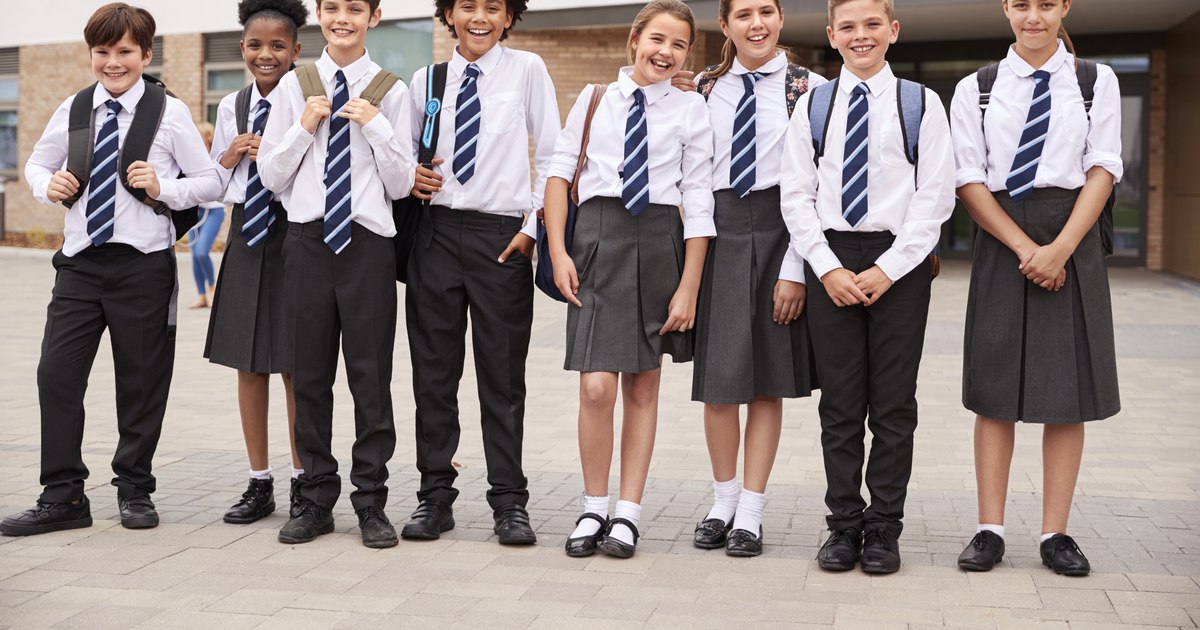
With or without school uniform? It is an evergreen of education. Opinions among parents are divided, but many believe that the uniform does not solve the problem of financial inequalities and that a better and less expensive solution would be a dress code. On the other hand, the director of a national college in Bucharest says that none of these options solves the problem of outfits that she considers inappropriate for school.
“Brand shoes will continue to make a difference”
After being mandatory during the communist period, the uniform is no longer imposed at the national level in Romania. It is up to the schools to decide whether or not to require such attire. And many of the schools do it, especially in primary and secondary school. In high school, such a variant is almost completely abandoned. It is precisely the reminiscence of the communist regime that makes many see the uniform as a restriction on freedom of expression. However, the school uniform is also specific to modern democracies. In Great Britain, Ireland and Malta it is almost universal and aims to create a sense of belonging to the educational institution, promote equality between students and reduce discrimination based on dress.
“The introduction of uniforms is not a panacea solution, but it smooths out some sensitive asperities. The uniform can be an extra expense, although in theory it aims for the opposite effect. Financial inequalities are mitigated, by no means eliminated. Designer shoes, pocket money, high-end mobile phones will still make a difference. The desire to show off will not be eradicated by the introduction of uniforms. Moreover, the introduction of uniforms will enable some “household” companies to make undeserved profits on the parents’ backs”says Zeno Daniel Șuștac, founder of the Parents of Students group from Romania.
I also asked him if he thinks that the uniform should be mandatory in all educational units or should still remain at the discretion of each individual educational unit.
“They should remain at the parents’ choice, unless they are financed by the state. From my point of view, no serious reform will start with the discussion of mandatory uniforms. There are heavy topics related to professionalization, depoliticization, strategic rethinking and funding. A non-performing education system, which provides functional illiteracy and crooked benchmarks, will not know a qualitative leap through exclusively clothing approaches”thinks Zeno Daniel Şuștac.
Father: “Whoever imposes uniforms, should pay for them, wash them and iron them”
His opinion is shared by many of the parents on the group he founded.
,,Valid arguments can be found both for and against. I think it is, however, the least of education’s problems”one father wrote.
“When everything will be resolved in the system: safety in schools (let’s not forget that they learn in schools at seismic risk 1 and 2), hygiene (there are schools that still have toilets in the yard, most of them do not have toilet paper and soap), the school curriculum, bullying, then we will be able to discuss uniforms. Let’s sort out the substance first and then look at the form as well.” completed a mother.
“Whoever imposes uniforms, should pay for them, wash them and iron them”another was more categorical.
Moreover, the costs were a reason against the obligation often cited:
,,Not. Bad materials and high prices, better not! My children have both gone through two types of uniforms, both public and private; I prefer a decent outfit to a uniform any time!”;
“I would agree as long as this would not become a real business, as is also done with books, didactic materials, etc. – the school has become a market for some”;
“If the state pays for the uniforms, maybe I would accept. In France, before the start of the school year, parents collect money from the state for school supplies and uniforms. Between 200 and 300 euros”.
There are also parents who see the uniform as a barrier to creativity:
“To my great joy, a uniform will not be imposed at our school, because the students’ originality and authenticity, their free expression, are supported.”
“Pro uniform and purchase vouchers”
Other parents see the requirement as a good idea:
“Adapted uniforms for 2026. I agree with that. Something comfortable for kids.”;
“It would help a lot to create a sense of belonging. In Vlahuța, in Bucharest, many years ago, we had some yellow t-shirts printed with the logo of the high school. Summer and winter. The children were very proud to wear them. When they left their classes, the Dorobanti neighborhood was filled with yellow.”;
“It would be perfect! But it should be made of cotton”.
“I am pro uniform. And purchase vouchers for those who really can’t afford it. I think it would help to reduce social inequalities, inequalities that should not be reflected so strongly at school”.
Parents whose children wear uniforms say:
“In Pitesti we have Initially I was against it, before they only had some news in the squares. But it is very good with the uniform: they have short and long sleeve polo, sport shirt and hoodie, they look very good, nice colors. The discussions about what to wear to school are over, we choose right away in the morning. There are no more discussions between children about brands and other crazy things”;
“My girls wore uniforms all through primary school and they were admired wherever they went”;
“I’m for the uniform! The eldest had it in primary school, in middle school and high school, no. There was the battle of brands/firms. The little one has and is very well like that”.
The dress code, the compromise option
One option that seems to be agreed upon by many is the dress code.
“We have a dress code (white/black). Is it easier? Yes (especially for parents). Is it cheaper? No, but the difference is not an end of the country either. Does it help prevent bullying and increase a sense of community? Definitely not. Whoever wants to look for differences in socioeconomic status, will not look at the color of the blouse and pants”;
“They can wear a white t-shirt and black pants”;
“I would agree with a color code. At my daughter’s school, they required dark pants or a skirt, and a white or blue top (shirt, shirt, etc.)”.
Headmistress: “You can dress your child as you want, you can also put ostrich feathers on him, but not at school”
The IL Caragiale National College in Bucharest also has a dress code. The regulation provides ,,white shirt/blouse/t-shirt, no prints, no written messages or drawings; long pants/skirt/sarafan/dress in dark color without cuts and appliqués; dark jacket/sweater/hoodie, no designs, no written messages or prints”. But, says the director of the educational unit, Andreia Bodea, not everyone respects him. And the situation would be far from singular:
“Let’s say that a third of the school respects him. But they don’t respect him because of my fear or the fear of the grade for his behavior. They respect him because they are educated, civilized children, children who come to school to learn and because their parents at home taught them that you don’t go to school dressed like you’re going to the beach. (…) The dress code goes head-to-head with the Student Statute, where it is stipulated that the way you dress cannot is a reason to deny a student access to school, the right to education being a constitutional right. This has translated and is increasingly translated into – I said it, others said it too – into
Andreia Bodea also says that educational institutions have no real tools to sanction inappropriate clothing:
“I’ve been a headmistress for 16 years. 10 years ago I was sending these students home and for three warnings related to dress I’d lose points for wearing them. And they lost them! To the point where they all came in that standard dress. Now they don’t even care about the dress code anymore. As long as we have modules, there are five modules, the arithmetic average is done”.
A large part of the responsibility rests on the parents’ shoulders:
“It’s a country where there are no rules, there are no limits. After all, there shouldn’t even be a standard outfit, there should be the institution of common sense. And these children are dressed by their parents. Their parents see them going to school in the morning. (…) Their parents buy them these clothes. And I don’t have any problem with them buying them, you dress your child as you want, after all you can put ostrich feathers on them, but not at school. (…) The uniform and if it were free, he wouldn’t wear it either! Because that’s not what it’s about. It’s about a society that’s all about exposure and conceit and <
On the parents’ group, many also talk about decency:
“Decent clothing is required and they do not enter the school otherwise. Where are the parents when their children leave home?”
“Light color on top, no nails, no baggy pants, common sense stuff.”
Daniel Zeno Şuștac says, for his part:
“Decency is a fundamental component of education at home and at school. Even in the presence of the uniform, the “uniformization” will be of various types, categories and levels. If you ask me strictly, disregarding the diverse views of the parents, I do not want children who dress alike, think alike and act alike. Maybe we should look more at the content and less at the packaging.”
