
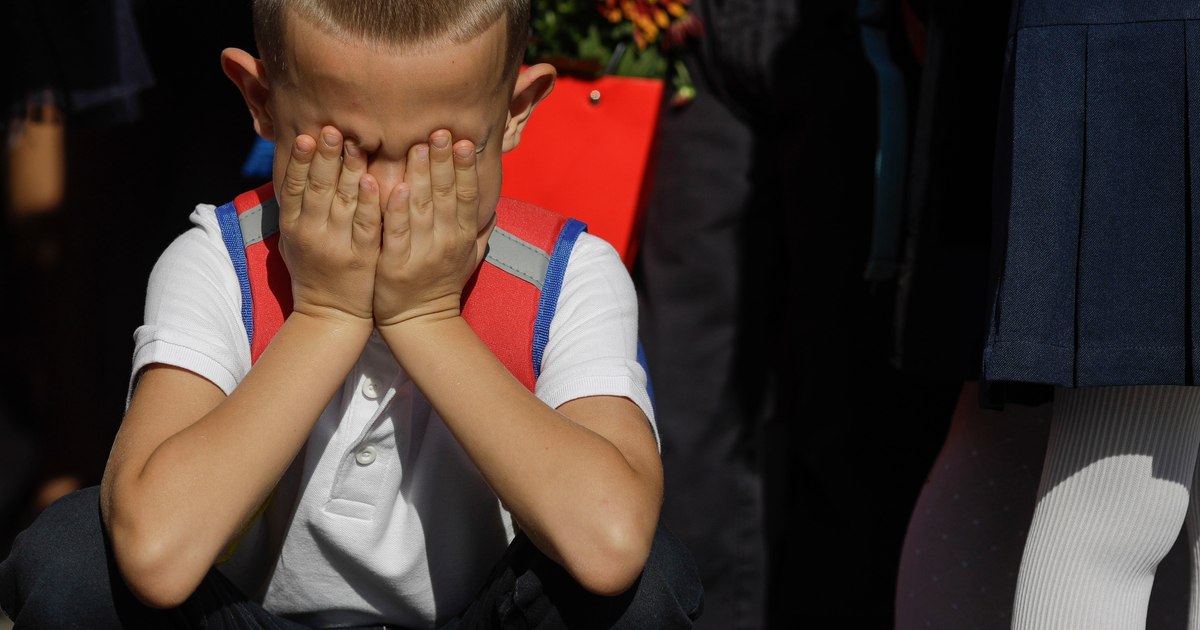
The prizes awarded at the end of the school year, depending on the average, are an integrated part of the Romanian education system. But in recent years, questions have begun to arise about their usefulness. Does the classification help at all? Does it motivate students to learn more or, on the contrary, demoralize them? And, very importantly, should students be in competition with others or themselves? Students and teachers say how they see things.
PHOTO Inquam Photos/Octav Ganea
“The impact of student classification is more negative than motivating”
“From what I have observed, the classification of students can have very different effects, and in many situations the impact is negative rather than motivating. Although some teachers believe that low grades or pressure from the hierarchy will make students ambitious to mobilize, the reality is that often the exact opposite happens. Students who feel that they are graded unfairly or that they are constantly placed at the bottom of the ranking end up giving up the effort, this is their response to the assessment made by the teacher. Frustration appears and the feeling that it doesn’t matter what I do anyway, and it doesn’t lead to the initially anticipated results”, ssays Bogdan-Lucian Gogan, vice-president of the National Council of Students.
However, he believes that awarding students also has advantages:
“The good thing is that, in theory, it recognizes effort and provides a framework through which students can be publicly rewarded for results and show that their academic effort is valued.”
But, the student believes, the same system often treats different performances the same:
“Especially when we talk about the national Olympians, the financial reward and the visibility they receive are far below the level of the work done. It is extremely difficult to reach the national stage and get an award, regardless of discipline, and yet the treatment does not reflect the sacrifice and the real value of the performance.”

Bogdan-Lucian Gogan, vice-president of the National Council of Students
Comparisons with others are also a constant of Romanian education, which often extends at home, when parents often want to know the grades of their colleagues. Competition with self or others? The Vice President of the National Student Council says:
“Students should not be constantly pushed to compare themselves with others to evaluate their academic performance. This model creates more pressure than real progress. Instead of permanent competition among students, I believe permanent collaboration should be encouraged, especially among students who perform differently in various subjects. Each can learn from the other, and mutual support leads to better outcomes for everyone in the long run. When they feel the need to make comparisons, students should refer strictly to themselves and not to those around them. It is not fair to put at the same starting line two students who come from completely different backgrounds, with different learning rates, problems and resources. Everyday life greatly influences academic performance, and this explains why some people can progress faster while others have a more difficult learning process.”
Teacher: “These are no longer the days of Spartan systems”
Professor Doru Căstăian believes that the two forms of competition are not mutually exclusive.
“In fact, any form of competition with others involves a form of competition with oneself. Not necessarily and the other way around… I think it’s an illusion to think that we can create, at least in Romania or in the near future, an educational system that excludes any form of competition with others, and I don’t think it’s very advisable either (we should evaluate this model to find out)”says the professor of Social and Human Sciences.
He believes that it is not the competition itself that is the problem, but the weight of it. An ultra-competitive system is not only not to the advantage of all students, but also not in the logic of the times, according to the teacher:
“The weight of the forms of competition is closely related to what you propose in your education system. If you propose an inclusive system, in which the fundamental aim is that everyone (as far as possible) acquires a quality education and to some satisfactory standard, I think that fierce life-and-death competition should have an absolutely marginal place. It should probably be limited to cases of gifted students and extraordinary abilities. If, on the other hand, you propose a very competitive system that gives only spikes, then you will certainly have a greater amount of that type of competition. Personally, I don’t think it’s part of the educational logic of the times we live in to have such spartan and ultra-competitive systems”.

Doru Căstaian, professor of Social and Human Sciences
In addition, he says:
“When you have competition in an education system (of any kind, but especially competition with others) you should also have clear conditions in which it can take place. You should have comparable starting conditions and you should have criteria that are beyond equivocation and different interpretations when judging. Or this is far from being the case in Romania. Because here, very often, school performance is based on grades or evaluations that are deeply subjective, or are relational, or take into account factors that do not directly concern school performance”.
Education specialist: The festive moment is not an encouragement, on the contrary
Regarding the awards ceremony at the end of the year, Education specialist Gabi Bartic says:
“I think that, in its current form, the end-of-year award fails to reflect the real work and progress of the children. It rewards, more often than not, those who already start with advantages – support at home, resources, time, meditations – and leaves in the shadows the immense effort of others who are taking real but invisible steps. For many children, the festive moment is not encouragement, but a public confirmation of the fact that they are “not there”. And that doesn’t help learning. I believe in a gentler, broader and more progress-oriented, not podium-oriented, recognition system.”
According to Gabi Bartic, the classification, as a rule, only targets one category of students: those who are already in the “top” comfort zone.
“For children with difficulties, it’s more like a label that stays on them all year. It’s hard to be motivated to grow when you’ve been told since summer that <
What really works is evaluating your own progress: where you started, how far you’ve progressed, what you’ve learned and what’s helped you. That’s where the motivation comes in. When you see that you can outgrow the child you were a few months ago – not the bank colleague – that’s where the real growth begins.” say this

Gabi Bartic, education expert
Gabi Bartic also gives the example of some European countries where such evaluations, related to their own progress, work:
,,Finland and the Netherlands use detailed assessment reports with descriptive feedback based on objective assessment, personalized goals and recommendations for the following year. Assessment is not a verdict – it’s an honest discussion about where the child is and what support they need to grow.
And the British system has an interesting model: emphasis on clear criteria, marks related to learning objectives, continuous assessment, plus a culture of constant feedback, sometimes annoying if we look at it from a system like ours where feedback is almost non-existent. Teachers convey to parents not just a grade, but a coherent and nuanced picture of the child’s progress. There, too, there is no “class winner”, but the student who reaches or exceeds his own targets”.
Is Romania ready to give up the award festivities?
The answer is no, says Bogdan-Lucian Gogan, the vice-president of the National Council of Students, but their form can be modified:
“I believe that Romania is not yet ready to completely give up awards and festivities. Even if they do not always perfectly reflect reality or the actual level of performance, for a large part of students they remain an important motivation factor. Instead of eliminating these moments, I think the solution is a reform of the way they are organized and thought about.
The award should be adapted so that it is fairer, more relevant and more connected to the real effort put in by the students. If the festivities were designed in a way that valued progress, diversity of performance and different needs of students, then they would succeed in not only motivating but also supporting healthy academic development. We must not eliminate them, but transform them so that they are truly useful and maintain the desire to learn and grow.”
To the same question, Gabi Bartic answers:
“I think Romania will be ready for this when we offer families and teachers another – better – way to honor children’s work. It is not about cutting the prizes and closing the festivities. (…) We can replace the podium with real discussions about progress, with well-done learning reports, with empathic feedback, with recognition of effort. Children actually need to be seen, not classified.
Yes, we can ditch traditional awards – but only if we put in place a culture of appreciation that includes everyone, not just a few. And I think we are starting on this road, slowly but surely. Maybe very slowly.”
