
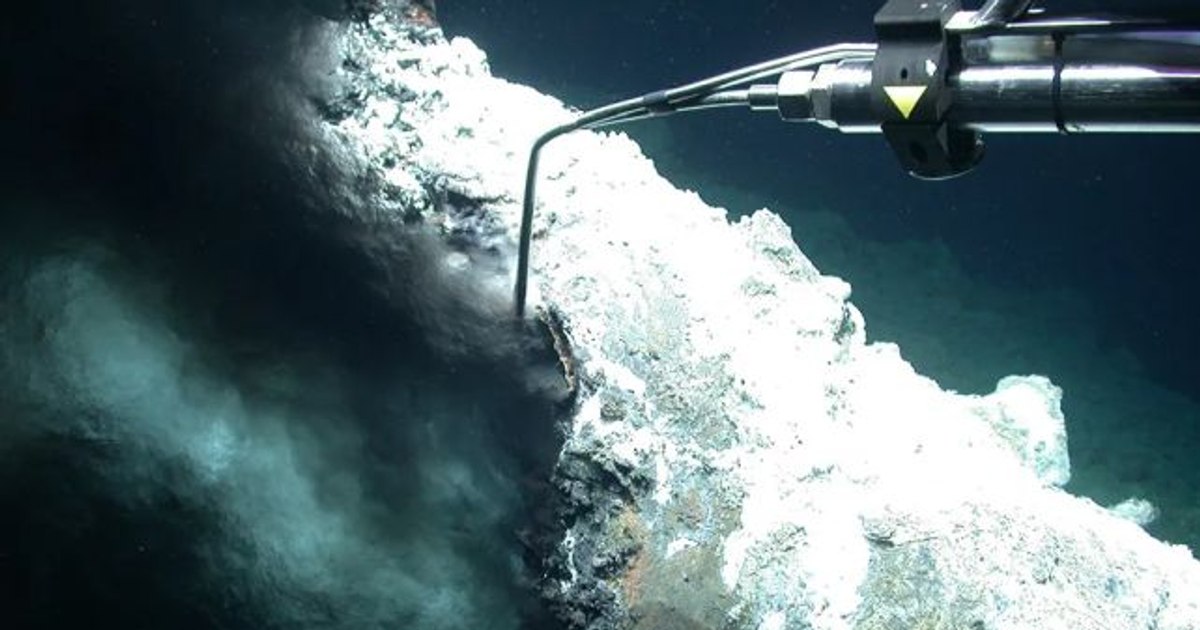
The frozen depths of the Arctic Ocean hide a wonderful world, recently discovered by researchers. Off the coast of Norway’s Svalbard island, more than 3,000 meters below the waves, stretches a field of hydrothermal vents the length of Knipovich Ridge.
The Jøtul field releases minerals into the water. PHOTO MARUM – Center for Marine Environmental Sciences
This underwater mountain range was previously considered featureless. Unlike their surroundings, these hydrothermal vents, called “Jøtul” after the giants of Norse mythology, are a spectacular discovery. Here, volcanic activity heats ocean water through cracks in the earth’s crust, triggering chemical reactions that give rise to rich ecosystems, according to sciencealert.com
“Water penetrates into The bottom of the ocean where it is heated by magma. The superheated water then rises back up to the sea floor through cracks and fissures“, explains marine geologist Gerhard Bohrmann from the University of Bremen, Germany.
The world of the depths is permanently shrouded in darkness and under enormous pressure. Sunlight does not reach here, and photosynthesis, the vital process for most life on the surface, is impossible. But hydrothermal vents provide the necessary energy through chemosynthesis.
The discovery of the Jøtul field is a missing piece in the puzzle of hydrothermal activity in the Norwegian-Greenland Sea. In 2022, a team of researchers explored the bottom of the sea with the help of a submersible robot – MARUM-QUEST, at a depth of 3 kilometers. There they came upon Jøtul, a vast expanse of active and inactive vents, emanating volcanic heat.
The Jøtul field is located right at the boundary between two of the Earth’s tectonic plates. This field gives us clues about how life might exist on other planets with completely different environments, experts say. It also helps us better understand ocean chemistry and the circulation of key elements such as carbon.
The discovery, published in the journal Scientific Reports, paves the way for future explorations of the Earth’s hidden depths.
