
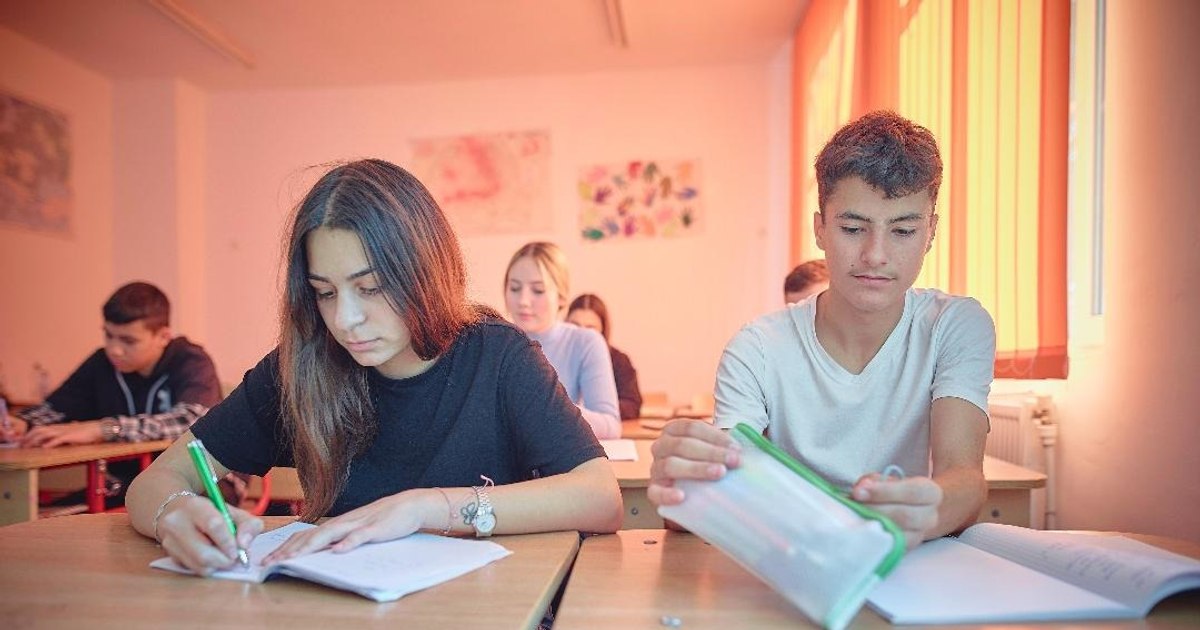
Disastrous results in the 2024 National Assessment exam! Almost half of the children in the village got grades between 1 and 4. Specifically, 42.5% of them failed to get the average 5.
Pupils from villages, poor results in the Evaluation. Photo source: World Vision Romania
National Assessment 2024. This year, 7 out of 10 students, exactly 74.4% of those enrolled in the National Assessment obtained averages above 5, compared to 76.2% last year, according to official data published by the Ministry of Education. In rural areas, 42.4% failed to obtain an average above 5. The results are the weakest in the last 4 years.
National Assessment 2024. Four out of ten children from the village did not achieve average 5
Also, an increase of more than 26% compared to the simulation is observed in the grades above 5 obtained by the students in mathematics. In contrast, the number of candidates with the highest averages dropped by more than 84%, only 65 secondary school graduates completed the exam with an average of 10, compared to 429 last year and 221 in 2022.
The urban-rural divide
“The National Assessment is considered the first major exam in a child’s life and is the first one with a high stake for the student. Given that, discursively, we position it as an assessment of the students’ knowledge and skills, accumulated or developed until the end of the class 8th, we should see proposed subjects that rely less on the reproduction of notions and more on creativity, on giving students opportunities to be themselves and to demonstrate that they are authentic and that they understand how to use the accumulated notions in the learning process. If we found options to digitize the evaluation process, we should focus our efforts to adapt the exam and the subjects to the reality of today, to the capabilities of young people, maybe, in this way, we would be able to have much better results. One reason for the fact that many children did not take average 5 is that no investment was made in recovering the losses accumulated in the 5th and 6th grades, respectively the losses accumulated due to the absence of school during the pandemic, as well as generated by the traditional system, based on memorization of concepts and less on logic or critical thinking. The National Assessment should be seen as a finality of secondary school studies, based on continuous learning and not as a trauma and a major stress for students, parents or even teachers through the pressure exerted. It is necessary to assume a plan with concrete measures and programs with learning actions, which address the needs of children, the needs of investment in education and the realities of a society in which the evaluation of what we are and how we think is done every day, not once every four or eight/nine years. And this happens, unfortunately, not because we have a set of values and principles, or knowledge in the development of which we invest, in order to then evaluate. But because it has to. But is that still the case?“, said Mihaela Nabăr, executive director of World Vision Romania.
16,000 students did not appear for the exams
According to the data published by the Ministry of Education, a number of approximately 16,000 students enrolled in the 8th grade either did not finish the grade or were not automatically enrolled by the schools in the National Assessment 2024. At the same time, this number is the highest in the last 5 years and represents approximately 10% of the total number of students enrolled at the beginning of the school year. More precisely, 15,866 students out of 176,266 students in the 8th grade either did not want to participate in the exams or remained repeat students. The situation is all the more worrying, given that the enrollment of students in this assessment is automatic and mandatory for schools, being done by the secretariat, for all 8th grade graduates.
The World Vision Romania Foundation has identified several causes why children from rural areas are far behind their peers, following the collection of information from the most vulnerable rural communities.
- 35% of teenagers say that they never or only sometimes have enough supplies and books for school;
- 24% of children are not helped by anyone with homework and only 8% have resources to call for additional support;
- 14% of parents of secondary school students say that they do nothing if their children do not do their homework;
- All subjects pose problems for adults who help their children with their homework, and the difficulties increase with the level of schooling, especially in mathematics;
- Only 67% of parents claim that teachers use attractive teaching methods;
- 47% of teenagers say they only sometimes or never like school;
- Almost a third of the teachers say that the proportion of students with learning losses is between a quarter and a half of the total class;
- 79% of kids say they commute to high school;
- 1 out of 3 children are involved in household chores since primary school, cleaning, taking care of animals or other household members;
The process of organizing national exams
The World Vision Romania Foundation draws attention to the way of organizing the end-of-year exams, considering the procedure made more difficult by the scanning of papers, the investigations carried out in several counties in the country that indicate certain suspicions of fraud, as well as the topics viralized in the online environment since the first time of the National Assessment. All this, in the context in which this is the first year in which the biggest exam in Romania was organized digitally, the students’ papers for the National Assessment being fully corrected through the digital platform.
At the same time, we remind you that a petition was launched in the public space requesting the Ministry of Education for more transparency in national exams and compliance with the education law:
Making it possible for student appeals to be made after viewing student work in digital format (the work being scanned). Thus, “blind” appeals are avoided.
When displaying the grades for the written tests of the National Assessment and the Baccalaureate, the grades awarded by the 2 or, as the case may be, 4 correctors, from which the average that generated the student’s grade, for each test, should appear. (assumes only the printing of a larger table).
What the teachers tell us
“From my point of view, I consider that the difficulty of the subjects was of an average level, considering the fact that they were mostly similar to last year. I did not encounter any problems when evaluating the works on the work platform, nor did I notice any major differences to the score between the two evaluators. The grades were varied – from 1.90 to 9.97. I think the bar should be raised a little in the formulation of the objective items. It is a national exam that evaluates the students’ skills after 4 years of secondary school. claims Nicoleta, a teacher evaluator.
How students feel about the exams, including the pressure
The National Assessment is the first major exam in a young person’s life, which can generate pressure or even anxiety for them. Exam pressure may be difficult for some students to manage, with them getting stuck in exam situations or even in the learning phase. In this case it is important that students have access to counseling to find ways to deal with stress.
“Psychological counseling sessions in the World Vision programs gave us multiple ‘lessons’ on how to manage our emotions during the exam and career guidance. It was very useful for me because I am an emotional person and because of this, at times, I get stuck. During the exam, when I felt pressure on myself, I tried to remember and follow the advice given in those sessions.”told us Denisa, beneficiary of the programs of the World Vision Romania foundation, which supported the National Evaluation this year.
Support for high school students from rural areas
Although education is free, the cost of supporting them in high school is very difficult for parents to cover, which causes children to drop out. Thus, 56% of students do not continue their studies after finishing the 8th grade because of their financial situation.
What are the solutions identified by the foundation to combat the phenomenon of school dropout and low student performance:
- access to mentoring programs and personal development and vocational guidance;
- additional support for the subjects for which the Baccalaureate and the National Assessment are supported;
- internship or volunteer opportunities;
- individual psychological counseling sessions
- summer camps where non-formal education activities are carried out
- financial support for total or partial cost coverage, as well as material and financial donations.
