

Spectacular images of the aurora borealis, seen including in the sky in Romania, recently reminded us of the power of the Sun to emit radiation. But, beyond these luminous phenomena, the Sun can also generate much more dangerous events.
Northern Lights in Bodo, Norway. Expedia photo
Called “solar particle events,” these intense bursts of protons are launched directly from the Sun’s surface and can hit Earth like cosmic lasers. Geological evidence indicates a frequency of about once per millennium for such extreme events. They can cause severe damage to the ozone layer and increase the level of ultraviolet (UV) radiation at the planet’s surface, according to sciencealert.com
A recent study looks at the impact of these events and has shown that during periods of a weakened Earth’s magnetic field, the effects on life on Earth could be dramatic.
Earth’s vital magnetic shield
Earth’s magnetic field acts like a protective shield for life, reflecting electrically charged solar radiation. Acting like a giant magnet, the magnetic field lines start at one pole, circle the planet, and return to the other pole, resembling a “turned grapefruit”.
The vertical orientation of the magnetic field at the poles allows some ionizing cosmic particles to enter the upper atmosphere, where they interact with gas molecules and create the glow we know as the aurora borealis.
But the magnetic field changes significantly over time. Over the past century, the north magnetic pole has migrated at a speed of about 40 kilometers per year across northern Canada, and the field strength has decreased by more than 6%.
Geological evidence indicates periods of hundreds or thousands of years when the Earth’s magnetic field was very weak or even absent.
To understand what would happen without the magnetic shield, we can look at Mars, which lost its global field in the distant past, losing much of its atmosphere as well.
After the aurora in May, Mars was hit by a powerful solar particle event that disrupted the operation of the Mars Odyssey spacecraft and increased the radiation level on the planet’s surface by about 30 times that of a chest X-ray.
The most recent period of weak magnetic field – including a temporary switch between the north and south poles – began 42,000 years ago and lasted about 1,000 years. Several major evolutionary events occurred during this period, such as the extinction of the last Neanderthals in Europe and the extinctions of Australian megafauna such as wombats and giant kangaroos,
The power of protons
The external atmosphere of the Sun constantly emits a flow of electrons and protons called “solar wind”, the cited source also shows. But the Sun’s surface also emits sporadic bursts of energy, particularly protons, through solar particle events – often associated with solar flares.
Protons are much heavier than electrons and carry more energy, so they can reach lower altitudes in the Earth’s atmosphere, exciting gas molecules in the air. These excited molecules only emit X-rays, invisible to the naked eye.
Hundreds of weak solar particle events occur every solar cycle (about 11 years), but scientists have discovered traces of much stronger solar events throughout Earth’s history. Some of the most extreme were thousands of times more powerful than any eruption recorded with modern instruments.
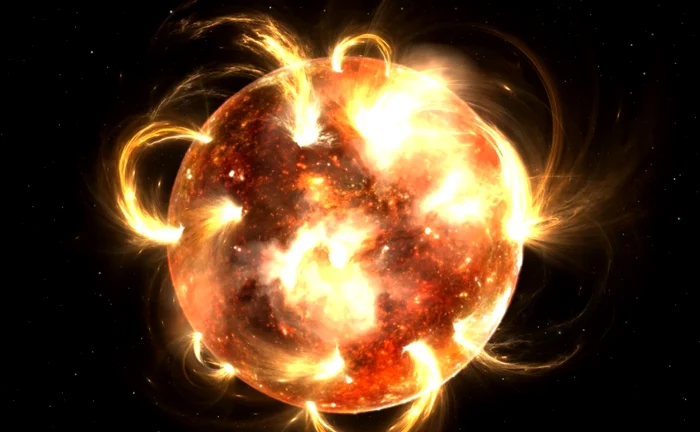
Solar storm PHOTO: Shutterstock
In addition to the immediate effect, solar particle events can trigger chemical reactions in the upper atmosphere that can lead to damage to the ozone layer. Ozone absorbs the Sun’s harmful UV radiation, which can damage vision and DNA (increasing the risk of skin cancer), also affecting the climate.
NASA believes it can warn us 30 minutes before a devastating solar storm hits Earth
This notice time is due to the fact that light can travel faster than the solar material ejected from the Sun in these solar storms. In some events, such as the one that occurred in Quebec about 35 years ago, they can cut off electricity for several hours, writes universetoday.com.
More extreme events such as Carrington, which occurred more than 150 years ago, can cause massive destruction of electrical and communications infrastructure if they occurred today.
Scientists have long been aware of this problem and have not sat idly by. At this point in our species’ exploration of the solar system, there are plenty of satellites looking at the Sun that can be used to spot these solar flares.
