
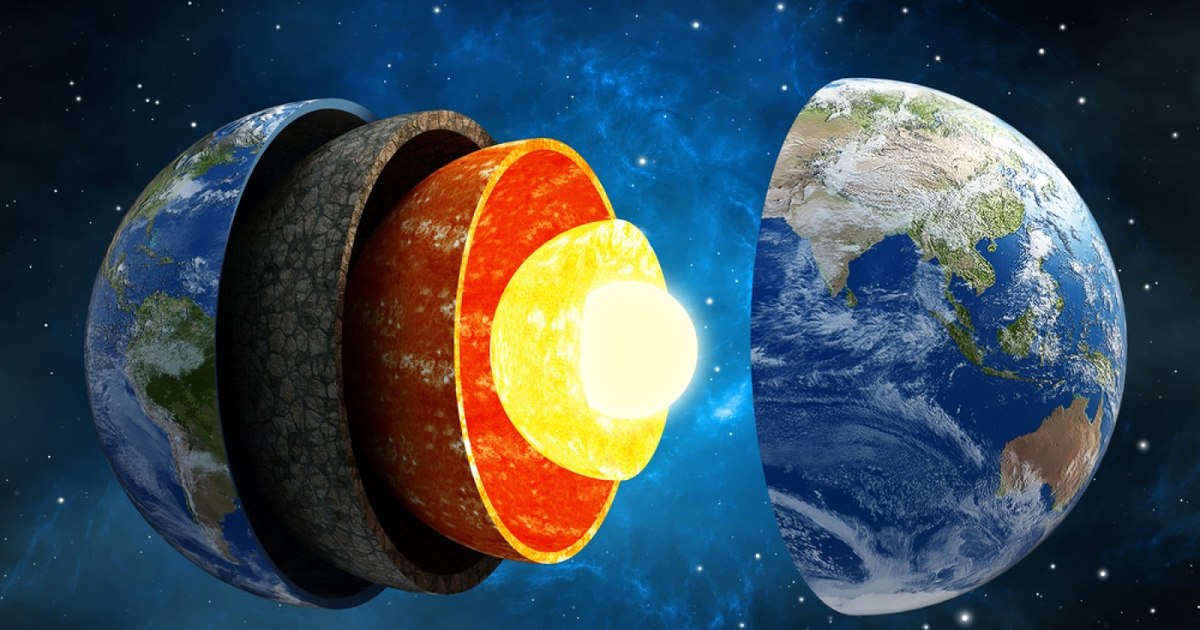
Deep inside the Earth is a solid metal ball that spins independently of our planet, like a spinning top inside a larger top shrouded in mystery.
Graphic representation of planet Earth PHOTO Shutterstock
This inner core has intrigued researchers since its discovery by Danish seismologist Inge Lehmann in 1936, and how it moves—the speed and direction of rotation—has been at the center of a decades-long debate.
A growing body of evidence suggests that the spin of the core has changed dramatically in recent years, but scientists remain divided over exactly what’s happening — and what it means, reports CNN Science.
Part of the problem is that Earth’s interior is impossible to observe or sample directly. Seismologists have obtained information about the movement of the inner core by examining how the waves from large earthquakes that strike this area behave.
Variations between waves of similar intensity that passed through the core at different times allowed scientists to measure changes in position of the inner core and calculate its rotation.
“Differential rotation of the inner core was proposed as a phenomenon in the 1970s and 1980s, but it was not until the 1990s that seismological evidence was published”said Dr. Lauren Waszek, senior lecturer in physical sciences at James Cook University in Australia.
But researchers have argued over how to interpret these findings, “primarily because of the challenge of making detailed observations of the inner core, because of its remoteness and the limited data availableWaszek said. As a result, “the studies that followed in the following years and decades disagree about the rate of rotation and also its direction relative to the mantle,” she added. Some analyzes have even proposed that the core does not rotate at all.
A promising model proposed in 2023 described an inner core that in the past rotated faster than the Earth itself, but now rotated more slowly. For a time, researchers reported that the rotation of the core coincided with that of the Earth. Then it slowed even more, until the core moved back against the layers of fluid around it.
At the time, some experts warned that more data were needed to support this conclusion, and now another team of scientists has provided compelling new evidence for this hypothesis regarding the rotation speed of the inner core. Research published June 12 in the journal Nature not only confirms the core’s slowing, but supports the 2023 proposal that this core’s deceleration is part of a decades-long pattern of slowing and speeding up.
The new findings also confirm that changes in rotation speed follow a 70-year cycle, said study co-author Dr. John Vidale, associate dean of earth sciences at the University of Southern California’s Dornsife College of Letters, Arts and Sciences. .
“We’ve been talking about this for 20 years and I think this hits the nail on the head“, Vidale said. “I think we’ve put an end to the debate about whether the inner core is moving and what its pattern has been over the past two decades.”
But not everyone is convinced the problem is solved, and how a slowing of the inner core might affect our planet is still an open question — although some experts say Earth’s magnetic field could come into play.
Magnetic attraction
Buried about 5,180 kilometers (3,220 miles) deep inside the Earth, the solid metallic inner core is surrounded by a liquid metallic outer core. The inner core is made up mainly of iron and nickel and is estimated to be as hot as the surface of the Sun – about 5,400 degrees Celsius (9,800 degrees Fahrenheit).
The Earth’s magnetic field pulls on this solid ball of hot metal, causing it to spin. At the same time, gravity and the fluid flow of the outer core and mantle drag the core. Over several decades, the push and pull of these forces cause variations in the core’s rotation speed, Vidale said.
The rocking of the metal-rich fluid in the outer core generates electrical currents that power Earth’s magnetic field, which shields our planet from deadly solar radiation. Although the inner core’s direct influence on the magnetic field is unknown, scientists previously reported in 2023 that a slower-rotating core could affect it and also fractionally shorten the length of a day.
When scientists try to “will give” the entire planet, they generally track two types of seismic waves: pressure waves, or P waves, and shear waves, or S waves. P waves pass through all types of matter; S waves only pass through highly viscous solids or liquids, according to the US Geological Survey.
Seismologists noticed in the 1880s that the S-waves generated by earthquakes did not travel all the way through the Earth, so they concluded that the Earth’s core was molten. But some P waves, after passing through the Earth’s core, appeared in unexpected places – a “shadow area”, as Lehmann called it – creating anomalies impossible to explain. Lehmann was the first to suggest that wandering P waves could interact with a solid inner core inside the liquid outer core, based on data from a massive earthquake in New Zealand in 1929.
By tracking seismic waves from earthquakes that have passed through the Earth’s inner core on similar trajectories since 1964, the authors of the 2023 study found that the rotation followed a 70-year cycle. Until the 1970s, the inner core was spinning slightly faster than the planet. It slowed down around 2008, and from 2008 to 2023 it started to move slightly in the opposite direction relative to the mantle.
The future core of the rotation
For the new study, Vidale and his co-authors observed seismic waves produced by earthquakes in the same locations at different times. They found 121 examples of such earthquakes produced between 1991 and 2023 in the South Sandwich Islands, an archipelago of volcanic islands in the Atlantic Ocean east of the southern tip of South America. The researchers also analyzed core-penetrating shock waves from Soviet nuclear tests conducted between 1971 and 1974.
When the core turns, Vidale said, this affects the arrival time of the wave. Comparing when the seismic signals hit the core revealed changes in the core’s rotation over time, confirming the 70-year rotation cycle. According to the researchers’ calculations, the core is about to start accelerating again.
Compared to other seismographic studies of the core that measure individual earthquakes as they pass through the core—regardless of when they occur—using only paired earthquakes reduces the amount of usable data, “making the method more difficult”, Waszek said. However, this method also allowed the scientists to measure changes in the core’s rotation with greater precision, according to Vidale. If his team’s model is correct, core rotation will begin to accelerate again in about five to 10 years.
Seismographs have also shown that during its 70-year cycle, the core’s rotation slows and speeds up at different rates, “which will require an explanation“, Vidale said. One possibility is that the metal inner core is not as solid as expected. If it warps as it rotates, that could affect the symmetry of its rotation speed, he said.
The team’s calculations also suggest that the core has different spin rates for forward and backward motion, which adds “an interesting contribution to the discourse”Waszek said.
But the depth and inaccessibility of the inner core means uncertainties remain, she added. As for whether or not the core rotation debate is truly over, “we need more data and improved interdisciplinary tools to investigate this furtherWaszek said.
