
The portrayal of Nicolae Ciucă as the “hero from Nasiriyah” in a documentary is, to say the least, romanticized, but we cannot say that he did not have a respectable military career, with stars obtained in theaters of war. His political career, however, is less respectable.
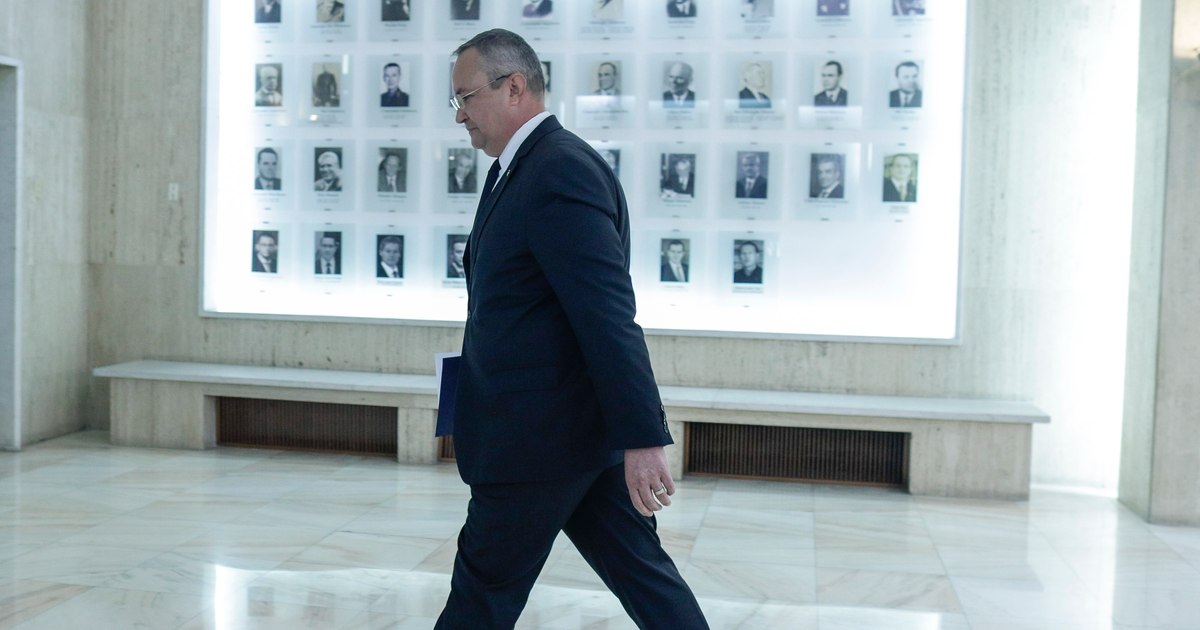
Nicolae Ciucă wants to go to Cotroceni. PHOTO: Inquam Photos/Octav Ganea
Nicolae Ciucă is running under the motto “A soldier in the service of the country”, the clever marketing artifice trying to transfer to the PNL presidential candidate as much of the 69% percentage of trust that Romanians have in the army, according to the latest Eurobarometer survey in April/May 2024.
If Nicolae Ciucă (57 years old) had an impeccable military career, after entering politics things changed.
Although in the report produced by Radio Romania Actualită, about the Battle of Nasiriyah, which the journalists of the national radio station say would be “the first battle of the Romanian troops after the Second World War”, the contribution of Nicolae Ciucă is romanticized. But the road from what happened to obtaining the title of “hero of Nasiriyah” is quite winding.
It is certain that Nicolae Ciucă is not the kind of military man who got his stars sitting at the office, but in the theaters of war.
The hero of Nasiriyah?
In fact, even from the report “Battle of Nasiriyah”, Iraq 2004, it does not appear that Ciucă was any great strategist in battle:
“There we were met with the first AG 7 hits. On a column of 10 armored personnel carriers, we had over 24 AG 7 hits. There was a rain of AG 7 hits. One of them hit half a meter in front the transporter I was in”the general told.
Being under enemy fire, the soldiers asked Ciucă: “It’s firing, what do we do?”. It did not take a genius of strategy to answer them what the general answered: “Fire! I ordered and everyone fired and we reacted exactly as we planned the mission.”
Ciucă graduated from the “Nicolae Bălcescu” Military School of Active Officers in Sibiu in 1988. He attended training courses in Romania and abroad, including command and staff courses at various prestigious military institutions.
He attended the Academy of Advanced Military Studies in Bucharest, where he studied to become a senior officer. This academy provides advanced education in military tactics and strategy.
Ciucă attended various staff courses, including those at the “George C. Marshall” European Center for Security Studies in Germany and the US Army Command and Staff College.
He attended courses and seminars organized by NATO, which gave him an international perspective and in-depth knowledge of multinational cooperation and operations.
After graduation, he started as a platoon commander and then a company commander in infantry units.
He was commander of the 26th Infantry Battalion “Neagoe Basarab” known as the “Red Scorpions”. In the period 2001-2004, under his command, the unit participated in international missions, including in Iraq and Afghanistan. He participated in the US-coordinated military mission – Enduring Freedom in Afghanistan (between 2002-2003) and in the NATO Ancient Babylon mission in Iraq (in 2004).
Ciucă graduated, in 2006, with a master’s degree in Strategic Studies at the US Army War College.
In 2014, he was appointed Chief of Staff of the Land Forces, holding this position until 2015. From this year until 2019, he was Chief of the General Staff of the Romanian Army, the highest military position in Romania. In this capacity, he contributed to the modernization and reorganization of the Romanian Army, as well as to the strengthening of international partnerships, especially with NATO
As Chief of the General Staff, he had a significant role within the North Atlantic Alliance, contributing to the planning and implementation of NATO policies and strategies in the region.
A soldier in politics
Although he promised not to do politics, Ciucă is now the PNL presidential candidate.
“I consider the honor and dignity of being the Chief of the Defense Staff so sacred that, regardless of what is proposed to me, I will not do anything else. Once you were the chief of the Defense Staff… It represents the greatest dignity for each of us. And I believe that this position should not be overshadowed in any way by the activity in another field. I will not do politics. I will do everything in my power and the future will allow me to support this institution. But not from a public position”, said Ciucă in June 2018 in an interview for Radio Romania Actualitătă.
Thus, after finishing his military career, Nicolae Ciucă entered politics and was appointed Minister of National Defense in the government led by Ludovic Orban, a position he held between 2019 and 2020. In this position, he continued efforts to modernize the Romanian Army and strengthen international relations, especially within NATO.
After the resignation of Ludovic Orban from the position of prime minister, Nicolae Ciucă was appointed interim prime minister, ensuring the continuity of government until the formation of a new government.
A budget holder with liberal economic views
In November 2021, Nicolae Ciucă was appointed by President Klaus Iohannis to form a new government. After negotiations, he managed to form a coalition government between the National Liberal Party (PNL), the Social Democratic Party (PSD) and the Hungarian Democratic Union of Romania (UDMR). He was inaugurated as Prime Minister on November 25, 2021.
As prime minister, Ciucă implemented measures for post-pandemic economic recovery, infrastructure modernization and strengthening the health and education system. He also continued to promote Romania’s international partnerships, especially within NATO and the European Union.
During his tenure, the government had to manage challenges related to the COVID-19 pandemic, including the vaccination campaign and support measures for the economy and population.
Under his leadership, the government promoted the controversial Anghel Saligny project, which allocated sums of money for local investments through simplified procedures. The project was criticized by the USR, but also by the PNL before entering the government, due to the numerous scandals and press investigations that proved that the works are carried out by the parties’ house companies at overvalued prices.
On June 12, 2023, according to the protocol with the PSD, he resigned as prime minister, which was taken over by the social democrat Marcel Ciolacu. Ciucă became president of the Romanian Senate on June 13, 2023.
Nicolae Ciucă is pro-American, Europeanist and Atlanticist.
Although he was a budget officer throughout his professional career, Ciucă follows, at least declaratively, the party’s line regarding the economy – having right-wing liberal views.
Also in line with the party, he is a follower of social conservatism, which fits his military profile much better than economic liberalism.
In October 2020, he joined the PNL to run as a senator in the Romanian Senate in the legislative elections of that year, in which he was elected.
Ciucă quickly became the president of the party and its candidate in the presidential elections.
The plagiarism scandal
The reason why it was proposed to bring a military man to the head of the Government and the reason why the PNL presents him as an effective leadership option, although it seems anachronistic in 2024 to put a general at the helm of some civilian leadership institutions, is the need for stability. The initial problem was the pandemic, then came the war in Ukraine.
So great was this need for stability that concepts such as institutional transparency, university ethics and even press freedom were trampled upon.
The scandal regarding the plagiarism of his doctoral thesis was “extinguished” in court. The publication PressOne discovered in his doctoral thesis several pages of his work that were copied word for word from other works without the texts being correctly attributed to the original authors, also lacking the necessary quotation marks, according to academic norms. Title of the paper: The dimension of the engagement of the Romanian army in multinational joint operations.
At least 42 of the 138 pages of the doctoral thesis were plagiarized and 94.2% of the plagiarized content in Prime Minister Nicolae Ciucă’s thesis comes from non-digitized works, which could not be detected using anti-plagiarism software – was the conclusion of journalist Emilia Sercan.
The general responded that the allegations “cannot be scientifically proven” but sought and won in court to suspend the National Defense University Ethics Commission’s review of the paper.
Following her investigation, the journalist was subjected to a compromise action and was targeted by three actions of threat, defamation and intimidation.
“I’m not a very good speaker”
Nicolae Ciucă was born on February 7, 1967, in the town of Plenița, Dolj county, Romania. He grew up in a family from a rural community, in Plenița, a village in Dolj county. Nicolae Ciucă is married to Cristina Ciucă. The couple has a son, named Tudor Ciucă. He followed an education and a military career. He is a doctor in medical sciences, he was prime minister, he is the president of the PNL and the candidate of the liberals for the presidency.
Although he is respected for his military career, there have been times when he has been criticized for certain statements or actions considered blunders.
“I’m not a very good speaker. I’m not very good at giving speeches. Ten years ago, I decided not to take any public communication courses, because at that time I thought I would never be a politician. I still keep that decision” – said Ciucă upon assuming the mandate of prime minister.
On several occasions, Nicolae Ciucă was caught making confusions or mistakes during official speeches, whether it was about historical data or technical aspects related to government policies.
“Beyond the clumsy to banal form of Prime Minister N. Ciucă’s words, the content of his statements worries me due to the lack of substance when he answers difficult questions. Then, Mr. Ciucă complicates his syntax, sometimes losing the grip of the concepts in the sentence, stumbling in his own arguments, a typical error of those who do not master the field in which they embarked”the Romanian linguist Alexandru Cohal characterizes Mr. Ciucă’s speech, in an analysis carried out by the quoted source.
On the other hand, the current president Klaus Iohannis is not known for his qualities as a great orator either. Sometimes voters can appreciate a politician who operates in the “shut up and do it” paradigm. Certainly, however, the comparison with former Prime Minister Viorica Dăncilă does him no justice. We will see what happens in the elections.
