
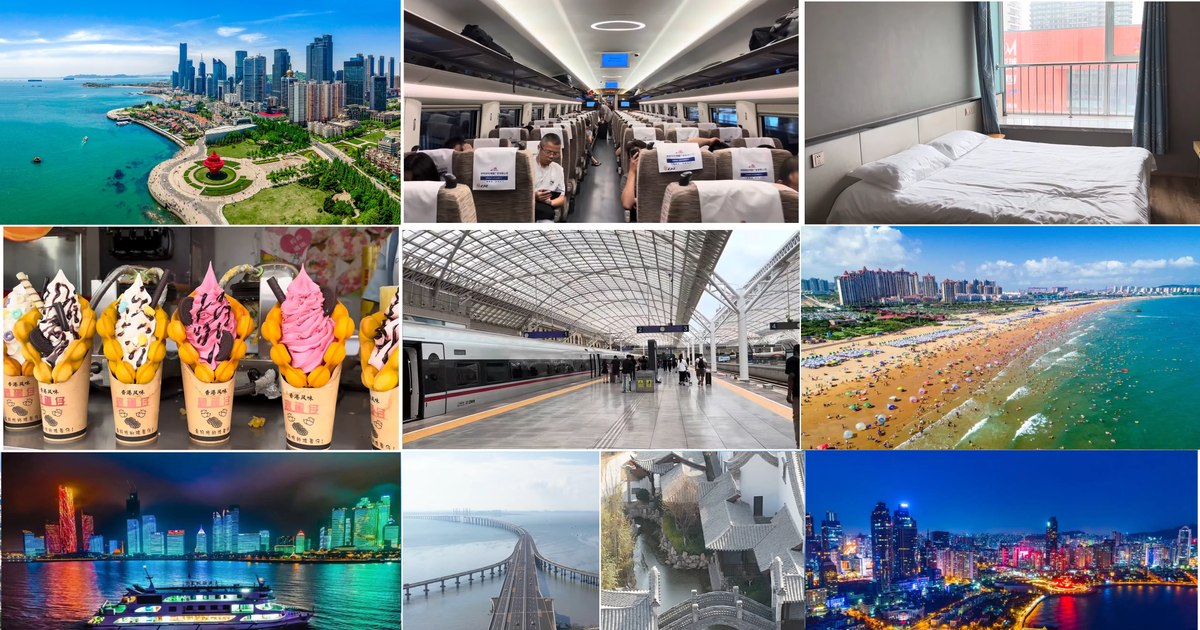
Appreciated by foreign investors, the tourist destination where overnight accommodation per person, in extremely decent conditions, costs less than 10 euros, was revealed by a Romanian woman who went to study abroad.
The coast with an incredible price for accommodation is not the Black Sea, in Romania, but the Yellow Sea, in China.
“Approximately 1,000 lei cost me the first stay (4 nights/5 days) spent at the sea, this year. Does it seem unreal? In Romania, yes! In China, no!”Kara, a Romanian student who went abroad to study, testified on a social media group intended for those who organize their vacations on their own.
The young woman posted photo and video content, both on Facebook and on her YouTube account (in English), about her experience at the seaside “Celestial Empire” – one of the names under which China is still known – mentioning at the same time how much a vacation at the sea, far from home, cost.
Qingdao port city in Shandong Peninsula China Collage Kara and Qingadao City FB
Unbeatable prices on the Yellow Sea coast
“There in the city Qingdao, located on the Yellow Sea, we had the first swim of the summer. A small gift that I allowed myself at the end of the year of studies at «Beijing Language and Culture University», before arriving on vacation, at home, in Bucharest. The most I paid for the train (round trip), Beijing-Qingdao (659 km – n.ed.), about 430 lei, because everything else was cheap. 35 lei per person/night in a double room in a residential complex, 40 lei/person, on average, a meal at a restaurant, not to mention street food prices,” shared Kara, the Romanian student from China, about her first summer vacation experience as a tourist.
In the video on YouTube, Kara revealed all the details of her vacation: from the train she took from Beijing, to the accommodation in Qingdao, in a decent room with a double bed, kitchenette and bathroom, for which two people paid 14 euros /night, from a central area of the city to street food – prices and places – but also what it looks like “Green Island” as the settlement is also called, as well as the interior of a mall, which can be entered directly from a subway station.
For example, for a huge ice cream in a bubble waffle / waffle he paid less than 4.5 euros (22.5 lei), for a dessert with seeds less than 2 euros (about 10 lei), two soft drinks with milk and mango, on sale, cost her 1.27 euros (less than 6.5 lei), and for a portion of sushi – 3.29 euros (approximately 16.5 lei).
How Qingdao went from a fishing village to the “Tourism and Culture Capital”
Qingdao, a coastal city in East China’s Shandong Province, was designated “Tourist and cultural capital” for 2024 – 2025, by the Shanghai Cooperation Organization (SCO).
Renowned as a crucial port on the 21st century Maritime Silk Road, this year the city is expected to attract a wave of international tourists eager to explore the city’s rich history, natural beauty, local delicacies and especially its world-renowned beer. world.
According to a forecast report by online travel agency Trip, Qingdao ranks seventh among the most popular summer tourist destinations in China. Ticket demand for Qingdao attractions has increased by 67% this year compared to 2023, and for travel by 52%.
Located on the southern coast of the Shandong Peninsula, at the eastern entrance to Jiaozhou (Kiaochow) Bay, the city is considered one of China’s best natural harbors.
Formerly a fishing village several centuries ago, the settlement began to develop only in the 19th century, mainly after the German Government granted a 99-year concession of the bay and surrounding territory, along with railway and mining rights. However, it was declared a free port in 1899, on which occasion a series of modern port facilities appeared, and the first railway to the outside was built in 1904. Then a modern European-style city began to be built, and this explains the architecture European that has been preserved to this day in the port city of China.
When Japan declared war on Germany in 1914, its main objective was to capture the port, which it did. In 1922, however, it was returned to China, but the Japanese had managed to build a strong position in the area. From ’38 to ’45 it was again under Japanese occupation, during which time the industry reached unsuspected heights, a fact that continued afterwards.
Today, the city with more than 9 million inhabitants is known for its parks and beaches, having been declared since 1984 one of the “open cities” of China for foreign investment. Since then, a new stage of its flowering has begun.
For example, in Qingdao there is a road, with a total length of 42 km, which is one of the longest bridges above water in the world, which crosses the bay. A submarine tunnel, 9.5 km long, crosses the mouth of the bay. Both structures were opened in 2011, making Qingdao one of the tourist destinations that has many opportunities to offer its visitors.
