
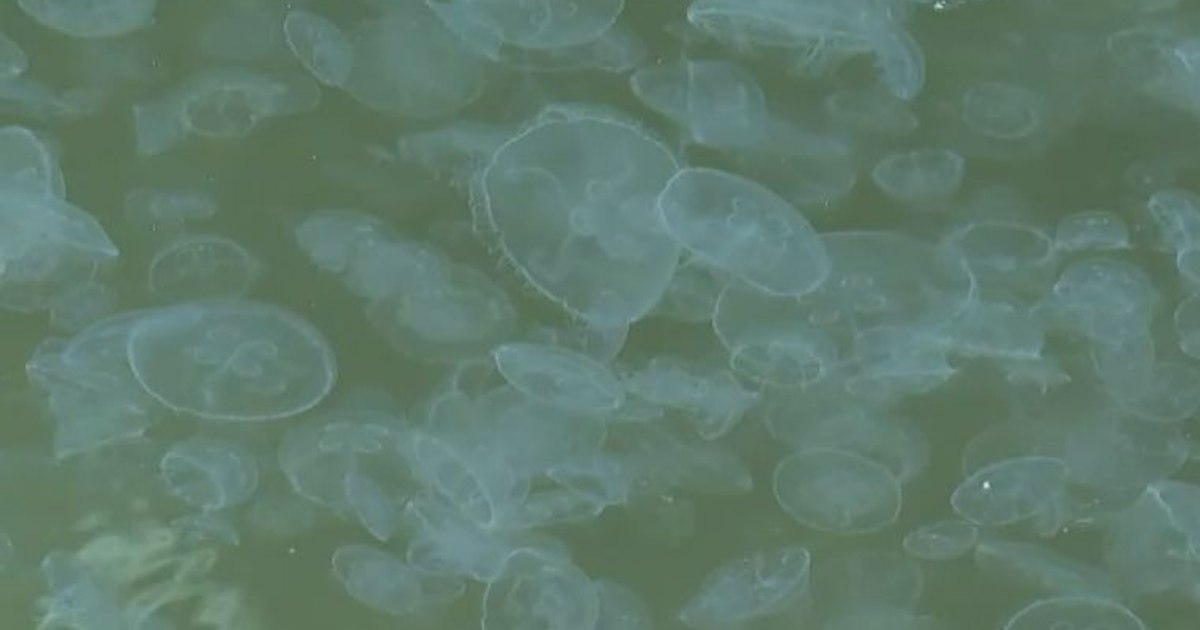
Every summer, there are fears about the invasion of jellyfish in the Black Sea, but experts say that the phenomenon is a natural one, which can vary from one year to the next. Although some species can cause irritation, most jellyfish in the Black Sea are not dangerous to humans.
Invasion of jellyfish in the Black Sea. PHOTO captured by StirileProtv
By following a few precautions, you can safely enjoy your beach vacation.
Jellyfish are seen on the shore from a few hours to a few days and are brought by the climatic conditions, the increase in temperature and other factors, notes the CNA agency, quoted by Agerpres.
The zooplankton-eating carnivorous jellyfish species Mnemiopsis leydi was first identified in the Black Sea in the early 1980s. This species is highly adaptable, establishing large populations, and has a particular impact on feeding fish species with zooplankton, with which they compete for food, according to the BTA agency, quoted by Agerpres.
Scientists have identified 26 invasive species in the Black Sea
According to the latest scientific data, 26 invasive species have been identified in the Black Sea. Nine of them are crustaceans and the rest are part of the zoobenthos, said Prof. Valentina Todorova from the Institute of Oceanology within the Bulgarian Academy of Sciences, who together with Prof. Assoc. Kremena Stefanova presented a report on the state of the marine ecosystem along the Bulgarian coast.
Invasive species can represent a risk for biodiversity, Todorova also claimed. She recalled that the estimates of their presence in the marine habitat over the years vary between 41 and 293 species. However, according to the latest data, the number of invasive marine species in the Bulgarian Black Sea coastal area is 26.
According to the National Marine Research and Development Institute “Grigore Antipa” in Constanța, jellyfish of the species Rhizostoma pulmo begin to appear in abundance in the shallow area of the Romanian coast at the end of summer (August – September), because it is the period of their maximum density. Their presence in these areas is due to the existence of abundant food.
“These jellyfish are not dangerous for humans, only in the case of sensitive people, by contact with the skin, irritations may occur, which disappear in a short time”, say the researchers from the National Marine Research and Development Institute “Grigore Antipa” from Constanța, quoted by Antena 3.
Jellyfish are relaxed, but at the slightest touch from a foreign body they suddenly contract and attack. Biologists argue that their venom is not strong enough to endanger human life.
If certain species of jellyfish come into contact with human skin, they can cause irritation, which varies in intensity from one person to another.
Specialists say that after every storm the jellyfish appear in the shallow waters near the shore, brought by the strong waves.
Many beaches in Europe, including Greece and Romania, have been overrun in recent years by purple jellyfish, whose toxic sting can cause severe reactions.
The purple jellyfish has one of the most venomous stings, which, depending on the sensitivity of each person, can cause from moderate allergic reactions to severe symptoms. We must not touch them even when they are dead.
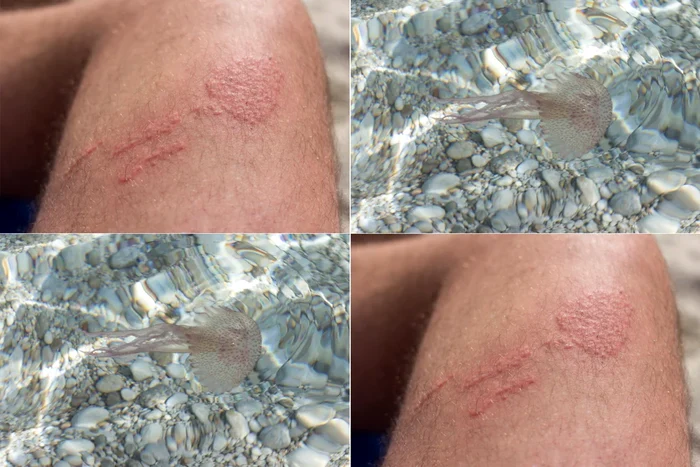
The purple jellyfish is a small species (the mushroom has an average diameter of 6-8 centimeters, but they can also reach larger sizes), but the tentacles can reach a length of two meters, and this makes them even more dangerous, because they can sting from a distance. The tentacles and body are covered with nematocysts (poisonous vesicular cells which are released when the tentacles touch another organism and which quickly enter the bloodstream of the stung organism).
What to do if you get stung by a purple jellyfish
Until the doctors arrive, here are the first aid measures that can be taken, according to Medsana:
- Remove the person from the water immediately.
- Remove the jellyfish or debris from the gelatinous body using a glove.
- Wash the affected area with sea water without rubbing.
- If you can, apply a bicarbonate solution (a mixture of 50% baking soda and 50% seawater) for a few minutes to neutralize the action of the needles (nematocysts), if there are still tentacles attached to the skin.
- Use a plastic card, such as a credit card, and scrape the area affected by the sting.
- Apply cold compresses or ice (do not apply directly to the skin, protect with a towel) for 5-15 minutes. Reapply if pain persists.
- Apply lidocaine or cortisone lotions to reduce itching, pain, and discomfort.
- In case of eye stings, use a saline solution, special for cleaning, and see a doctor immediately!
- Do not wash with plain or tap water! Do not use vinegar or alcohol!
- Watch for any extreme symptoms or signs of shock and seek medical attention.
