
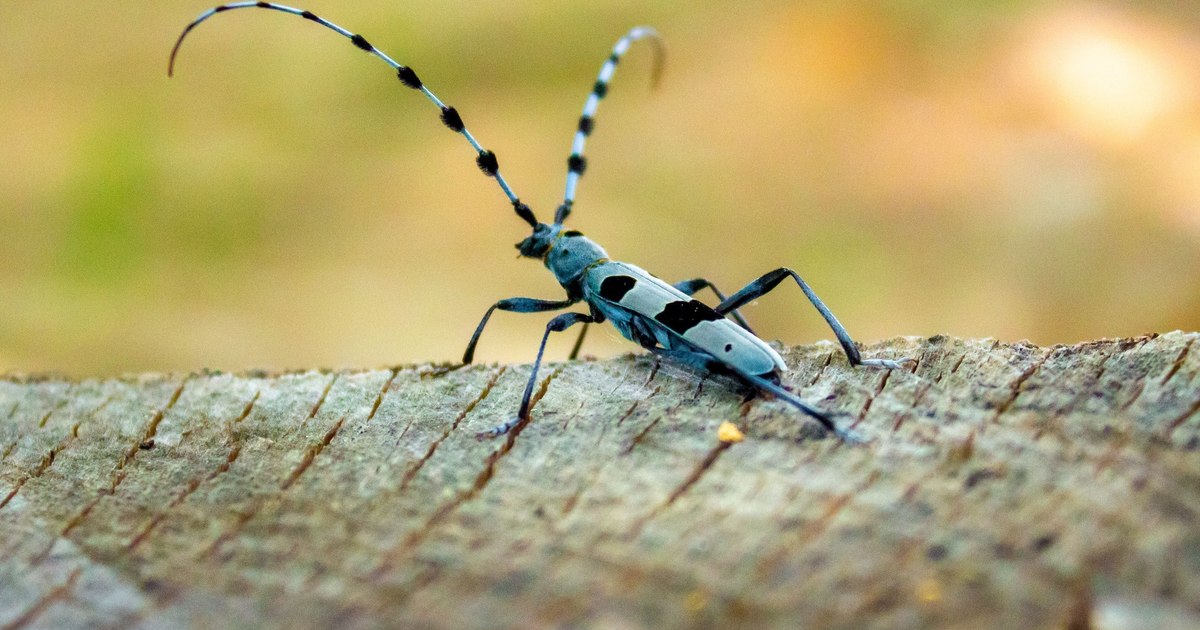
Covered for the most part by forest, the wild land of Grădiștea Muncelului Cioclovina Natural Park offers its guests numerous reasons for delight. one of the most “photogenic” insects lives here, but tourists are not allowed to touch it.
The Alpine Tailor. Photo: Grădiștea Muncelului Cioclovina Natural Park.
A “photogenic” insect arouses the curiosity of hiking enthusiasts on the mountain trails of Grădiștea Muncelului Cioclovina Natural Park, in Hunedoara. It can be admired in the beech forests, especially during the summer.
“It lives predominantly in cold and humid beech forests in the highlands, where the species can be locally common. It is also rarely found in mixed forests or in quercine and beech forests. Most likely, you have noticed it in our forests and know it: Rosalia alpina – the alpine tailor. Being present in the Gradistea Muncelului-Cioclovina Natural Park, our colleagues have met some very photogenic specimens recently”, informed the administration of Grădiștea Muncelului Cioclovina Natural Park, which published some photos of the alpine tailor on the reserve’s Facebook page.
The unmistakable species from the forests of the reserve
Relatively large insect, 15-38 millimeters long, with an elongated body, gray-blue in color, with black spots on the elytra and long antennae, which can exceed the length of the body (reaching 50-55 millimeters), the alpine tailor (beech tailor ) is an unmistakable species. Adults can be found from June to September. They are active on sunny days, but can also appear at dusk, reserve representatives say.
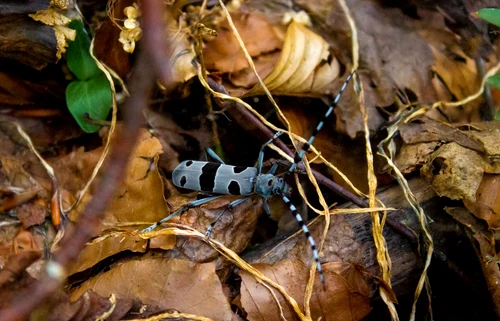
Image 1/7:
Rosalia Alpina Photo Grădiștea Muncelului Natural Park Cioclovina (7) jpg
Alpine tailor prefers old, dry, sun-exposed forests. We can observe them on trees or piles of recently cut logs, as well as on inflorescences, especially umbelliferae, where they feed on pollen. The life cycle lasts 2-3 years, with the female laying her eggs in the spring in the bark of trees. Larvae develop in dead wood or old live trees. It prefers beech, but also grows in willow, hornbeam, oak, hornbeam, even apple.
The species is widespread in Central and Southern Europe, east to the Caucasus Mountains, as well as in Turkey. In Romania, the alpine tailor is present in the low alpine area, in the beech and mixed forests and sporadically in the hilly, continental area.
“The beech tailor is a species protected by the Habitats Directive (priority species, listed in Annexes II and IV) and by Emergency Ordinance no. 57/2007 regarding the regime of natural protected areas, conservation of natural habitats, flora and fauna. It is considered to have a favorable conservation status in Romania (period 2013-2018), but this is due to the overestimation of the area that can be occupied by this species”informs the Life Rosalia project, which aims to stop and reverse the trend of habitat loss of saproxylic coleoptera species with an area in the Carpathians.
The reserve in the Șureanu Mountains
Grădiştea Muncelului Cioclovina Natural Park was established in 1979, and since 2000 it has been declared a protected area of national interest. It is located in the Şureanu Mountains, with the subdivisions of the Orăştiei Mountains and the Sebeşului Mountains, being bordered by the depressions of Haţeg and Orăştiei.
The Grădiştea Muncelului Cioclovina Natural Park is spread over more than 38,000 hectares, in the Şureanu Mountains, and only a few thousand people live within the limits of the protected area. It includes the Dacian fortresses in the Orăştiei Mountains, places like Fundătura Ponorului and several impressive caves, the most famous of which is the Cioclovina Cave.
The park occupies the administrative territory of the communes of Pui, Orăştiora de Sus and Boşorod, and the few villages within its range are scattered on the mountain, or lined up along the valleys of streams. All the settlements are surrounded by the forest that occupies more than 70 percent of the surface of the natural park.
The karst relief in the Șureanu Mountains favored the appearance of spectacular places, such as the numerous waterfalls and gorges, but also dozens of caves, sinkholes, sinkholes and sinkholes shaped by mountain waters and underground springs. However, the forests remained the great natural wealth of the land in the Șureanu Mountains,
They have a rich fauna, and in their vicinity, several “grove villages”, each inhabited by a few families engaged in shepherding, settlements surrounded by forests and vast pastures, occupy the crests of hills and mountain plateaus that stretch over thousands of hectares , at altitudes of about 1,000 meters.
Tourists can reach the park’s trails from Costeşti, Măgureni, Boşorod, Pui, Ponor, Baru, Crivadia and from the Streiului and Băniţei valleys. Those planning longer trips to the park are advised to equip themselves with maps, compasses or GPS, suitable hiking shoes, first aid kits, flashlights and utility bags. Also, they must take weather warnings into account.
