
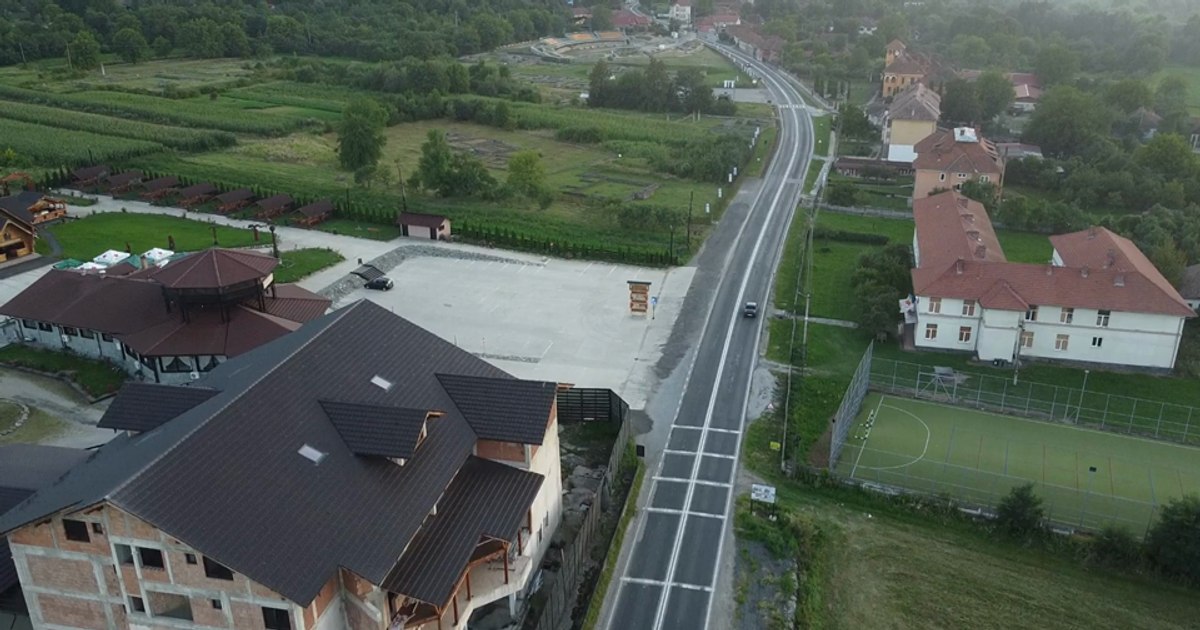
Two years have passed since the beginning of the restoration of the ancient amphitheater in Ulpia Traiana Sarmizegetusa (video). The work has come to an end, and this fall, the monument will be reopened to the public, which it will receive with a completely changed appearance.
The amphitheater in Ulpia Traiana Sarmizegetusa. Photo: Daniel Guță THE TRUTH
The new metal tribunes with wooden benches and the round stage in the middle of the amphitheatre, recently arranged, give the ancient monument of the former Roman colony a fancy look.
The ancient civil settlement of Ulpia Traiana Sarmizegetusa was recently included in the UNESCO world cultural heritage, which includes the Roman border sites (Limesul) of the province of Dacia.
Those who visit Hunedoara county will have, starting this fall, another reason to head to Ulpia Traiana Sarmizegetusa. The most important monument of the former city of Roman Dacia will be reopened to tourists.
The amphitheater in Ulpia Traiana Sarmizegetusa, equipped with metal stands
The ancient amphitheater of Ulpia Traiana Sarmizegetusa Regia has been in the construction site since the summer of 2022. Since then, the monument has been closed to the public, during the restoration works, estimated at 17 million lei.
They were supposed to be completed by December 2023, but the investment financed by European funds started late, so it was “phased”, and the works not completed last year could be continued in 2024, also with European funding, through the Western Regional Program 2021 -2027.
The investment must be completed by the end of 2024, but representatives of the Hunedoara County Council, the institution that launched the restoration project, claim that the Roman amphitheater could be reopened to the public sooner.
“The works are at the end, and they will probably be finished in September“, says Costel Avram, the public administrator of Hunedoara county.
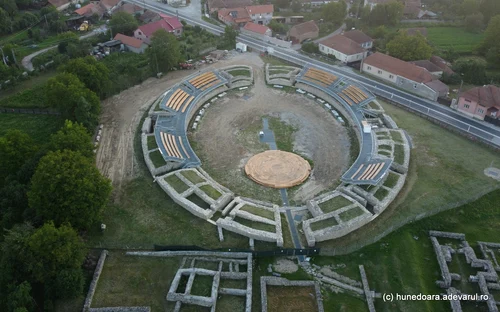
Image 1/16:
Ulpia Traiana Sarmizegetusa Photo Daniel Guță THE TRUTH (11) JPG
The amphitheater built in the early years of the second century, with the establishment of the Roman colony Ulpia Traiana Sarmizegetusa, has been restored and equipped with metal and wooden tribunes, which will be able to accommodate up to 500 spectators.
The project aimed both at rehabilitating the ancient monument, but also at arranging it to be able to host artistic and cultural events. A small stage has been placed in the arena, and the stands are partially covered with wooden bleachers, on metal structures, which can be detached.
The solution of covering the tribunes with the light structures was chosen by the designers in favor of the proposal of stone and marble reconstruction of some components of the tribunes – the second option being considered more harmful to the monument.
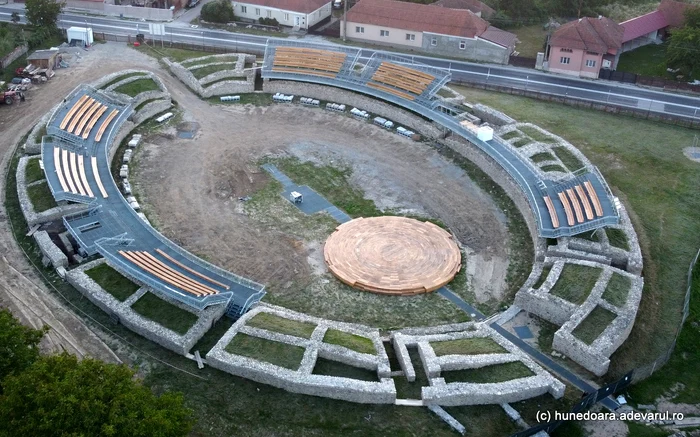
The amphitheater in Ulpia Traiana Sarmizegetusa. Photo: Daniel Guță. TRUTH
“It was proposed to build stands on several sectors of the southern and northern sides, from a galvanized metal structure, independent of the historical structure, supported on prefabricated concrete slabs placed on a bed of earth and supported by pillars to ensure the slope of the Roman arena. Therefore, the new bleachers will not be rebuilt on the existing historical structure and will be located only towards the interior of the amphitheater. Their extraction will be possible without causing damage to the historical monument, thus being a reversible intervention”said the Hunedoara County Council.
The boxes between the walls of the amphitheater were filled with earth, covered with vegetation, and the monument was rebuilt where it had suffered destruction in recent decades. Also, the masonry mortars with which it was restored in the 60s, but which, according to specialists, did not prove to be a viable solution for the amphitheater, degrading over time, were replaced.
The amphitheater in Ulpia Traiana Sarmizegetusa was discovered in the 19th century, and over time it went through several stages of research, restoration and conservation, the most extensive being carried out in the 60s.
Only four ancient amphitheatres have been identified in the former Roman settlements on the territory of Romania, the other three being discovered at Vețel (Hunedoara), Porolissum near Zalău (Sălaj) and Drobeta Turnu Severin (Mehedinți).
The amphitheater in Ulpia Traiana Sarmizegetusa is among the great monuments of the former capital of Roman Dacia.
Along with the many ancient temples, it was the landmark of the former colony intended for veterans of the Roman armies, a flourishing city in the second century, whose ruins are located 15 kilometers from the town of Hațeg in Hunedoara, accessible from the Hațeg – Caransebeș road.
Trajan’s Forum enters the construction site
By the end of 2024, another important monument from Ulpia Traiana Sarmizegetusa will enter the construction site, according to Hunedoara County Council. Trajan’s forum, or “forum vetus”, located in the center of the Ulpia Traiana Sarmizegetusa colony, will be restored.
“Initially built of wood, it was rebuilt in stone during Trajan’s reign, acquiring a monumental character. Its decoration exalted the recent victory over the Dacians. In front of the entrance was the altar (groma), erected on the occasion of the foundation of the colony and the founding of the province, the whole space thus acquiring a sacred status, loaded with great symbolic value“, informs the National History Museum of Transylvania.
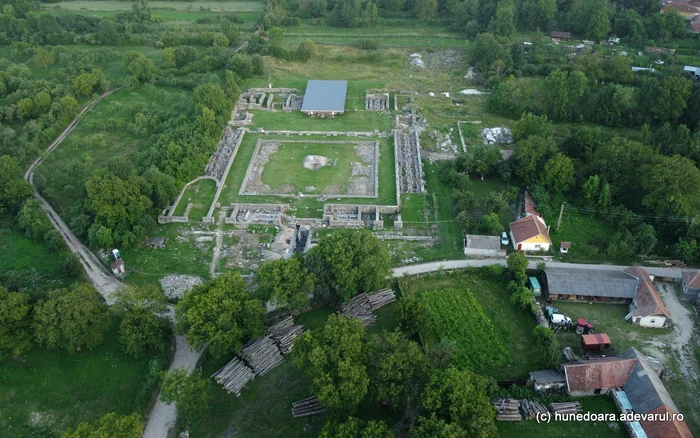
Trajan’s Forum. Photo: Daniel Guță THE TRUTH
The investment financed by the National Recovery and Resilience Program amounts to approximately two million euros and must be completed within 28 months from the date of signing the contract, i.e. from June 2023.
The project includes archaeological research, inventory, conservation, restoration and rehabilitation of the monuments of Trajan’s Forum.
“The masonry fragments of the portico wall (including the fragments of steps and the two fragments of columns) and those preserved to the north of it (proportionately), the preserved fragments of the foundations of the two wells located on the side of the propylon, the fragments of emplecton of the pedestals of the columns will be restored to the right of the propylon, the preserved portion of the decumanus and the canal below it, the groma and steps of the tetrapylon. The propylon columns will be rebuilt. The project also proposes exterior arrangements, coverings, presentation and accessibility elements; Creating an application to present the virtual reconstruction of the forum”, it is shown in the investment documentation.
In Antiquity, Trajan’s Forum in Sarmizegetusa occupied about one hectare and was surrounded by a colonnade (porticus), flanked by a large hall for meetings and judgments (basilica) and decorated with architectural marble elements, brought from the Bucova quarry , located in the vicinity, on the other side of the Iron Gates of Transylvania pass, in Caraș-Severin county.
