
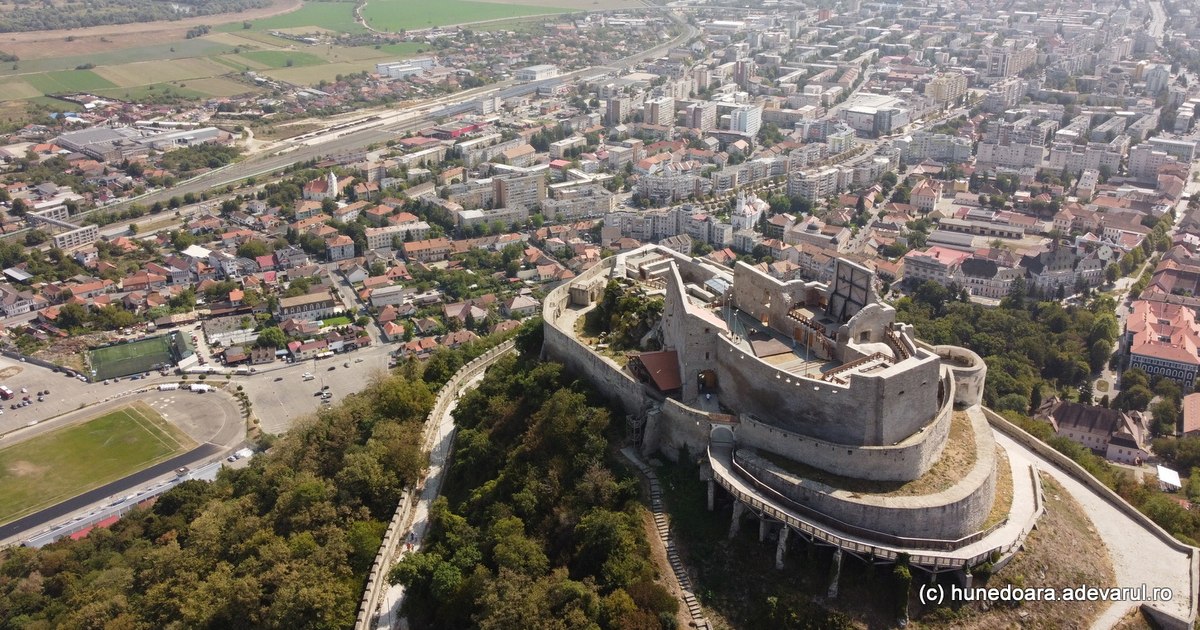
The new four million euro cable car of Cetăță Deva (video) has been defective since August, and this fact has led to a decrease in the number of tourists. Some of them complain, in the reviews, that they had unpleasant experiences in the most spectacular medieval fortress in western Romania.
Citadel of Deva. Photo: Daniel Guță THE TRUTH
More than eight million euros have been invested in the medieval Deva Citadel in recent years, and the works inaugurated in the spring of 2024 were intended to bring the historical complex back to the top of the tourist attractions in Hunedoara – a county rich in historical and natural monuments.
The medieval fortress of Deva is an important historical monument, being one of the most spectacular medieval fortresses in Romania, and the volcanic hill on which it was built is a natural monument, classified as a Natura 2000 site to protect its biodiversity.
With these two “natural” advantages and with the major investments that led to its complete rehabilitation and its equipping with a modern cable car, the medieval Deva Fortress could have competed in popularity with the Corvinilor Castle in Hunedoara, located about 20 kilometers from it and visible from its ramparts.
The Cetății Deva cable car, broken since August
But the plans of the authorities did not have the expected success. The new cable car in Deva was inaugurated on March 29, 2024, almost three years after the start of the works that led to the replacement of the old elevator and the modernization of its stations. The investment, financed from funds from the local budget of the municipality of Deva, caused controversy, both due to the amount of expenses, but especially due to the numerous malfunctions of the installations.
From the end of August 2024, the Cetății Deva cable car no longer works. “The cable car from Cetatea Deva is stopped! The Leisure Center Directorate announces the stoppage of the Cable Car that facilitates access to the Deva Citadel. Work will be carried out to replace some cables from the elevator’s traction system. Then all cables will be recalibrated,” informed, on August 30, 2024, the City Hall of the municipality of Deva.
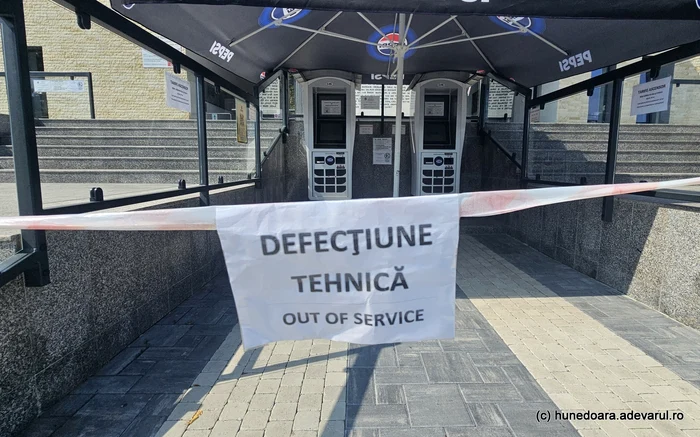
Tourists who arrive at the parking lot at the foot of Cetății Devei Hill, where the lift start station is located, find the poster hanging on a plastic tape “Technical failure. Out of service”.
Some shrug their shoulders and continue on their way without visiting the fortress, on foot. Others, who know the area, go around the hill and go up to Gate 1 of the medieval fortress, from where they enter its precincts. From the medieval gate, they can choose to walk up the steep steps that lead to the medieval fort, or go around the hill on the paved path. In both cases, it takes about 10 minutes to Precinct 1, the most spectacular, of the medieval complex (video The Truth, aerial images).
From the parking lot to Gate 1 of the Deva citadel, the road can be covered on foot in about 20 – 30 minutes. By car, the route is much shorter, but on busy days, tourists have to manage to find a parking space. Also, the car route goes through a narrow and steep lane where two cars can hardly pass each other.
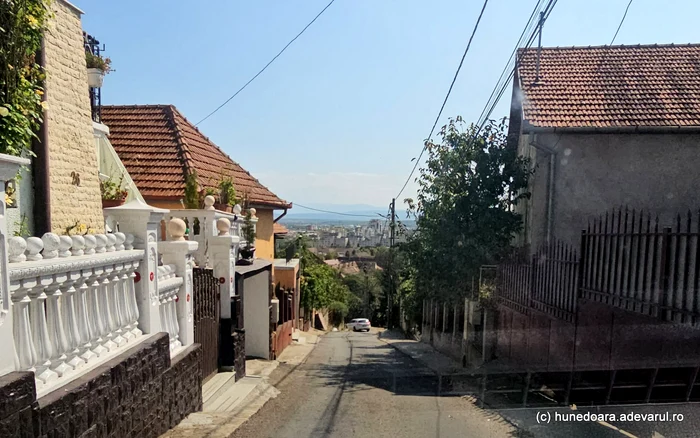
The road to Gate 1 of the Deva Citadel. Photo: Daniel Guță. TRUTH
Using the cable car means reducing the efforts made by tourists, but also reducing the time traveled to and from the fortress by a few tens of minutes.
It is also an expense of 20 lei, the ticket price paid by adults. It would also have meant income to Deva’s local budget and probably less negative reviews published by tourists on the Internet.

Image 1/11:
Cetatea Deva Photo Daniel Guță THE TRUTH (18) JPG
“Disappointment of the day! The cable car was broken, but that wasn’t a problem for us. I followed the path on foot, through the forest, to Gate I, then took the stairs on the right. The stairs are narrow, but with care they can be climbed. If you don’t want to climb these stairs, you can continue your ascent to Gate II. Unfortunately for any visitor, there are no directions on the route and no information about the citadel and what you see inside it. Not even a leaflet, a tablet, a pointer, a guide or the slightest bit of information. Nothing! Everyone takes what they think is best, everyone clearly understands what they want from what they see. Great pity! It’s a shame that so much money has been invested in the restoration and yet the fortress looks abandoned. I felt a great sadness today visiting this fortress”, was one of the most recent reviews of the medieval settlement on Google.
Cetății Deva cable car, series of malfunctions
But in the five months since the inauguration of the new elevator, it broke down several times, to the disappointment of tourists.
The first problems appeared as early as the second day after the inauguration of the new cable car of the Deva fortress, on March 29, 2023, when one of the coils failed as a result of an overvoltage. The cable car could no longer be used for the following days.
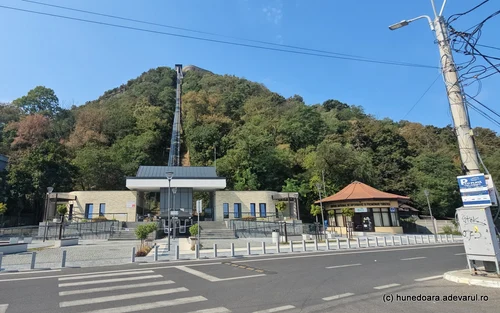
Image 1/14:
Cetății Devei cable car Photo Daniel Guță THE TRUTH (13) jpg
In April, the number of tourists was reduced, but from May 30, 2024, the medieval Deva Citadel re-entered the tourist circuit and can be visited in its entirety, after the rehabilitation works of its inner enclosure (Enclosure I, which includes the Princely Palace) have were completed. The investment worth over 23 million lei started in the summer of 2022 and was financed from European funds.
In anticipation of the waves of visitors during the summer, other malfunctions followed, which again suspended the operation of the cable car and led the representatives of the town hall to request damages, in court, from the builders of the new cable car.
The bottom station of the Cetății Deva cable car. Photo: Daniel Guță THE TRUTH
The elevator on Cetății Devei Hill went through several revisions, maintenance and maintenance works during the summer, but on August 9, 2024, the transport system broke down again, for a few days.
Since August 30, the four-million-euro cable car has been shut down again. On Saturday, the parking lot at the foot of the Deva fortress was deserted, while the area around Gate 1 of the medieval complex was crowded with cars parked chaotically by tourists who were not disarmed by the poster about the broken cable car.
Deva Citadel, the strong fort on the Mureș valley
The Deva fortress was built in the 13th century on a spur of the Poiana Ruscă mountains, in the Mureș valley, and was used in the first centuries for military purposes. In the 15th century it belonged to the Huniads, and then to several princely families from Transylvania.
In the Middle Ages, the medieval fortress of Deva (video The Truth, April 2024) was a strategic objective for the defense of Transylvania. It had been built on the hill of the last branch of the Poiana Ruscăi Mountains, and in front of it lay the Mures Valley and the Apuseni mountains.
“The fortress is invincible, being the master of such an important river, which is close at hand, because the mountain cannot be reached by any other way. It is always supplied with all that is requisite to support any strong siege for three or more years, and has the advantages of the river and the adjoining woods and mountains, to aid and save itself.” recounted, in the 16th century, the scholar Giovanandrea Gromo, adviser and military expert of King Sigismund.
Two centuries later, the fortress was considered by Nicolae Bethlen to be the most successful fortification in Transylvania and one of the most resistant in Europe, before the discovery of firearms, according to historian Ioan Andrițoiu.
In the summer of 1849, a large part of the fortress was destroyed by a powerful explosion in the mountain storehouse it housed. The locals then used its ruins to build some houses in Deva.
Over time, the old fortress became a tourist landmark of Hunedoara. In the last decade, its three enclosures were rehabilitated, one by one, with the help of European funds attracted by the local authorities of Deva.
