
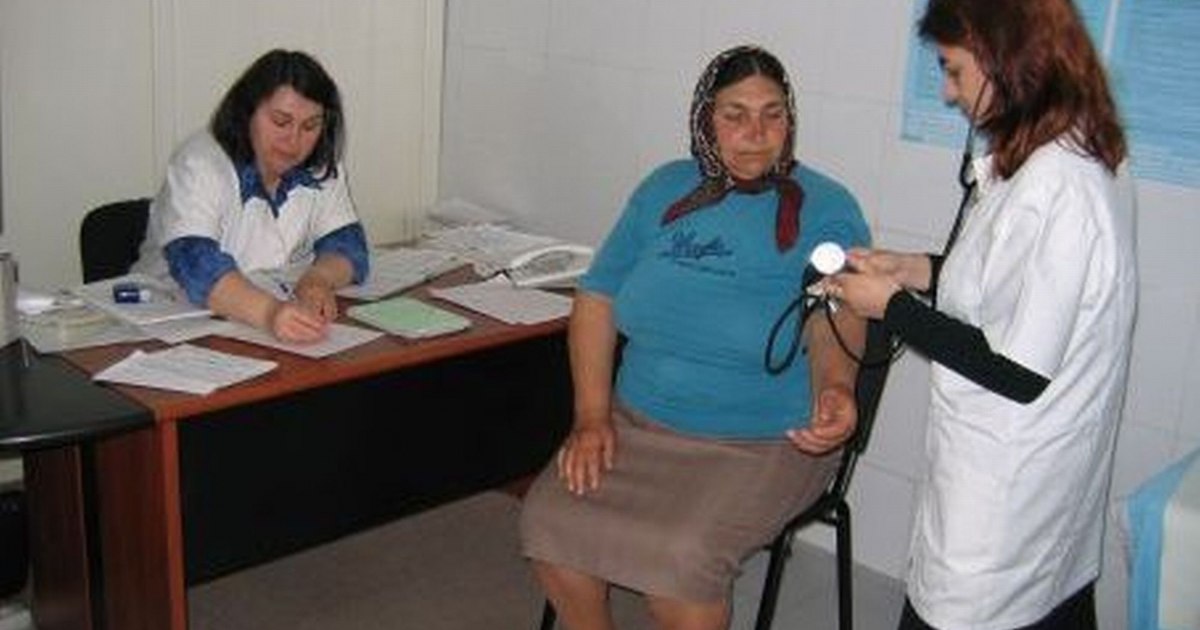
Rural Romania has an acute lack of family doctors, and the reasons are among the most diverse. First of all, even those active in the system say, we are talking about a specialization that, for students, is no longer so attractive. Then, young people are not attracted to rural areas because of poverty, lack of infrastructure, no one wants to commute to the village or live there on rent. “Those who retired were not replaced. On the one hand due to the lack of medical personnel, on the other hand…who would want to come to this dead end of ours?” asks Alina, a community nurse in the town of Adășeni, Botoșani county, who told “Adevărul” the situation in the village.
More than 50% of rural areas do not have access to medical services. Source: archive
Our country has been facing a human resource crisis in Health for years, and village family medicine is among the most affected medical branches. And the consequences are borne especially by patients who sometimes travel tens of kilometers to be seen by a doctor. Even worse is when, due to lack of financial resources, without a means of transport or relatives, these people die within days.
People walk dozens of kilometers to see a doctor
About 1,300 people live in the town of Adășeni, Botoșani county. It is a small commune, located in the north of the county, near the border with the Republic of Moldova. “Where the map hangs on the nail”, jokes Alina. But the joke is a bitter one, because the woman carries a very heavy burden on her shoulders. “There is no family doctor in Adășeni. There was someone many years ago, but he’s gone. He found a better job and our practice was left without a doctor. He went somewhere to an emergency reception center in Suceava. The residents were taken by the doctor from the neighboring commune, Avrămeni, but it is about 15 kilometers to get there. Others registered with the doctor in Săveni, a town about 25 kilometers away,” the woman said.
The nurse provides medical care to all the residents, from the youngest to the oldest, but only does as much as her job and job allows. “I am not a doctor. I give them basic medical care. I do an infection, I put in an infusion, I change a dressing. I help them with advice, put them in touch with the family doctor, with those at the county hospital. And when they need a doctor, and I can no longer help them, people get on the minibus, some have personal cars, others carts, others take used cars…everyone can go to the neighboring commune or to the city. But some money is spent, and people may not have it. And the doctor is still very close to us. But there are patients who walk 40 kilometers to the first dispensary. And I take a few hundred lei out of my pocket, because transport is expensive, gas is expensive, the man who takes you also has expenses. A day’s work for him reaches 200 lei. And you have to pay them, right?”
The doctor also visits patients who cannot move, the woman continues. “But even for him it is a long distance. But it’s coming. Some time ago he came to a grandmother’s house one evening, after finishing the program at the office. He found the gate closed, shouted, knocked… Finally he reached the woman by jumping the fence in the yard. This is how they work in the village. That’s life here,” the nurse also tells us.
“A young doctor does not come to the edge of the world. We don’t even have a phone signal”
Why are there no family doctors in the village? First of all, Alina explains, a family doctor must have at least 1,500 insured people on the list. “But they are common where they are not so insured, people are poor. They live on what they have in the household, some are unemployed, others work part-time, others only receive allowance and social assistance. There are no jobs in the country. That’s the reality. I’m over the moon, many of them are also old and sick”.
But there are many more reasons why family doctors do not flock to the villages. Because, as Alina says, no one rushes to come and work in the village. “Here, we don’t even have a signal like people on the phone. And the way here… Well, the doctor who left us was driving.”
Florin Cârlan, the secretary of Adășeni town hall, told us that the family doctor left the town in 2017. “We have been struggling like this for seven years. He had his office right inside the gymnasium. Now it’s locked on the door. I understood that he didn’t have enough patients left on the lists…our commune is small. I heard that he would have found somewhere in the city.”
The secretary also told us that there are many old and sick people in the commune who would greatly need a doctor. “The youth has kind of left, the elderly have remained, but you know how it is with these old women. Some are in wheelchairs, unable to move, others are bedridden, others suffer from various diseases. They need monitoring, referrals, prescriptions. It’s one thing to have the doctor in your village and another to be 15 kilometers away…”
The secretary also told us that opposite the town hall there is a medical office equipped with everything you need and that could be opened tomorrow. “But there is no one to work there. He is not a doctor”.
Romanians, cared for by retired family doctors
Almost 5,000 souls live in the town of Bățani, Covasna county. Here I encountered another situation: although the family doctor is retired, he is 71 years old, he has not yet put his coat on. “When he quits too we don’t know what we will do then. Over time, we kept trying to attract doctors to the commune, but without success. None of them stayed with us, although we offered them accommodation in a modern furnished and equipped three-room apartment, we provided them with two CABINET equipped with everything you need. Some, as they came, so they left, and others only promised us. And I’m left with only promises”the mayor of the town, Simon Andras, told us.
Family doctor from the village: “I commute 80 kilometers every day”
Dr Mihai Mara, family doctor in Ceanu Mare, Cluj county, is one of those who chose to work in the rural area. “I live in Cluj Napoca and commute daily. 40 kilometers out, 40 back. The journey, all in all, takes me about 90 minutes. But it’s good that I have a car. 10 years ago we didn’t have it and it was very difficult”the doctor told us.
Why did he choose the office in the village? “It was meant to be. Initially, I searched in the city, in Cluj”he says. But, because the prices were high in the city and he couldn’t find something that suited him, the doctor chose to go 40 kilometers away. And now, if he could, he wouldn’t leave there. “I have about 1,300 patients on the list, and I couldn’t give them up to start over in the city. I like the country. I got used to it. It’s quiet, people are respectful, they listen to me, I get along well with them. I wouldn’t leave here. The commune is big, it’s beautiful. It’s as if you’re more peaceful working in the country than in the city”the doctor also told us.
Dr. Mihai Mara believes that the family medicine specialization is no longer very attractive for students. “The first and last internship students go through in college is family medicine. And no one wanted her. Because whoever was teaching was not teaching properly… We were going to internships in hospitals and everyone presented family medicine as a job for secretaries, the last specialization in the system. And when I did the family medicine module in year 6, it wasn’t who knows what. I had already gone through all the departments..after you saw what it’s like in surgery, cardiology, orthopedics..and you don’t find it so interesting, so attractive” is the opinion of Dr. Mihai Mara.
On the other hand, the doctor believes that for many it is much more convenient to work close to home, family, friends and relatives. “The faculty you did it in the city, the residency is still there, you are young and you want to stay in the city. That’s six years of college plus four more years of residency in family medicine. It’s 10 years of being in the university center and then it’s like you want to stay there. You have become accustomed to a certain lifestyle. It’s hard to give it up,” doctor Mara also said.
“If there is mud on the floor, the doctor has no call”
Prof. Dr. Adrian Miron, primary physician of general surgery at the Elias University Emergency Hospital, doctor of medical sciences, stated that Bucharest is very crowded with doctors, even more than it should be, while other areas are poorer in this regard. “You have to develop the country in such a way as to attract people to these areas. If there is mud on the ground and the city, that place has no schools or no industry, then that doctor has no calling to go there, even if he is from there”he believes.
“If you have a balanced country, a balanced society, you will have a balanced labor force distribution. The decision to choose a workplace is not strictly professional, it is also cultural and depends on many things, the period in which they were formed, childhood, adolescence, other models, different possibilities to promote in a place, it can be a place empty and a very full place. If that empty seat is in an unfriendly or unattractive area, it stays empty. And instead they congregate elsewhere. Bucharest is very crowded with doctors, very crowded, much more than necessary, while other areas are much poorer“, explained Adrian Miron.
