
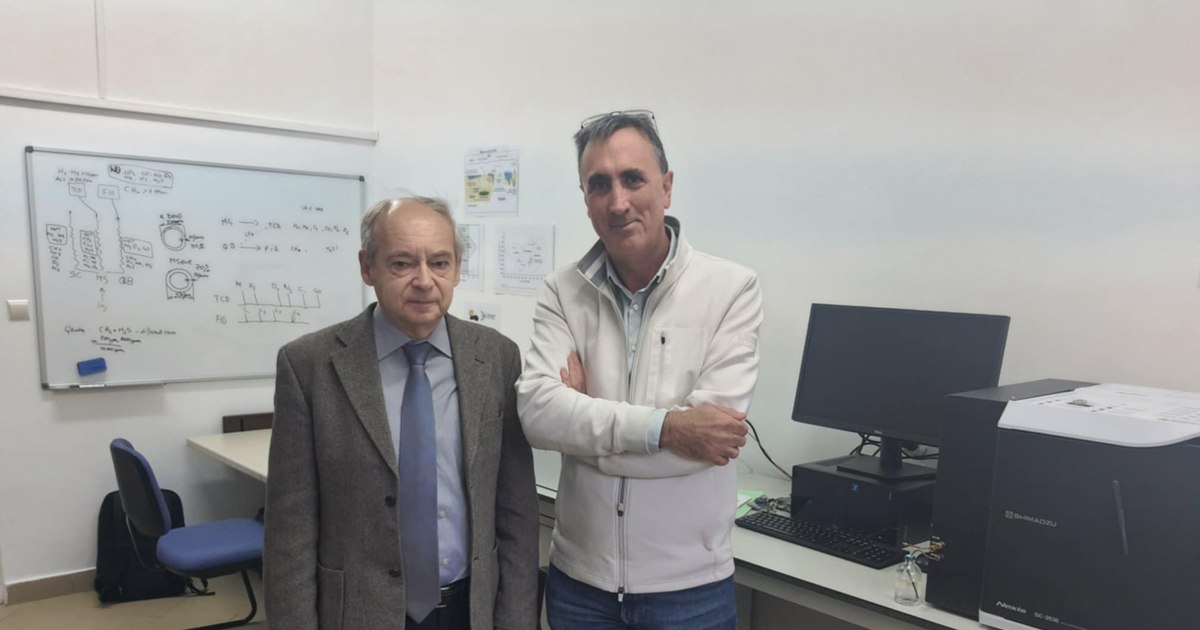
Giuseppe Etiope, geologist at the National Institute of Geophysics in Rome and director of a PNRR project to build the first gas geochemistry laboratory in the country, claims that Romania has natural hydrogen resources. It is one of the research directions of the ENGAGE laboratory, from UBB.
Professor Călin Baciu and Dr. Giuseppe Etiope in the ENGAGE laboratory. PHOTO: R. Florescu
“I discovered that Romania has natural hydrogen, a potential source of non-polluting energy. It’s a different story than factory hydrogen, which requires a lot of energy to produce. A lot of investment is going on right now in Spain, France, USA, Australia to research natural hydrogen resources”Dr. Giuseppe Etiope, geologist at the National Institute of Geophysics and Volcanology in Rome, told “Adevărul”.
He is the director of a unique project in Romania – the first laboratory dedicated to gas geochemistry, carried out at Babeș-Bolyai University (Faculty of Environmental Science and Engineering), with PNRR funding of around 1 million euros. The laboratory will be inaugurated this week, in Cluj.
One of the research directions that the ENGAGE laboratory will focus on is finding non-polluting alternatives to conventional energy sources.
“Unfortunately, there is not much interest in natural hydrogen in Romania“, says the Italian geologist.
He claimed that the study is at an early stage and cannot estimate the value of hydrogen deposits in Romania, but in the context of the energy and climate crisis, many countries are investing massively in this field.
The chase for hydrogen. Bill Gates also attends
“In recent months, prospectors have rushed to find it – drilling for hydrogen in northeastern France, Australia, Spain, Morocco, Brazil and, in the United States, in Nebraska, Arizona and Kansas. Even Bill Gates has joined the hydrogen rush, making a major investment in a company exploring for hydrogen in the US Midwest”says an article published in January 2024 in “Yale Environment 360,” a publication of the Yale University School of the Environment.
The quoted article states that because studies in recent years show that there is much more natural hydrogen underground than previously thought, well-funded efforts to drill for hydrogen are underway around the globe.
At the moment, natural hydrogen, a carbon-free, therefore non-polluting energy source, is used in only one place in the world, the quoted source said. The people of Bourakebougou, Mali (West Africa) are the only people in the world who get their electricity by burning natural hydrogen since 1987.
“But the Malian pioneers may soon lose their unique status. Geologists who once dismissed the idea that the earth’s crust was widely impregnated with hydrogen reserves now say there may be trillions of tons of it lying undetected beneath the planet’s surface, and the amount is steadily increasing.”says the article by Yale researchers.
Geoffrey Ellis, a scientist at the US Geological Survey in Denver – an institution created by the US Congress to provide scientific data to the authorities related to resources, environment and public safety issues – claimed that there could be about 10 trillion tons of hydrogen naturally or “geologically” buried underground throughout the world.
Many reserves will be too deep or far away to reach easily, but if Ellis is right, then just a small fraction of this hydrogen could meet the world’s needs for centuries, according to the article published in “Yale Environment 360.”
And it could be mined in some places for less than $1,000 a ton, says Emily Yedinak of the US Department of Energy’s Advanced Research Projects Agency, making it substantially cheaper than manufactured hydrogen.
US Energy Secretary Jennifer Granholm called natural hydrogen a “breakthrough to achieve a net zero economy by 2050”.
In addition to being cheap and carbon-free, natural hydrogen is also potentially a renewable resource. Ellis estimates that Earth can generate hundreds of millions of tons of new natural hydrogen annually. But he warns that “we need more data to convince ourselves.”
There are also many specialists who are skeptical about the feasibility of being able to capture and exploit hydrogen as an energy source.
Helium resources in Romania
Romania lost the start of the “chase” for natural hydrogen, but Giuseppe Etiope is optimistic. The project led by the Italian geologist – the ENGAGE laboratory – in addition to bringing top equipment for studying the geochemistry of gases, unique in Romania, also aims to train a team of 16 researchers who, in addition to research work, will be able to provide consultancy to various mining companies. “We don’t have the capacity to exploit hydrogen, but we can help the government or different companies identify where the resources are“, he claimed. Etiope’s team has already been working at UBB for a year.
Another important resource that Romania does not exploit is helium, a gas used in numerous electronic, medical and space industry applications, says Etiope, and which cannot be produced artificially. “When the natural resources of helium run out we will have to find replacements. There are a few extractors like the US, which has a monopoly, but as the resources decrease the price of helium has gone up”explains the geologist.
Studying global warming
Another important concern of the ENGAGE laboratory is related to the study of greenhouse gases responsible for global warming, an increasingly topical topic today.
An old collaborator of Etiope, professor Călin Baciu, who made an important contribution to the creation of the unique laboratory in Romania, stated: “Among the main directions of research are the identification of the sources of greenhouse gases, especially methane and CO2, which have the most important effect on global warming, but also the identification of ways to reduce emissions and find alternatives to certain industries or concerns that may generate greenhouse gases”.
He claimed that Romania has a long tradition of hydrocarbon extraction and is a real natural laboratory for studying gas emissions. “However, so far we do not have a research laboratory dedicated to these topics. To carry out theoretical studies and practical applications, this is the purpose of the laboratory“, he specified.
Etiope claimed that in addition to being unique in Romania, there are few such laboratories even in Europe.
The laboratory will be inaugurated on Tuesday, October 22, at the headquarters of the Faculty of Environmental Science and Engineering, within the UBB, with top researchers in the field from around the world invited.
Successful PNRR project
The ENGAGE (ENvironmental GAs GEochemistry) Laboratory, created with the financial support of the PNRR-i8 program (https://engage.granturi.ubbcluj.ro/), is the first laboratory in Romania specialized in Fluid Geochemistry, studying the main greenhouse gases, responsible for amplifying climate changes and gases that constitute energy sources.
The creation of the ENGAGE Laboratory at Babeș-Bolyai University in Cluj-Napoca is one of the main objectives of the project “Building research and know-how on ENvironmental GAs GEochemistry in Romania – Consolidation of research and knowledge in environmental geochemistry of gases in Romania (ENGAGE)”. funded through the National Recovery and Resilience Plan (2023-2025).
The laboratory has natural gas analysis capabilities, including gaseous hydrocarbons (methane, ethane, propane, butane), carbon dioxide, hydrogen, nitrogen, helium, oxygen, hydrogen, sulphide, which come from natural systems or from human activity.
The laboratory includes a series of high-performance, state-of-the-art instruments (https://engage.granturi.ubbcluj.ro/facilities/), capable of detecting and measuring the concentration of gases in air, soil, rocks, surface and underground waters. Particular attention is paid to methane and hydrogen, two key compounds for the study of greenhouse gas emissions and alternative energy resources, respectively.
Romania is a “natural laboratory” for the study of gases, hosting natural structures and economic activities that generate gases with a polluting effect or that contribute to the amplification of climate change. At the European level, Romania has the most locations with natural gas emissions, mainly methane and carbon dioxide. Also, there are real prospects for identifying natural hydrogen resources. On the other hand, at the national level, the expertise and analytical capabilities needed to study such structures are limited.
The ENGAGE project has created a modern equipped laboratory and a professional team, dedicated to innovative research and consulting in the field of gas geochemistry. The ENGAGE laboratory, as a whole, is currently unique in Romania.
