
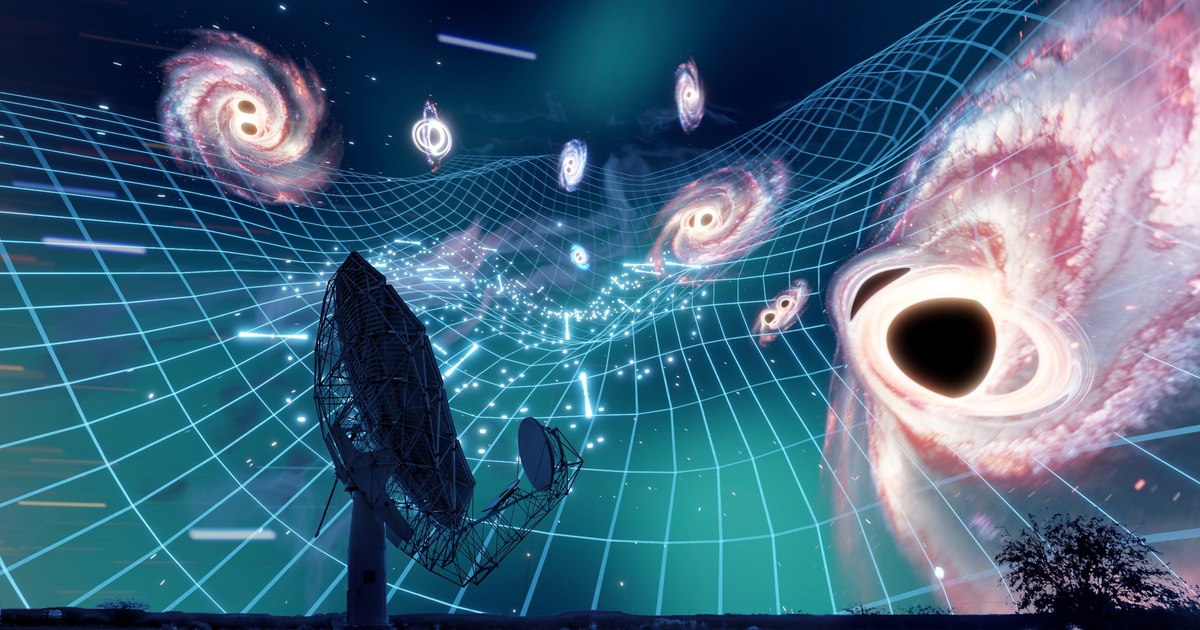
Researchers from an international team coordinated by Australian astronomers have created the most detailed map of gravitational waves in the Universe so far, according to three studies published on Tuesday, Xinhua informs.
Gravitational waves PHOTO: X
Scientists have used the MeerKAT radio telescope in South Africa to uncover new information about the largest black holes in the Universe, how they shaped the Universe and the cosmic architecture they left behind.
Coordinated by astronomers from Swinburne University of Technology and Monash University, both in Melbourne, the authors of the study have developed the largest detector of gravitational waves on a galactic scale so far, writes Agerpres.
Gravitational waves are fluctuations in the structure of the space-time continuum that occur when dense and massive cosmic objects, such as black holes and stars, collide with each other or start orbiting very close to each other. First described in theory by Albert Einstein in 1916, gravitational waves travel at the speed of light and were detected for the first time in 2016.
The authors of the new study used the tiny changes caused by gravitational waves to study the constant pulsations of fast-rotating neutron stars, known as pulsars, as a galactic-scale detector of these waves.
The detector then allowed them to create a very detailed map of gravitational waves throughout the Universe.
The map revealed an unexpected “hot spot” in the signal emitted by gravitational waves, which could indicate a directional polarization.
“The presence of a ‘hot spot’ also suggests a distinct gravitational wave source, such as a pair of black holes several billion times more massive than our Sun,” said Rowina Nathan, lead author of one of the three studies, a researcher at Monash University and the Australian Research Council Center of Excellence for the Detection of Gravitational Waves (OzGrav).
“Examining the configuration and patterns of gravitational waves shows us how our Universe exists today and contains signals dating back to the Big Bang. We still have a lot to study to determine the significance of the ‘hot spot’ we discovered, but this it is a very exciting step forward in our field of activity“, she added.
Another study, led by Matt Miles, a researcher at Swinburne University of Technology and OzGrav, found further evidence that gravitational waves originate in merging supermassive black holes, picking up stronger signals than previous studies and within a range three times less time.
Matt Miles believes that these discoveries reveal a more dynamic and active Universe than scientists have thought so far.
Researchers are now working on refining the gravitational wave map to find “fingerprints” underlying processes.
