
A writer draws attention to education in schools and exemplifies what tasks children have to solve at the National Assessment using a fragment from the electoral program of the candidate Călin Georgescu. “We educate children to become parrots”, says Iulia Iordan.
How children are educated. Photo: Mediafax
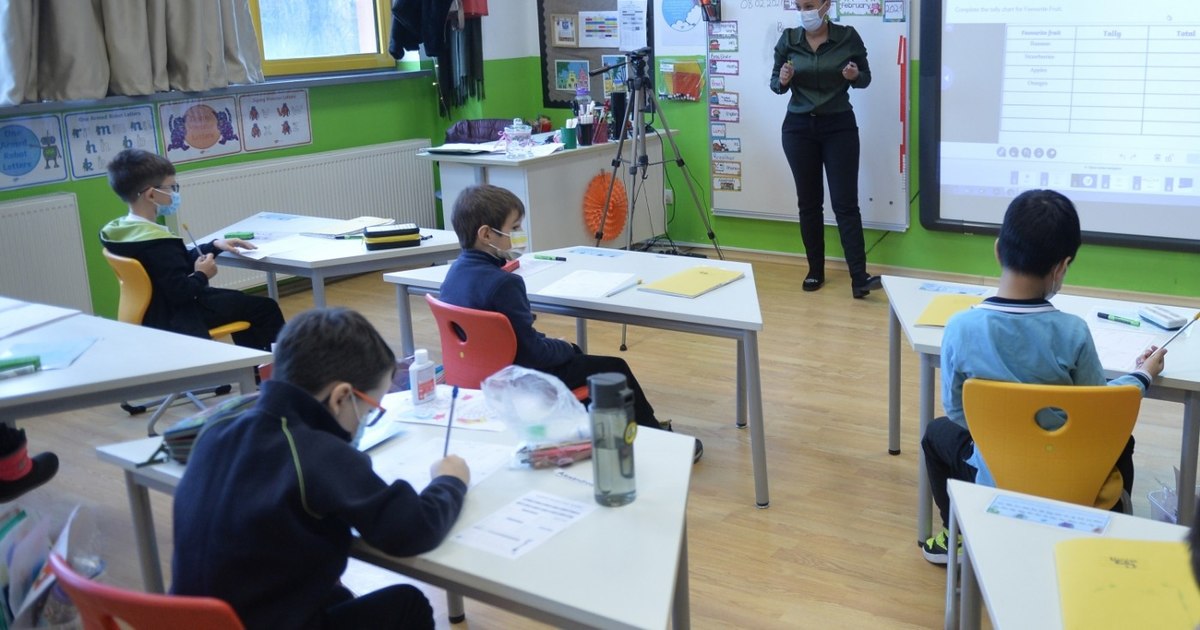
Writer and museum educator Iulia Iordan draws attention, as she has been doing for years, that what is happening to us today, namely the unfiltered reception of messages, has its roots in what is (not) happening in school. The writer gives the example of the debates she organizes in high schools and during which the students are hardly removed from the template.
The National Assessment, which doesn’t actually assess anything that young people would need to know at this age, is an example of how ‘training’ takes place.
“I recently had a workshop in one of the country’s big cities with a high school class. After ten minutes of talking to them, I found myself at an impasse because no matter what I asked them, they answered me in quotes. I told them that if I wanted to know Eminescu’s opinion on the subject, I would have gone straight to the library. Instead, in order for our dialogue to make sense, I am strictly interested in their opinions, however expressed. It was so hard for the poor children not to say at least two words without immediately giving the implacable quote from Eminescu, Blaga, Coșbuc, Creangă”, says Iulia Iordan, on Facebook, from her experience working with teenagers.
The children’s teacher, says Iulia Iordan, chose to leave, considering that the students are inhibited by her presence and anchored in the “methods used in the classroom”.
“I asked her to at least stay at the door to hear them speak when no one expects a certain answer from them and when in exchange for an opinion they don’t get a note. For the rest of the workshop I just read with them and talked about the emotions and ideas that the texts conveyed to us. It ended up being an hour of… philosophy. At the end, the teacher told me that she never imagined that she had such intelligent, sensitive, deep children”. shows the writer.
Iulia Iordan draws attention to the fact that nothing we do remains without consequences, “not even a mundane Facebook post, let alone what happens to a child at school day in and day out”. Complete by saying that “the way education is done in school today in Romania is a way to completely form the way a young person will relate to information in the future and connect it or not with his world” and at the same time it also shows the way teachers think about learning as a whole, but also “their limits and morality as men and as teachers.”
“At 14-15 years old, children are fragile and deep, curious and angry, they want to experiment”
The school today offers too little to the students the framework in which to really form, to experiment, to be valued. Moreover, the National Assessment exam became the high point of the adolescence of a young man living in Romania, “which is not normal from any point of view, especially from a psychological point of view”, draws the writer’s attention.
“ At 14-15 years old children are fragile and deep, curious and angry, they want to experiment, not choose a fixed box in which they feel captive for four years, also then they discover a world to which they have not yet had the chance to contribute, which do not yet bear their mark, instead have expectations, sometimes very high. A rigid, meaningless exam that assesses nothing useful in terms of how learning then proceeds does nothing but kill all that life out of their minds. What’s left? For most, there remains the distaste for knowledge that they associate with this experience and flash backs, quotes taken out of context, but so appreciated by some people who understand education as a puzzle of information retained from the outside, a puzzle that you can finish it and then deliver it on,” points out Iulia Iordan.
“Candidate Georgescu would get 10 in any school exam in Romania”
The writer continues, the “Country Plan” and candidate Georgescu’s speech abound, the one who, Iulia Iordan appreciates, “he would get 10 in any school exam in Romania”.
“In this way, he manages to appear educated, his mind seems to be juggling concepts and values, he is very attached to nationalisms, intensely taught at school and encouraged by the way the history curriculum is thought out, even in Romanian, but especially of all school rituals, celebrations, holidays, etc. Candidate Georgescu never fumbles, has dramatic pauses in his expression, perfectly masks all his hesitations. Whatever he says, he says it with conviction. Candidate Georgescu would get 10 in any school exam in Romania, even unprepared because he never answers I don’t know. Candidate Georgescu would give the expected answer to any question. He’s doing it right now live on all stations and platforms. And his “country plan” is written in the wooden language so loved and perpetuated in education”, points Jordan.
“Values” in the Country Plan
The writer does an exercise similar to the one that students are subjected to in the Romanian Language and Literature written test, at the National Assessment, referring to a fragment of the “Country Plan” presented by the independent candidate Călin Georgescu.
“One of the tasks that children have to solve in the Romanian exam from the National Assessment is to “remove the values” from a text. “Values” is a list of keywords. You don’t have to think about the context, the connection between meaning and context, and no one cares what you think “value” means anyway. You just have to find these key words/concepts in the text, but quickly so that you can solve everything in time. This is what the idea of the value of a text/speech has been reduced to. It’s like calculating the area of a circle: you have a formula and some data at your disposal, all against a timer,” says Iulia Iordan, before explaining what is usually asked of the students in the exam and playing a topic designed on the pattern of the National Evaluation.
“Therefore, here is the “list of values” and a fragment of the “country plan”. The more “values” you tick, the more “valuable” a text is. So, find in the fragments of the “country plan” below the “values”: respect, care, admiration, education, love, courage, sacrifice, kindness, friendship, generosity, devotion, family, trust, freedom”, sets the writer and the requirements that students usually have to solve.
The fragment chosen by Iulia Iordan from the Country Program can be found below:
“THE FOUNDATION STONE OF THE PROGRAM The establishment of the sovereign-distributist state and a society based on participatory democracy in which Truth, Freedom and Sovereignty are the axis of values of Romania’s development.
(…)
THE “FOOD, WATER, ENERGY” PROGRAM FOR THE UNDERSTANDING OF ALL Through this program a flag is raised – the Flag of Truth, of Love, of Awakening the consciousness of the Good and the beautiful in all of us! Under its folds, the traditional Romanian spirit will be restored (including economically). There is a need to bring the country up to the level of a calling by a grand programme, which will unleash the energies, enthusiasm and confidence of the entire nation.
(…)
THE MAIN OBJECTIVE OF THE PROGRAM Strengthening the state and resovereigning the person. Today there is an unfathomable gulf between the citizen and the state and the only meetings take place at the level of dysfunctional bureaucracy, manipulations, ideology and confrontations. The current state (servile and unrepresentative of the people) will be replaced by the sovereign state, where meetings between citizens, specialists and the state will take place at the table of Truth, Freedom and Reconstruction, for the benefit of all Romanians. The resovereignation of the person will be done by restoring and spreading the small and medium productive property and the peasant household”.
The writer shows at the end how students actually get a lower or higher grade depending on how much they practiced and managed to fit the pattern.
“Okay, now determine what the main value of the text is and compare the above masterpiece with another of your choice. Ready. Repeat this exercise 5-6 times a day for a year or two, take an exam, surrounded by teachers who got below 7 in their exams, get into whatever high school you end up in and then, dear children, become young, think and critically analyze the world around you, be free, coherent, persuasive, embrace all democratic values, even though you did nothing in fourth grade civics when you memorized the rights the child and you have no idea what the difference between parliament and government is. Because history, geography or social education are not “required” at the gymnasium, and at the high school you do more of the profile subjects. We educate children to become parrots, and when they self-educate despite school and take a stand or take to the streets at their first protestwe laugh at them. Obviously, we know better how things are. Are we… adults/educated/bright/normal?”, concludes the writer.
“Their access to information comes down to luck”
In the last six years, Iulia Iordan has reached dozens of schools, together with other colleagues eager to show children that writers exist in the flesh and that they are ready to listen to their opinions. The fairytale caravan stopped in the countryside, in small towns, but also in prestigious schools in big cities. I ask how she found the children, and Iulia Iordan explains how there is a difference between casual students, who easily express their opinions, and children who, although they may have well-defined opinions on various topics, fail to express them.
“I found the children in different ways, depending on how lucky they were. In fact, this is what their access to information, to luck, is reduced to. If there is a passionate librarianif there is a teacher, no matter what he teaches, who is passionate in that community, then you can see that he has worked with the children, that they have read something, that they know how to express themselves, that they know how to formulate some simple things in a way expressive, or at least convincing, or at least authentic. If they haven’t met these providential people – here we go back to the saviors – then things are very, very bad. We at De basm generally collaborate with EduCab and every time we write another app we tell them – send us where it’s worst”, says the writer.
We return to the evaluation of students and the writer Iulia Iordan explains why such an exam in no case can give the measure of what a teenager knows at 14-15 years old, as the subjects are structured today.
“To evaluate a child you have to do it holistically, to have the opportunity to talk with him, not just give him a test to solve in two hours. They don’t even have three hours at their disposal. And then these topics were refined over time until they reached the absurd (in my view, they are absurd) proportions of the moment. You have no way of really evaluating a child. I know children who have read more than my friends philosophy, universal literature, contemporary Romanian literature, who have read anthropology books, who have read and are interested and are aware of what is happening in this world now, I repeat, more than many adults, and who got 8 in Romanian, in the National Assessment. Because they didn’t pay attention to I don’t know what grid”, detailed Iulia Iordan.
The exam is far from objective, and the difference actually comes down to how much the kids train, with the help of meditations that parents pay for, to memorize patterns.
