
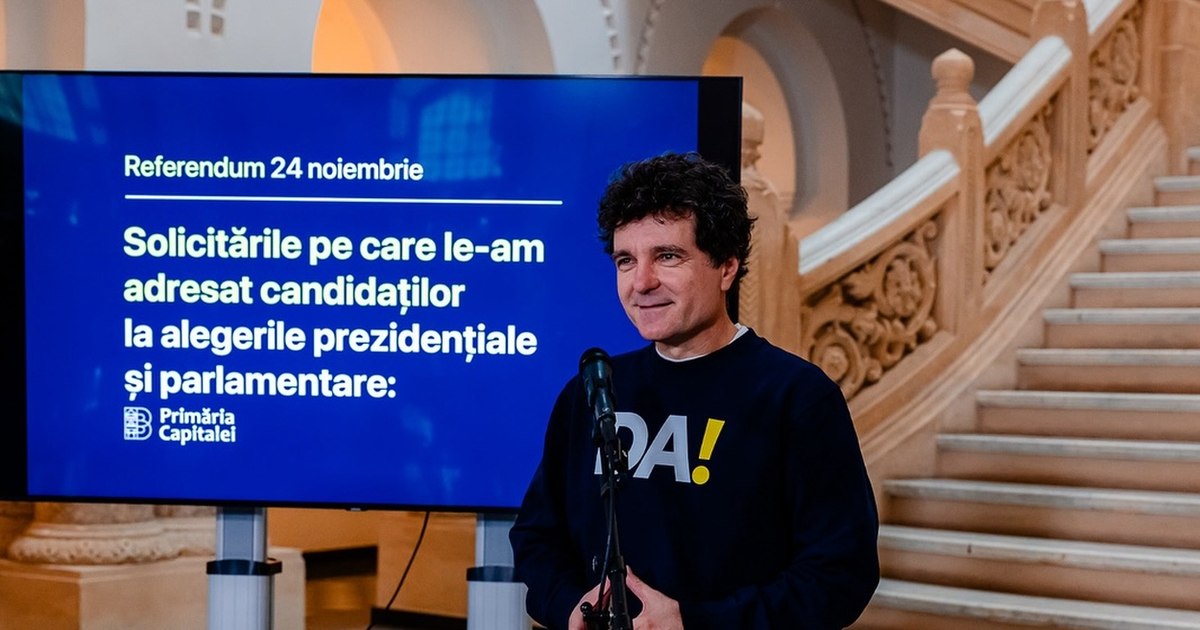
The general mayor of the capital, Nicuşor Dan, stated to TVR Info that he hopes that the November 24 referendum will be transposed into legislation by June 2025. The changes must be made in Parliament.
PHOTO Facebook
“They are two different issues: one aimed at money, one aimed at urbanism. On the urban planning side, things are a bit simpler, because even the new minister and former Minister of Development, Mr. Cseke, declared at the Parliament hearings that he wants to complete the debate on the Urban Planning Code. The urban planning code systematizes all the main and secondary legislation that we had on urban planning and construction”the general mayor explained to TVR Info, according to News.ro.
According to the mayor, regarding the division of the budget “there are several legislative mechanisms that need to be changed. On the one hand, the Local Public Finances Law or the National Budget Law, which concerns the division between the Capital City Hall and the District Town Halls. On the other hand, the Fiscal Code, which talks about how money from local taxes and fees is divided and on the other hand, the powers of the Capital City Hall and the District Town Halls, as provided for in the Urban Planning Code”.
“They are matters of a certain complexity, not particularly complex, which, in my opinion, can be finalized in the legislature that starts in February and ends in June 2025. But we will have a national budget law, probably in January and here we have to see what the percentage is, how the taxes and incomes coming from the income tax of the Bucharest residents are divided between the Capital City Hall and the District Town Halls, and here there will be a discussion between us and coalition to establish this percentage”, added the mayor.
The final data of the local referendum in Bucharest, organized on November 24, 2024, show that over 60% of those who voted answered “Yes” to the first two questions, those related to the issuance of building permits and the approval of budgets.
When asked about funding a program to combat drug use in schools, more than 84% of participants answered “Yes”.
