
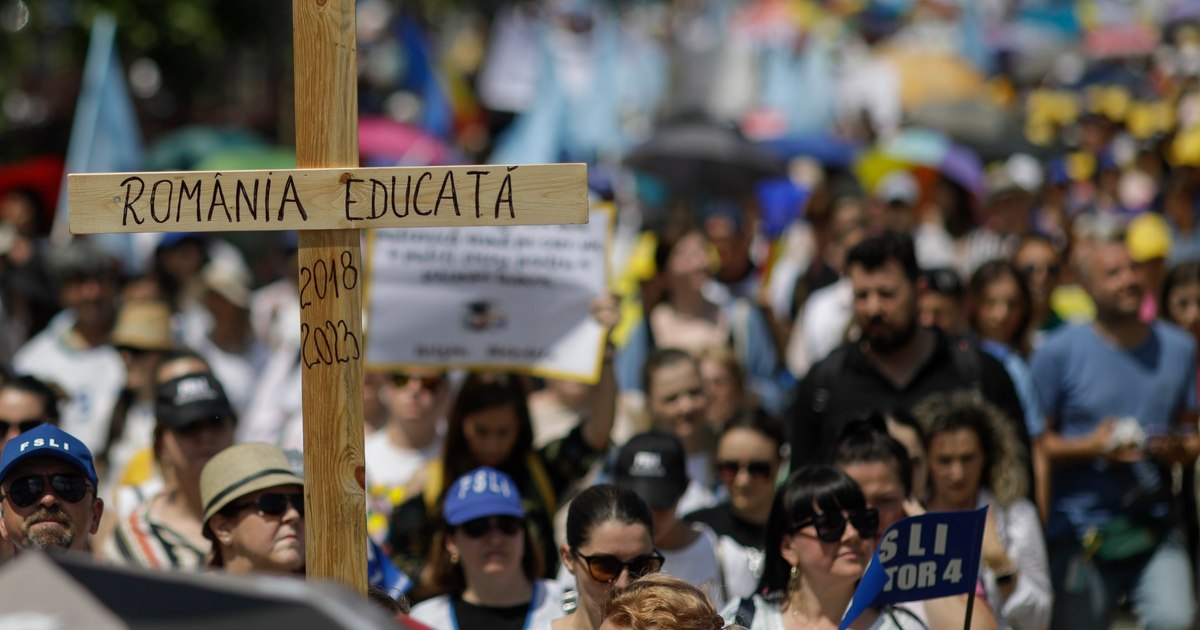
In the context in which the “Trenuleț Ordinance” is already producing its effects, the education unions are asking Prime Minister Marcel Ciolacu to take the stage for discussions and negotiations. Teachers are threatening to strike if they do not receive the pay rises promised following the historic 2023 strike this year.
The teachers’ protest of 2023 then paralyzed the entire system. Archive
“If we don’t get along, if we don’t reach a common denominator, most likely in February we will take to the streets. But it is not a promise. We’ll see how things go until then,” Anton Hadăr, president of the National Trade Union Federation (FNS) “Alma Mater”, told “Adevărul”.
He stated that a first meeting with the Minister of Education, Daniel David, has already taken place. “But we want to have a meeting even at a higher level and we hope that it will materialize. A meeting with Prime Minister Marcel Ciolacu. If no agreement is reached, we will proceed as usual, first with picketing. We will start the protests gradually. Probably in the coming weeks, that is from February. But that doesn’t mean I’ve already made an announcement. Remains to be seen. A lot can change by then“, Anton Hadăr also declared.
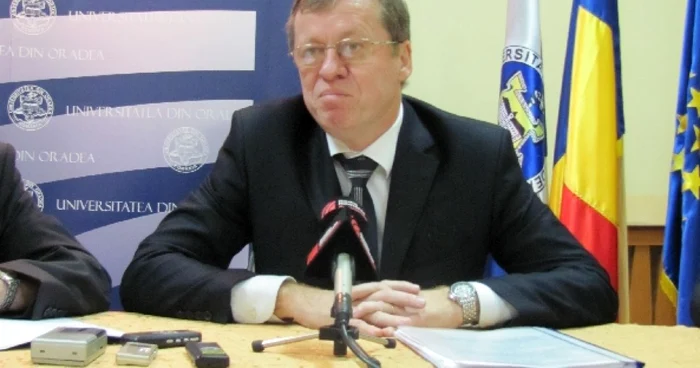
Anton Hadăr, president of the National Trade Union Federation (FNS) “Alma Mater”. Archive
Why haven’t the trade unionists taken to the streets yet? “We were prevented by the political protests of this period”
The trade unionist announced last December that “between January 13-15 we will have the first protests that have already materialized“. His reaction came in the context of the adoption of the Train Ordinance, which provides that, in 2025, salaries are frozen at the level of November 2024. However, these protests did not take place. The reason? The AUR protests and the one in support of Călin Georgescu turned the unionists’ plans upside down. “We did not organize these protests because they would have overlapped with other protests organized by supporters of some political parties. And it was complicated for us to come too. So we decided to wait a little longer until the waters calm down.” explained Anton Hadăr.
“We are waiting to be invited to talks”
And Dragoș Neacșu, the representative of the Federation of Trade Unions in Education “Spiru Haret”, stated for “Adevărul” that “until we have a meeting with Minister Daniel David and maybe even with the representatives of the Government, i.e. with the Prime Minister, we cannot pronounce on the protests. We are waiting to be invited to the discussions, and I hope this will happen next week, when we are going to discuss more effectively”.
Dragoș Neacșu stated that the first meeting of the unions with the Minister of Education took place last week. “But it was a rough-and-tumble meeting with no substantive discussion. We didn’t discuss anything clearly. And this for the minister needs time to adjust to the situation. He couldn’t come two days after he was invested and say we can do this, we can’t do that.”
The trade unionist stated that, apart from salary increases, which are currently blocked, there are other grievances. “We have a whole list of grievances, in addition to the salary part, but we cannot make it public for now. What I can tell you, however, is that we are waiting for the Government to keep its promises from 2023, after the general strike since then. Namely, that the minimum salary in education, that of beginning teachers, should be equal to the average salary in the economy”.
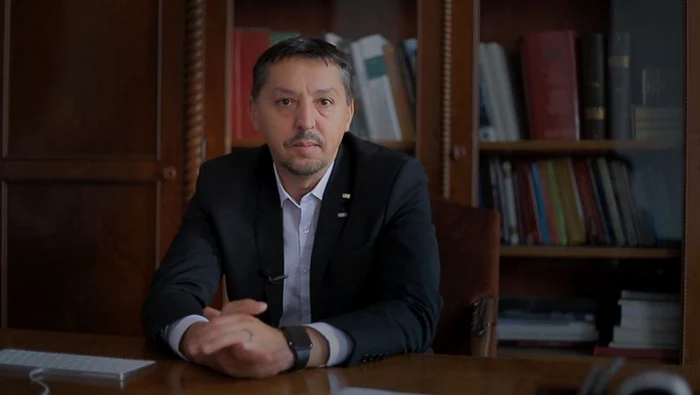
Daniel David, Minister of Education. Archive
Daniel David, Minister of Education: “I expect protests”
Asked how he responds to teachers threatening to strike if they don’t get the promised salary increase this year, Finance Minister Tanczos Barna said 2025 is a special year with a lot of influence from 2024. “I think the increases in 2024 are significant, they have been achieved. There have been increases in education in 2024. My objective is to be able to pay those salaries in 2025. It is a special year from that point of view, with a lot of influence from 2024 to 2025. Our objective is to be able to pay the pensions and salaries as well at that level,” the official also sent.
And Minister David came with a series of statements. “I would like them not to be very likely (n. ed.: the protests). I’m in discussion with the unions, I’m in touch with the people in the system, I’m trying to explain that the country is going through this complicated situation”, said the minister. He added that if we were to discuss honestly, there were no salary cuts. “There are negative things, but they are not very serious, because basically what they tried to do was to stabilize and start the year 2025 with the resources that we had somewhat in 2024. But, of course, people are unhappy, and in our system, especially in the area of education, the dissatisfaction is a bit greater because there were a lot of commitments and promises that were made to stop the strike in the field of Education”, explained the Minister of Education.
The official stated that the “Trenulet Ordinance” will not cause problems in the tenure area. “There are things that have been frozen. There are no problems and there will be no problems in the Titling/substitutions area, but I expect there to be – for sure – protests, I expect there to be dissatisfaction. The Prime Minister said at the meeting with the social dialogue partners that he is aware of the fact that the field was promised some rights and that as the economic and financial situation recovers, Education will be a priority in receiving those rights.”
How the “Little Train Ordinance” Affects Education
These days, Romania is sitting on a powder keg ready to explode amid social unrest that reminds us of the historic teachers’ strike of 2023. The austerity measures adopted by the Government cut teachers’ tuition fees and vacation vouchers. Teachers will also be affected by both salary freezes and job freezes.
According to the GEO adopted by the Government, teaching premiums are granted only if they can be settled from non-refundable external funds. The transformation of the ISJs into county departments is postponed, while the teachers who coordinate European projects will no longer benefit from the reduction in the didactic norm. The government is also trying to raise money from schools: the standard cost supplement for disadvantaged schools is being cut, and the limits on the number of students in high school classes are suspended. The “little train ordinance” also runs on children’s money. It is specifically about the education vouchers for students from poor families that will come only from non-reimbursable external sources, which is very unlikely to happen this year. Then, vouchers for children with special educational needs are also delayed until the start of the 2026-2027 school year. The Government also “walked” on students’ money: discounts on train tickets were restricted and scholarships were frozen.
“Why do we still make the wage law if we don’t apply it?”, trade union leader Anton Hadăr asked in this context. “When we make a law, let’s enforce it. Or better not do it anymore. Why should we keep people’s hope that our salary will be increased even after that, when the “Train Ordinance” comes to cancel everything? We must take these actions (n. ed.: the protests) to get the politicians to find other solutions too”, Hadar said.
Teachers’ money, controversial topic on social networks
There are also heated debates online, on social networks, where the camps are also divided. There are voices that say that a higher salary for teachers would not be justified, given that many of them are extremely poorly trained. Businessman Cristian Sima, PhD in Mathematics, posted a very harsh message to the teachers. “Do you think that the one who teaches Mathematics at Mizil and doesn’t know the Pythagorean theorem if you double her salary will learn the Pythagorean theorem? Not. Do you think a teacher will do problems from the Mathematical Gazette or read Dostoevsky? Not. Nothing will happen. With more money, teachers’ lives will be nicer, but they won’t be better.” The post drew a flurry of comments, with many users questioning this logic. In general, people say that higher salaries will attract better, better trained people into the system who are now fleeing the department and moving to more financially attractive fields.
