
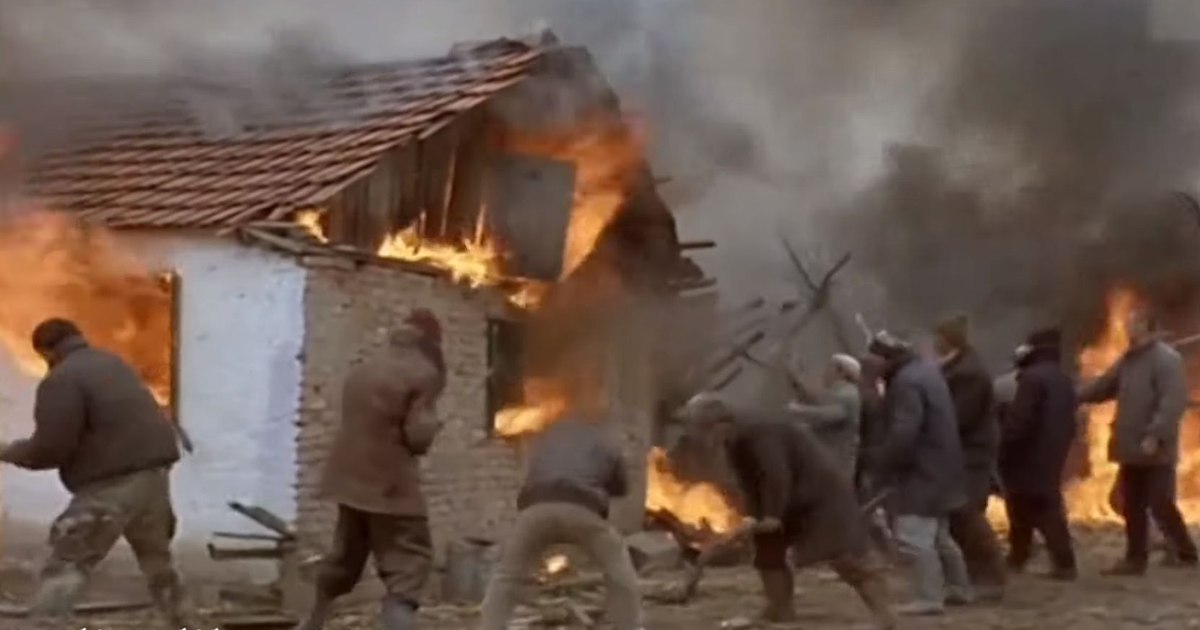
The enthusiasm with which Romania was regarded in the West after the Revolution of December 1989 was overshadowed, in a short time, by a series of tragic events that showed the intolerant face of the Romanians, barely emerging from the era of the Ceaușescu regime.
A sequence from the film Gadjo Dilo (1997) shows the burning of a Roma house. Source: Youtube.com
The collapse of the Ceaușescu regime revealed a series of serious problems that Romanian society had kept quiet during the decades of communism.
Shortly after the Revolution of December 1989, the respect with which the Romanian people were regarded in the international press began to shake, together with the series of bloody revolts from the beginning of the 90s.
Along with the mining that started in the Jiului Valley, a lot of inter-ethnic conflicts that had Romanians, Hungarians and Roma in the foreground destroyed the image of the Romanians as a tolerant people and contributed to the marginalization of Romania in Europe for the following years. At the same time, they showed the inability of the authorities to take firm measures to stop crimes.
The most intensely popularized inter-ethnic conflict since the beginning of the 90s were the violent confrontations between Romanians and Hungarians, in March 1990, in Târgu Mureș. The events of March 19 – 20, 1990 resulted in the death of five people (two Romanians and three Hungarians), 278 injured, an Orthodox church burned down and the destruction of the local headquarters of some political parties.
More than 20 people (Romanians, Hungarians and Roma) were arrested for serious crimes committed during the riots in the Transylvanian city, and most were convicted. It then took a long time for relations between Romanians and Hungarians, residents of Târgu Mureș, to return to normality, reported the media of the time.
The first violences, kept under silence
The March 1990 riots were not the only bloody inter-ethnic conflicts that occurred in the early years of the post-Ceaușescu era. The Roma from the camps and border settlements established on the edge of some towns in Romania were among the first targets of “revenge” actions in which many Romanians took part.
The first riots directed against the Roma took place since the days of the Revolution and were not reported in the national press, showed a report published by the European Center for Roma Rights, made by the human rights activist Istvan Haller.
“In Virghiş, Covasna county, villagers killed two Roma and destroyed two houses on December 24, 1989; in Turulung, Satu Mare County, a child disappeared and 36 houses were burned on January 11, 1990; in Reghin, Mureş county, locals set fire to five houses on January 29, 1990; in Lunga, Covasna county, the non-Romanian population killed four Roma and set fire to six houses on February 5, 1990.” the research showed.
Between June 13-15, 1990, the miners from Valea Jiului brought by special trains to stop the demonstrations in Piața Univeristății also reached the outskirts of the Capital, where they unleashed against the Roma who lived in the border neighborhoods. Numerous people were beaten and some women were assaulted, the same report said.
“More violence followed: in Cuza Vodǎ, Constanța county, an angry mob of locals set fire to 34 houses on July 10, 1990, and in Cașinul Nou, Harghita county, villagers burned 29 houses on August 12, 1990.” andinform the author of the research.
Church bells announced the uprising in the village of Mihail Kogălniceanu
In the fall of 1990, an angry mob set fire to more than 30 houses inhabited by Roma families in the village of Mihail Kogălniceanu, in Constanța. It was the first such conflict reported in the national media, but the authorities did not take action against those who participated in the arson.
The commune, which then had a population of 15,000 people, was inhabited by Romanians – the majority, Macedonians, Turks, Tatars, Roma and Hungarians, and the inter-ethnic conflicts expanded after a few isolated incidents in the village disco between Roma and Macedonians and Romanians.
On October 9, 1990, the church bells were rung, and the villagers gathered to take revenge on the Roma they had lived with for four decades.
“The Gypsies came in 1951. The village welcomed them without reservations. They multiplied quickly, today 43 families (207 souls) live here. Unfortunately, recently they have caused us problems, 70-80 percent of them are delinquents — they steal, kill, commit rape,” said in October 1990, Constantin Ionescu, then mayor of Mihail Kogălniceanu commune, quoted by Revista 22.
He added that after a period of calm that followed the Revolution of December 1989, the village was gripped by terror, because some Roma were committing crimes.
“Gypsy children robbed the school twice. Not a day went by without a theft. The issue of lynching arose in the village. But, I must emphasize, this does not refer to all gypsies — no one has anything to do with their species, only delinquents. After the ringing of the bells, about 800 – 1,000 people gathered. I tried to calm the population down, but I didn’t succeed. I considered that this method of justice is not a suitable solution. However, only those houses where criminals lived were burned. This proves that the population had nothing to do with the Roma species,” said in October 1990, Constantin Ionescu, then mayor of Mihail Kogălniceanu commune, quoted by Revista 22.
The Police’s investigation did not lead to the discovery of any culprit and caused that in the following months, such actions directed against the Roma in the border areas of some localities in Romania took off.
Bears, chased out of the village under the eyes of the Police
In the spring of 1991, in the village of Bolintin Deal in Giurgiu, a young man was killed by a Roma bear, even on Easter Sunday, after a spontaneous conflict.
The killer was arrested shortly, but the next morning, when the siren sounded in the center of the village with 7,000 inhabitants, almost 2,000 people gathered and headed towards the houses of several dozen bear families in Bolintin Deal, which they burned or completely destroyed. The police warned the 150 Roma to run away from the crowd and not to return to Bolintin Deal.
“Vengeance was not directed against men and animals. Only the houses were set on fire, to drive away the criminals. They have no business among us”, declared Sorin Nuță, the secretary of the Giurgiu town hall in 1991.
On Ascension Sunday 1991, a Roma teenager stabbed a waiter in a bar in Ogrezeni, and shortly after, thousands of people gathered to take revenge on Roma families living on the outskirts of the village, some without to know why.
“Clumps of people gather on the road, in the streets. The church bells start tolling as the dump trucks honk. Reinforcements are arriving from Bolintin. The bearers — about 16 families — sense the danger and rush away in cars and carts. The people decide to punish them. For their thievery, for their audacity and cruelty with which they poisoned their lives. The bears’ houses are devastated, demolished with the help of dump trucks. The villagers get even more angry, because they find the color televisions, the cassette players, the chests full of Persian carpets, the tons of grain. Where does so much wealth come from people who, from father to son, run away from work like the devil of incense“, informed Libertatea, in 1991.
Roma, warned to run away from the villagers
The police watched the revenge of the villagers carelessly. A few days later, similar scenes took place in Găiseni, another village in Giurgiu, where the houses of some Roma families were also attacked by Romanians. And they continued in other areas of the country.
In the town of Plăiesii de Sus in Harghita county, in July 1991, the almost 30 houses inhabited by Roma families were set on fire, and one of them was killed by the villagers. Three days before the tragedy, a Hungarian local had been beaten by some Roma after trying to stop them while they were kicking his horse. Shortly after, notices were pasted in the slum inhabited by Roma warning them to leave the town, because their houses would be set on fire. People notified the Police, but the authorities did not intervene. A group of villagers cut the electric wires leading to the Roma quarter and the telephone lines, then the people attacked the houses and set them on fire.
In the fall of 1993, a shocking new conflict attracted the attention of the media. In Hădăreni village, a fight between Roma and Romanians led to the stabbing of a young man. The two Roma involved in the conflict ran away and hid in a neighbor’s house. The villagers gathered in large numbers around the house and, so that the Roma were afraid to leave it, they set it on fire. The two young men had to flee, but were caught and lynched. Among the ruins of the house consumed by fire, the charred corpse of another Roma was found. While the police were overwhelmed by the events, the locals went to the homes of the other Roma families in the village and set them on fire.
“The official bodies in Romania did not recognize that the lynching of the Roma and the burning of their houses had ethnic reasons. The rhetoric produced was about a massive popular movement against criminals as well as about social conflict. The phrase “ethnic conflict” – not to mention pogrom – provoked vehement protests from the authorities“, showed the research published by Istvan Haller.
The number of those found guilty for participating in such conflicts was small compared to their scale and severity, and the punishments were also reduced, human rights activists complained over time. However, some conflicts remained in the memory of Romanians, after they became themes addressed in Romanian films such as Gadjo Dilo or The Snail Senator.
