
Scientists at the University of Oxford are using an innovative technique to help patients communicate the extent and severity of symptoms associated with post-infectious diseases such as long-lasting COVID and chronic fatigue syndrome.
Covid patient. Illustrative photo. Source: Freepik.com
Patients affected by long-term symptoms of COVID disease often struggle to communicate their experiences during the illness and also face stigma and dismissive attitudes, which may discourage them from sharing their experiences.
Body mapping can help them communicate their experiences more effectively to health professionals, family and friends, say researchers from Oxford University in the UK in a study called “When you can’t find the words: Using body mapping to communicate the experiences of patients with Long Covid”.
Specialists quoted by the British publication The Guardian, show that patients with post-illness conditions of COVID 19 report debilitating symptoms, such as extreme fatigue, breathing difficulties or muscle pain, but often show normal results in routine medical checks. And many patients don’t look sick, leading some to question the seriousness of their illness.
“In the absence of diagnostic tools or an understanding of pathophysiological processes, many sufferers find it difficult to share their experiences. They lack a verbal language that expresses the true impact of the disease. Now researchers at Oxford University are using ‘body mapping’ to help patients better communicate the physical, cognitive and emotional dimensions of their illness to family, friends and healthcare professionals”The Guardian reports.
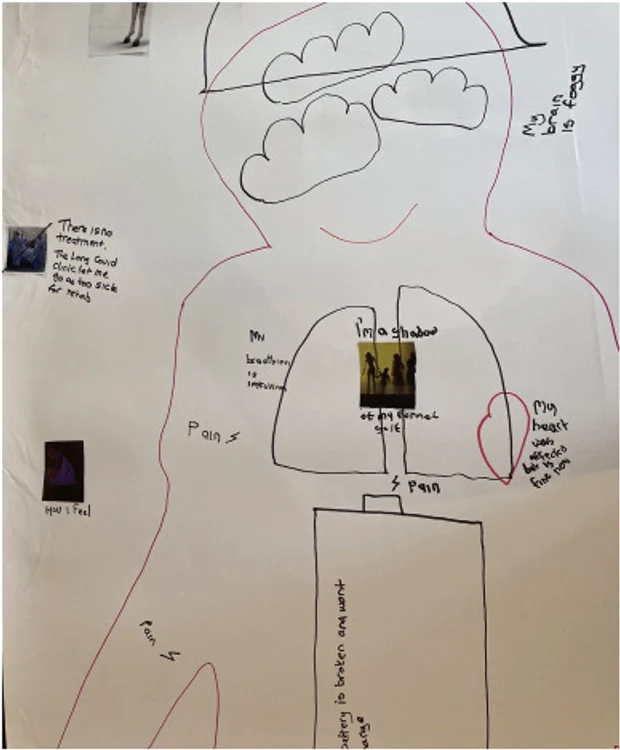
A body map made to identify the effects of Covid. Source: sciencedirect.com
People infected with COVID-19 may still experience long-term symptoms and effects after infection; this condition is called “long-lasting COVID” or “post-COVID syndrome”. Many long-term aspects of COVID are still unknown. New information continues to emerge as long-standing COVID research progresses, the Washington State (US) Department of Health reports.
Long-lasting Covid symptoms, identified on the body map
People with long-standing COVID may experience a wide range of symptoms, which may last for weeks, months or years after infection. These include: feeling tired, especially after mental or physical exertion, fever, shortness of breath, cough, chest pain, change in taste and/or smell, difficulty thinking or concentrating or ‘brain fog’, pain in head, stomach pain, change in menstrual cycle.
“People deal with illness in many different ways, depending on economic, social and cultural factors such as age, gender or the possibilities to access healthcare. When we talk about health and disease, we must always consider space and time.” says researcher Maaret Jokela Pansini from Oxford, according to The Guardian.
Jokela Pansini reports that she first became familiar with body mapping while working for a women’s organization in Honduras that ran workshops in prisons. The technique involves creating a life-size outline of a body, where it aims to capture patients’ experiences. It has been used in trauma therapy and with chronic pain patients.
“We call it alternative mapping. We think of the body as a map: pain, emotions, experiences are all located somewhere in your body, which in turn is seen in relation to a specific environment.” shows the researcher.
The method was adopted in a long-standing Covid-related disease research project. So far, eight workshops have been held in London and Oxford with the help of the charity Long Covid Support.
Here, participants begin by tracing the body on paper. They are then given a list of questions and asked to draw, write or collage the answers on their body map. How did you feel about your health long before you got Covid? What impact has it had on everyday life? What kind of support do you get? How has the disease changed the way you see yourself?
“Body mapping is really about storytelling“, says Jokela-Pansini. Most participants start with the head or the heart. “Family members are often in the heart,” she says. And despite the fact that each body map is unique, there are recurring motifs such as shadows.
“Participants use them in the sense that they are now just a shadow of what they used to be and they feel left behind. The world has moved on, but they are still living in the pandemic – an experience that can be deeply isolatinge”, said the scientist quoted by The Guardian.
In the wake of pain after Covid 19
Oonagh Cousins from Long Covid Support says that after body mapping she was able to reflect on how illness is experienced in different parts of the body. Cousins attended one of the first workshops and later joined the project as a research fellow.
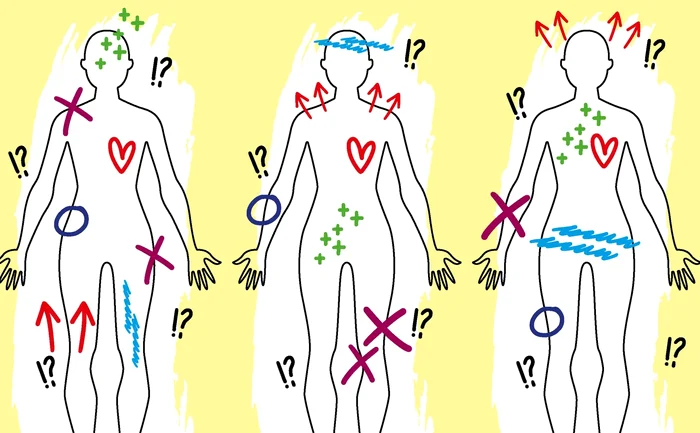
A sketch of the body map. Source: The Guardian
“You might ask: where is the pain located? Is it in the gut, in the heart, in the arms? how does it feel Is it red, is it orange, is it lots of scribbles, is it soft? And how about going to a clinician and being told: It’s all in your head? Where would you draw the emotion of that experience on your body? Body mapping invites lots of different ideas and allows you to share them with other participants“, she says, according to the British publication.
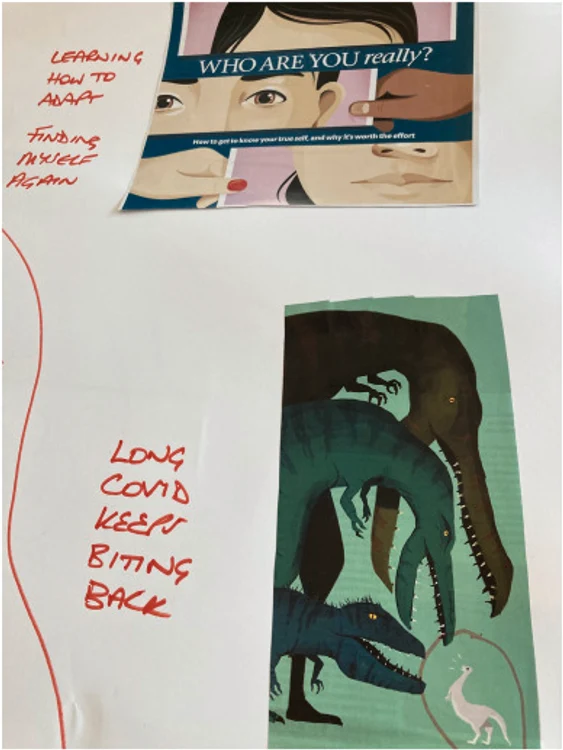
Body map. Source: sciencedirect.com
Cousins finds the long-standing Covid vocabulary unnecessary.
“Fatigue, brain fog – these words don’t do justice to what people are actually experiencing. Fatigue sounds like fatigue, but it’s actually a deep illness. It feels like the worst hangover of your life combined with the worst flu of your life. Your brain and your whole body, everything, feels very, very weak and fragile. It’s not you anymore.” The same goes for the term brain fog, which has an almost comfortable connotation. It doesn’t come close to describing how crippling cognitive symptoms can actually be.” says Oonagh Cousins
Researchers have recently developed an online toolkit that makes body mapping accessible to more people, including those unable to leave their homes due to their illness. “In the coming year, we hope to hold regular body mapping online workshops,” says Cousins.
