
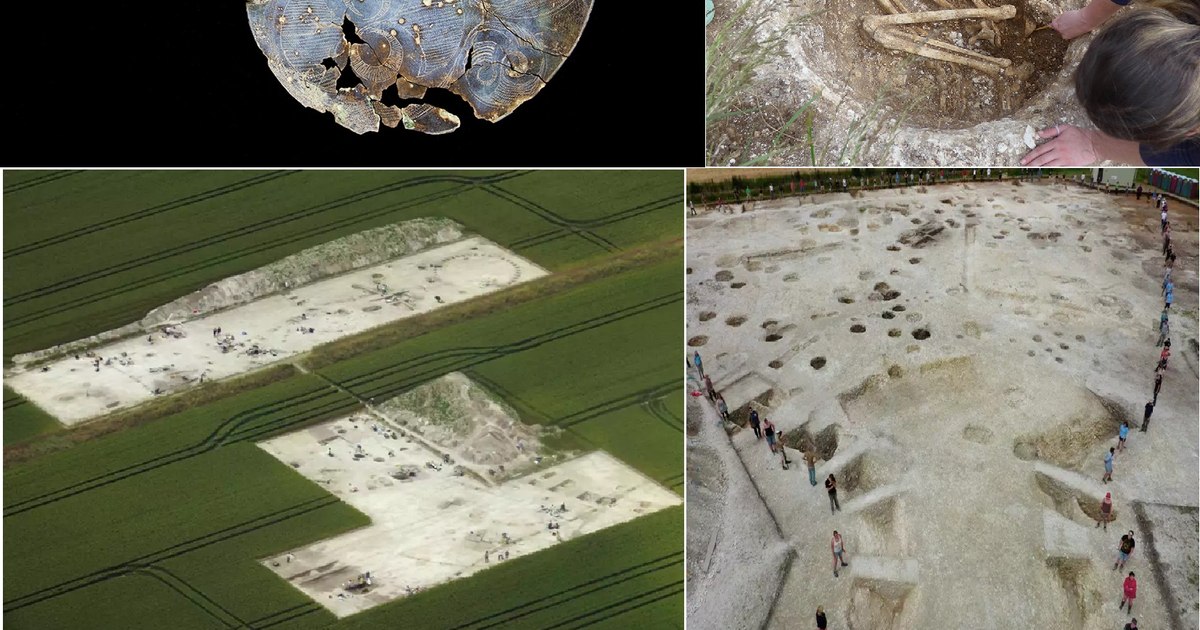
More than two millennia ago, the Romans considered Celts as the most amazing figures in history. Modern historians did not understand their fascination until the last archaeological excavations, from the south of England, brought to light the truth buried in the depths. For centuries of mystery they are now revealed, and the new discoveries radically change the perception of the role of women in ancient societies.
The archaeological discoveries prove the power of women celte collage bournemouth university via ap
Throughout history, women have often been presented as secondary characters in the world’s great civilizations. But new archaeological discoveries, from the territory of the ancient Britain, rewrite this story.
A team of researchers analyzed the graves of the Durotriges tribe and reached a surprising conclusion: more than 2,000 years ago, women in antiquity not only occupied power positions, but also dominated the social structure.
Part of the old UK was a world of women, as new evidence suggests. The discovered tombs show that women in some Celtic tribes had as much power – and sometimes even more – than men. Even the ancient DNA suggests that they were the basis of the social networks in the Celtic society in Britain.
The recent study published in Nature It also brings new fascinating explanations about the funeral habits in the Britain of the Iron Age, showing why women were often buried with high value objects, such as mirrors or even fighting.
“It is a remarkable result. These discoveries greatly deepen our understanding of the archaeological evidence (vestiges, artifacts – n.red.) From that period ”also points out Carola Metzner-Nebelsick, an archaeologist at Ludwig Maximilian University in Munich, who was not involved in research.
Durotriges: Celtic tribe that defies the norms of the ancient world
In the heart of southern Britain, between 100 BC. and 100 AD, the Durotriges tribe flourished on the territory of the current Dorset and in the neighboring coastal regions. These Celts were not only redoubtable warriors, but also a sophisticated civilization, mentioned by both the ancient geographer Ptolemy and the Roman emperor Hadrian. Their inheritance remained alive through impressive vestiges: rich necropolis, imposing fortifications and distinct coins, testimonies of a special culture.
However, what really distinguished Durotriges from other tribes of the time was their unusual social structure. Unlike the dominant patriarchal societies in the ancient world, they followed a matrilocal model, in which women were the pillars of the family and the inheritance. A system that, according to new discoveries, offered them a central role in the community – and perhaps more power than ever believed.
However, it cannot be said that it was necessarily about matriarchy. However, the results suggest that women played an essential role in making decisions and social structure, which made Celtic society in Britain “More equal than the Roman world”as Miles Russell explains, archaeologist at Bournemouth University and a study co -author.
Lara Cassidy, a geneticist at Trinity College Dublin and study co -authors, also stresses that Celte women had status and influence on family, decisions and property.
And Iulius Caesar considers Celtic women among the most fascinating figures in history
When the Romans, a deep patriarchal society, invaded Gaul and entered the territories of Celtic tribes in France and the United Kingdom, were deeply surprised by the reversed roles, as described by ancient historians.
Recent discoveries confirm some of the Roman reports, including those of Iulius Caesar, which mentioned around 50 BC. that Celtic women had an unusually high status. In fact, the writings spoke with contempt about their relative independence, about their fighting skills, about powerful women such as Boudica and Cartimandua queens.
Boudica was one of the most famous Celte queens, the leader of the Iceni tribe in the east of the Britain. Is known for his revolt against Roman rule in 60 or 61 AD. After the death of her husband, Prasutagus, Boudica took over the tribe and led a large uprising against the Romans who were in the territory of Britain. The revolt was a symbol of Celtic resistance against the Roman invasion. Although the uprising was defeated, Boudica remained in history as a symbol of women’s courage and power in the face of oppression. Cartimandua was another Celtic queen, this time of the Brigants tribe, the largest tribe in northern Britain. He had a complex relationship with the Roman Empire, sometimes collaborating with it, which brought him a certain prestige and protection.
“Such a phenomenon of matrilocality has not been observed until now”
“It was really shocking – it has never been observed before such a phenomenon (Matrilocality – type of social organization in which, after marriage, the man moves to his wife’s household or community – n.red.) in the European prehistory. The Romanians wrote about it because it seemed so strange ” explains Lara Cassidy, a geneticist at Trinity College Dublin and study co -author.
“Throughout history, it has been suggested that Romanians exaggerated the freedoms of British women, using this to portray a wild society. However, both archaeological and genetic research now shows us that women from the iron age had an essential role in many aspects of daily life. Moreover, there is evidence that maternal descent would have been the basis of group identities of that period ”also stressed archaeologist Miles Russell.
So far, many modern historians have rejected ancient reports, considering them exaggerated or interpreting the rich graves of women as mere exceptions. However, in the last decades, the evidence discovered have radically changed this perception.
Evidence from graves: mirrors, jewelry and … swords!
The Durotriges cemeteries, located near the city of Bournemouth, offer a unique window to the world of Celts at the Iron Age. This tribe did not incinerate his death, as other communities in ancient Britain did, but buried close to the house, on the hills around the households. This practice allowed the preservation of the graves and, implicitly, some crucial details about the life and status of the buried.
What attracted the attention of the researchers was the huge difference between the graves of men and women. While the men were buried with food and drinks for later life, women had much more elaborate offerings: mirrors, comb, jewelry and even swords.
“If you judge the social status according to the funeral objects, the women had a higher position”, says archaeologist Miles Russell. And Lara Cassidy recognizes: “This suggests either an equality of status between men and women, or even a higher position of women, reflected in funeral practices.”
The DNA confirms: Societies were matrilocale
In order to better understand the structure of these communities, the researchers analyzed the DNA of dozens of skeletons from the Durotriges cemeteries. The results were amazing: by comparing the genetic material, the team reconstituted a genealogical tree that stretches over six generations.
Most individuals came from a single maternal line, which suggests that women were staying in the community, and men came from other families.
Moreover, two thirds of those buried in this cemetery had a rare type of mitochondrial DNA, transmitted exclusively from the mother. Even some of the men came from the same ancestor (they had common ancestors), which shows that society was organized around women, not men.
“The women remained close to their family and were deeply integrated into a stable support network since childhood. The husband was the one who came as a stranger and had to adapt within the wife’s clan ”explains Cassidy.
Essentially, women had economic and social power, and men became addicted to them.
How widespread this model was in the Celtic world
This social organization does not seem to be an isolated case. The researchers compared the genetic data from over 150 archaeological sites in the UK and other areas of Europe, some dating from the stone age.
Around 500 BC, they observed a decrease in mitochondrial DNA diversity, a sign that more and more communities were based on maternal lines. In contrast, the Y chromosomes, inherited on the paternal line, did not suffer the same decrease, which confirms that men came from outside to join the communities led by women.
This discovery is enthusiastic about specialists. “The genetic signal discovered in Durotriges is also found in other British sites. It is a clear proof ”, explains Joscha Gretzinger, archae-genetician at the Max Planck Institute for evolutionary anthropology.
A radical change to previous millennia
The new research suggests that, in the Iron Age, something has changed deeply in the social organization of communities in Europe. In the previous millennia, for example, around 5,000 BC, the Neolithic tribes in the United Kingdom and France operated on a completely different model, called patrilocality. At that time, women left their family to marry, and men remained in the native community.
This transition from patrilocality to matrilocality could indicate major changes in the structure of power, gender roles and economic organization of European tribes. “It’s fascinating. There are moments in history in which societies seem to give women an incredibly high status, ”says Rachel Pope, an archaeologist at the University of Liverpool.
Conclusion: Celtic women – leaders of the ancient world
These discoveries rewrite what I thought we knew about ancient Britain. In a time when history was written almost exclusively by men, DNA evidence and archaeological remains tell us another story: one in which women not only had a place in ancient society, but leading it. The women in the Celtic tribes were not only passive figures in a world dominated by men – they were the architects of a society in which the power, inheritance and stability were based on their shoulders.
If these conclusions will be confirmed by other research, then we will have to fundamentally rethink the way we perceive the past.
