
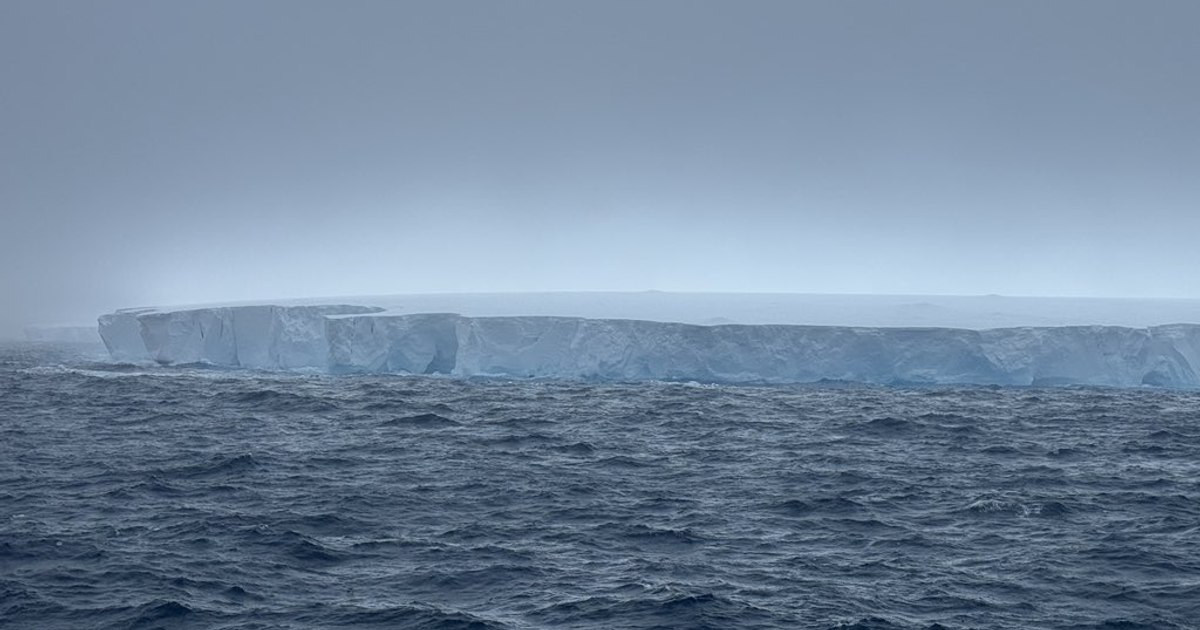
Scientists study if the Aisberg A23 failed could contribute to increasing the availability of food for penguins and seals.
A23A, the largest iceberg in the world photo: X
The largest iceberg in the world seems to have failed about 70 km from a distant island in Antarctica.
The colossal Aisberg A23A – which measures about 3,300 km is heading from 2020 to the north of Antarctic, to the island of South Georgia.
This has aroused fears that it could collide with the island or fail in the less deep waters near it, which could disrupt the ability of penguins and seeds to feed their chicks, writes theguardian.com.
It remains unclear if the iceberg is permanently blocked. “It will be interesting to see what will happen now ”, said Andrew Meijers, Oceanographer at British Antarctic Survey (bass).
The gigantic ice wall remained blocked at 73 km from the island from March 1, according to a BAS statement. “If the iceberg stays on the ground, we do not expect it to significantly affect the local fauna”, said Meijers.
“In the last few decades, the numerous icebergs that come to follow this route through the South Ocean break, dispersed and melt soon,” added Meijers, who met A23A at the end of 2023 and followed the satellite fate since then.
The largest and oldest iceberg in the world came out of the Antarctic platform in 1986.
He remained blocked for more than 30 years before he finally released in 2020, his cumbersome journey to the north being sometimes delayed by the ocean forces that were holding him in place.
The satellite images had previously suggested that they did not break into smaller pieces along the known path that such icebergs follow. However, a 19 km long piece was detached in January.
If the iceberg would have approached too much, there were concerns about the wild life in the crucial breeding area of South Georgia. This would be forced animals like penguins and seals to travel much further to bypass the colossal ice block.
Concerns for the food of penguins and seals
“This could reduce the amount of food that belongs to the chicks and chicks on the island, thus increasing the mortality,” said Meijers.
However, in its current location, the iceberg could provide benefits to wildlife.
“The nutrients aroused by the fault of the iceberg and its melting can stimulate the availability of food for the entire regional ecosystem, including for penguins and charismatic seals.“Said Meijers.
Together with the nearby South Sandwich Islands, South Georgia houses about 5 million seals and 65 million breeding birds from 30 different species.
The seals and penguins on the island already had a “bad season“Due to an avian flu epidemic, Meijers told AFP in January.
Aisberg is not a threat to navigation. It is so large that the ships can easily avoid it.
However, as they break into smaller pieces, certain areas could become forbidden to commercial fishing vessels “Due to the number of smaller pieces – but often more dangerous ”, said Meijers.
There is no permanent human population on South Georgia, which the United Kingdom administers as a British territory over the seas.
Also, Argentina claims the island, along with the Western Falkland Islands, which she calls Las Malvinas.
The icebergs of this dimension are rare, but not unmoved. In the last five years, in the same area there have been two of similar dimensions, said Meijers.
Such huge icebergs are a “completely normal part of life cycle“Of the ice caps in Antarctica, said Meijers.
However, ice platforms have lost 6,000 billion tonnes of mass since 2000, which matches the acceleration of ice loss attributed to climate change, he added.
The researchers warned last month that an increase in the average temperature of the planet between 1.5 and 2.0 degrees Celsius above the pre -industrial levels could melt enough frozen water to raise the oceans with a dozen meters – and beyond the point without return.
Last year – which brought down previous heat records, while the world was hit by fires, floods and storms – was the first calendar year with a temperature higher than 1.5 ° C.
