
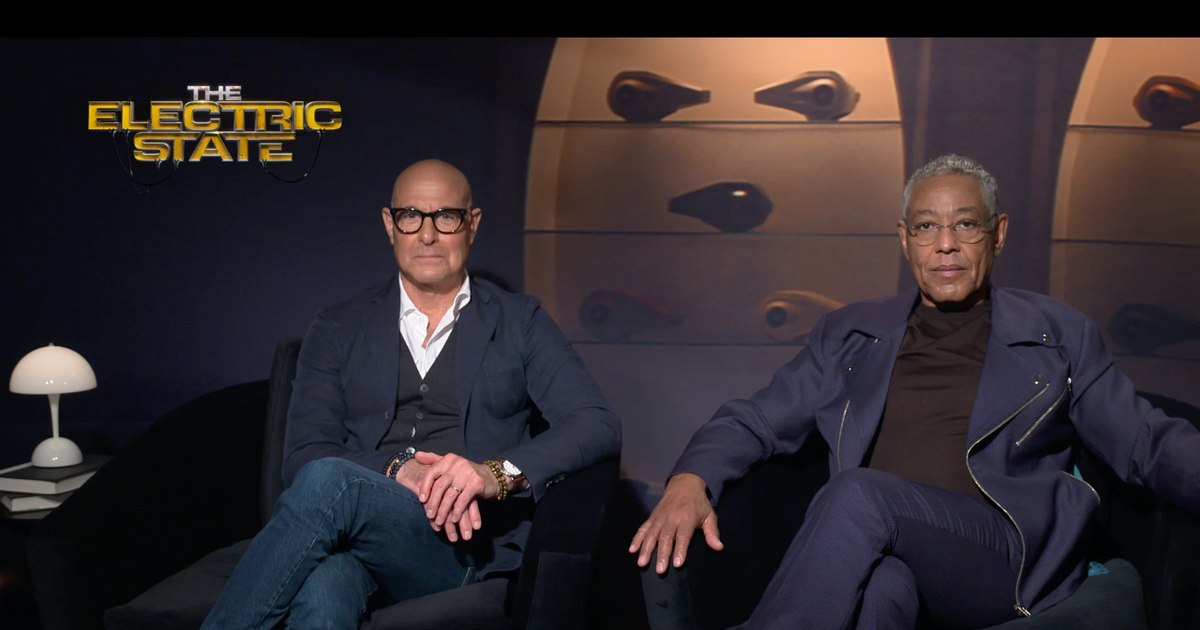
In an interview given exclusively to a Romanian publication, actors Stanley Tucci and Giancarlo Esposito talk about how we find humanity in a world dominated by technology and who actually holds control. They also say that we live in an uncertain world and the only thing we can master are our own feelings.
Stanley Tucci and Giancarlo Esposito, during the interview for “Weekend Adevărul”
At the beginning of the spring, Netflix brings us the graphic novel “The Electric State”, published by the Swedish Simon Stålenhag in 2018, in an adaptation to which the Anthony and Joe Russo brothers only made as they know. The action is placed in the early 1990s, in a post-apocalyptic world, which we did not rarely: after a war with robots, humanity, victorious, had to make new living rules and learn to coexist with the losers. Unlike other films, here, not robots are negative characters, maybe even people, but how people use the power over technology – we could say that it is the immediate reality, in which we live.
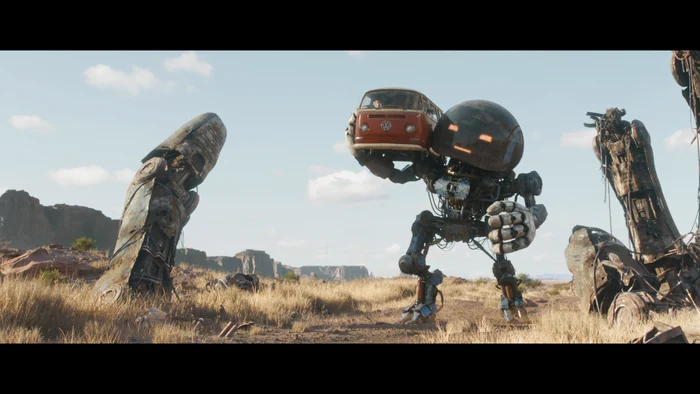
The world of robots in the movie “The Electric State”. Photo: Netflix
In “The Electric State”, the robots are not only cars, but they are relics of a world that once believed in a bright future, based on artificial intelligence. After the failed revolt of the robots, many of these cars remain scattered in the landscape, abandoned and without purpose. They are ghosts of progress, memories of a technological ambition that went too far. Unlike traditional Cyberpunk, where you have an increasing threat, robots in this film are more tragic than threatening-lost beings seeking meaning in a world that has evolved. Instead of showing robots as harmful or rescuers, the new Russo brothers film treats them as symbols of a failed future, wandering with people who feel lost. The story suggests that both humanity and technology were once full of hope, but eventually they fell together, remaining only with a deep melancholy.
Those who control the world
Here’s how a dystopia with a distribution to the highest standards puts us in thoughts and lets us run in parallel with the movie. “The Electric State” brings to the people Ethan Skate, played by Stanley Tucci, a tech entrepreneur who, like some personalities across the ocean, poses in the world rescuers, but, in fact, they want to control it.
In an exclusive interview for “Weekend Adevărul”, Tucci says about his character is “An almost schizophrenic man, in the sense that outside is very charming, but inside has a certain darkness, whose origin we know what is: from loss, from suffering. But the most interesting to me is that Skate is a person, as are these people of technology, who cannot understand the failure and continue to go forward and for this reason there is an enormous amount of collateral damages. They do not know how to manage the failure because they are myopic. This is a defining moment of my character: When he realizes he will probably not win. And for me this is very interesting, because a specific mentality is needed – a narcissistic thinking“.
And as no post-apocalyptic world is lacking in a representative of the military world, here we have Colonel Marshall Bradbury, played by Giancarlo Esseto, whose duty is to keep the robots away from the world of people and whose mission is to watch Michelle The younger brother found in a robot: the friendly Kid Cosmo was brought to life by Christopher’s consciousness, a small genius who was the victim of a car accident, along with their parents.
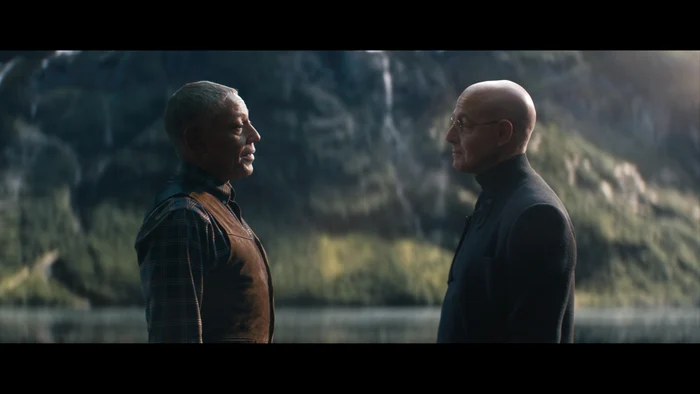
The memorable meeting of the two characters. Photo: Netflix
Colonel Bradbury is going through a total change, which was a challenge for Esposito, as he confesses in the exclusive interview for “Weekend Adevărul”: “The character has gone from being a man of the army, very aware of what he does, who does not stop until he gets what he wants, at a time when he is patient, then he is put to the ground and begins to run, to be on alert, and finally, to stop and to observe – it was a moment. I was alone, I was no longer interacting with other characters-it was great to have scenes with Stanley’s character, Ethan Skate, I was really glad that there is someone I can change face to face (laughs). Bradbury’s transformation was an uplifting moment for me: a man with a life career in the army becomes insubordinated, no longer respects the orders given to him“.
As the story takes place, Skate’s role highlights the nature of technological ambition: the way every great innovation bears the risk of unwanted consequences. If he serves as a final warning or a saving figure, we find at the end of the film. Does he assume responsibility or, like many technology giants before him, do he leave the consequences on account of others? Tucci says that “is a movie that came at the right time“, And Esposito emphasizes that every man must have control over him, because the outer world only changes by the way we maintain our relationships with ourselves, but also with the others:”Who would have known that historical events would reach this point? We all, people, are struggling to believe that all of these are not permanent. Changing is difficult, because I like to feel safe, to feel good as a man – in reality, there is no security and safety outside our relationships, there is only how we behave between ourselves and how we make ourselves feel between us. I have an attitude of a man who likes to have total control and I like to think I can manage everything, but in fact I can’t control anything (smiles). Then you look inside and ask yourself: Do you even control yourself? I do not think you can control what is happening in the world, but you can start controlling your own attitude, your own feelings – only on them you have control. This film has many layers of entertainment – because it is very fun – but also has a deep personal significance, especially for the times we live“.
Back on retro rhythm
Beyond the fact that the characters seem to be complemented in movements, in words, decisions, but especially in survival, they live in a world that combines the 90s, the retro-phyuturistic style and the American pop-culture elements (and, of course, a tailor-made soundtrack). The film is a contrast between the world of devices that have enjoyed people’s lives, but now they are out of use, and future technology, with glasses inspired by those created for today’s VR (virtual reality). The film has a retro, nostalgic air, the basic notes being the apocalyptic ones – perhaps a splash of the series “Stranger Things” (whose Final season is to appear this year) – a combination between the nostalgia of the 1990s and the dystopian world that offers it a special visual identity.
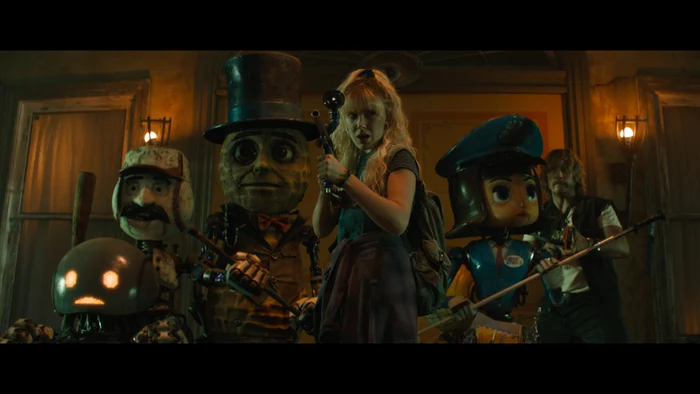
Protagonist Millie Bobby Brown. Photo: Netflix
The chronological placement could not influence the two actors, both the decorations, but especially the clothing, as Stanley Tucci says: “The costumes, especially, inspired me. It was a very interesting process. The materials from which they were made, the models that were chosen by the designer, everything was impressive, especially since we took the 1990s. For an actor, who wears in a film he has a great influence on the movement, as it feels, but, above all, an effect on how that role plays. For me, clothing was a key factor“.
“The costumes, of course, especially because they place the action better in a certain chronology and make the spectators better understand those times. Plus they were the only things that made you understand what was happening to you – apart from the director’s instructions, which explained what is next to you, behind you. Stanley and I had a scene in which I was above the water of a lake, and that first step, the confidence that we can go on the water – only one man know doing this in our history (laughs) – they were a little more awkward, but everything was made of inertia, without thinking a lot. We both lived at that time, so I understood what it should be “completed Giancarlo Esposito.
