
Some scientists now claim that humanity, earth and anything else in the universe are actually part of a huge holographic projection.
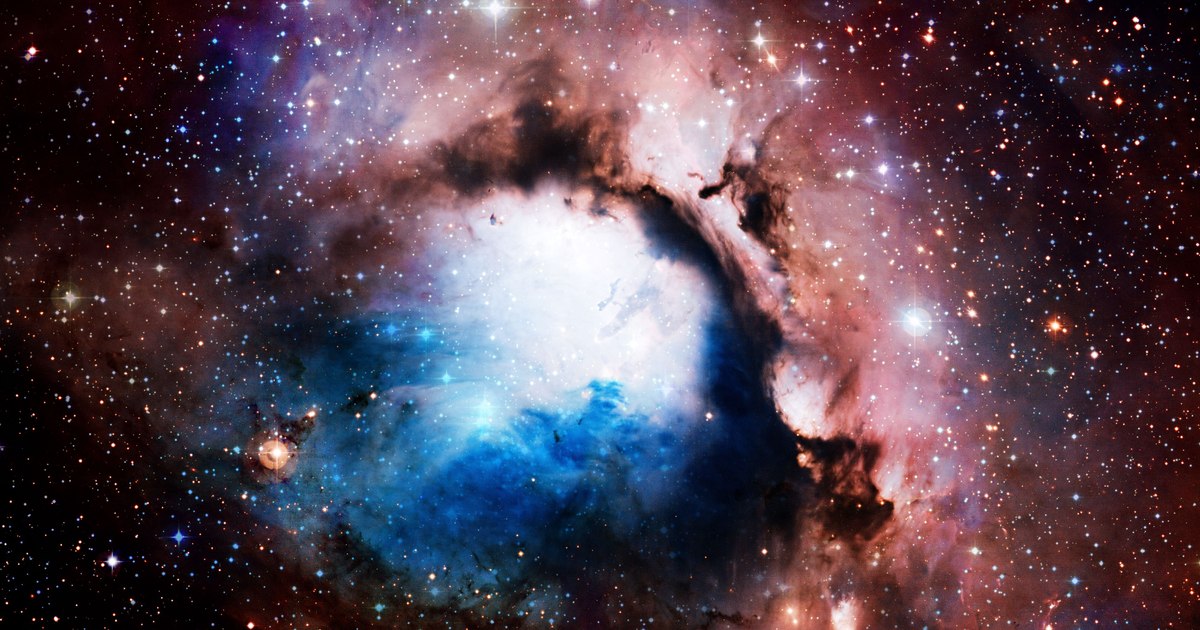
Infinite universe with stars and galaxies in the Cosmic Photo Shutterstock / NASA
Although this might seem too familiar to Matrix fans, this bold idea could solve some of the most difficult questions of physics.
From what happens if you fall in a black hole to how the universe was immediately after the Big Bang, our thinking as holographic could provide the answer, according to the Daily Mail.
According to Professor Marika Taylor, a theoretician physicist at the University of Birmingham, the universe is actually two -dimensional.
However, as when we watch a 3D movie on a flat screen, the images on that 2D surface seem to have depth due to the way they are designed on it.
So, although we see the world around us as a complex three -dimensional structure, Professor Taylor claims that this is just an illusion. This does not mean that our lives or the universe are less real, but the cosmos could be much more strange than I have believed so far.
What is the theory of the holographic universe?
When you think the universe is a hologram, you can imagine the images designed from the Star War or Abba Voyage.
Although this is the correct basic idea, it is not the same type of hologram that physicists think about. The idea that the universe is a hologram has nothing to do with light or projectors, as the name could suggest.
In scientific language, a hologram is a bidimensional surface that seems to have a third dimension – like holographic images on some credit cards.
Because the holograms seem three -dimensional, you can move around them and see different parts of the image as if there is a real object there.
However, if you extend your hand to reach one of them, you would find only a flat surface. Scientists like Professor Taylor claim that the whole universe is exactly so – a bidimensional surface that only seems to have three dimensions.
Instead of the universe it is like a solid block, Professor Taylor says we should think of him as an empty ball.
Our solar systems and galaxies are contained in the “3D” space inside the ball, but the real structure of the universe surface has only two dimensions.
Conformable “The holographic principle”, We can describe the gravitational movements of the planets and stars inside the ball just talking about what is happening on the two -dimensional surface.
Although this may seem completely crazy, scientists claim that the return of our world is not necessarily a problem.
Professor Taylor says: “It is very difficult to view this. However, it is also quite difficult to view what is happening inside an atom. At the beginning of the twentieth century I learned that atoms follow quantum rules, which are also quite different from our daily reality. Holography leads us to an even more extreme world, in which not only forces are quantum, but the number of dimensions is different from the reality we perceive. “
Does this mean that the universe is not real?
One of the greatest misconceptions about holographic theory is that this means that the universe is not real or that we are in a kind of simulation.

Hologram
Although the holograms we are familiar with are always designed by someone and can be started or stopped as you please, that’s not what scientists say about the universe.
Professor Taylor says: “Matrix movies are very challenging, but probably not surprising all the ideas in the holography. ”

Matrix
Also Fermilab, a physics laboratory of the US Department of Energy, states that the notion of universe as “simulation“It can mislead.
Fermilab writes: “The idea that our three -dimensional familiar universe is somehow encoded in two dimensions at the most fundamental level does not imply that there is someone or something outside the two -dimensional representation, projecting the illusion or running simulation.”
This means that we do not have to worry that we are in any way of Matrix type simulation, even if the universe is holographic.
Similarly, one of the consequences of the holographic principle is that characteristics of the universe as the third dimension and gravity are not a fundamental part of reality.
However, this does not mean that scientists say they are not real.
Instead, physicists say that gravity and higher dimensions are properties “Emerging”.
Professor Kostas Skenderis, a mathematician physicist at the University of Southampton, says he can think of this in the same way as at temperature.
If we look at an individual atom, it does not have a temperature, but only a position and a speed.
But if there are enough atoms that move and collide between them, we can say that they have a collective temperature.
“Temperature is not an intrinsic property of elementary particles. It appears rather as a property of a collection. This does not make the temperature less real. Rather explain it.” says Professor Skenderis.
Also, gravity and third dimension appear when parts of the 2D universe interact in certain ways.
And, just as you know that the temperature is a simple movement of atoms does not make your tea less hot, this does not make gravity or less real depth.
Why do scientists believe that the universe is a hologram?
Although this may seem like an interesting mathematical exercise, you may be wondering why scientists get tired of trying to explain everything in two dimensions.
The answer to this question is drawn from a problem proposed by Stephen Hawking, known as “the paradox of information”, Which suggests that black holes violate a fundamental law of physics.
You may have heard of the law of physics that says matter cannot be created or destroyed.
In the same way, a law of quantum physics is that “ithe formation“It cannot be created or destroyed.
Professor Taylor says: “The paradox of information is that the black holes seem to lose their memory of what has been thrown inside them.”
Imagine writing a message on a piece of paper and then break it to small pieces.
You might think you destroyed the information, but no matter how small the pieces may be, someone could put them back and read them.
However, if you throw that ticket into a black hole, you could do nothing to reconstruct the information.
Scientists began to realize, in the late 1970s, that this problem can be avoided, but only if we think of black holes as something two -dimensional.
From this point of view, when you throw your ticket into a black hole, the information is scattered on the bidimensional border of the black hole, instead of being destroyed.
This is the point of view that Stephen Hawking, who has discovered the paradox of information, has come to adopt it in recent years before his death.
If this is hard to imagine, don’t worry; Even physicists are still trying to understand exactly what that could mean.
The important thing to understand is that if we look at the world in two dimensions, physicists are easier to understand what is happening in some cases.
This is particularly useful when we want to understand what happens when gravity is extremely powerful, such as in the first seconds after Big Bang or inside a black hole.
And, if this works for the most dense and wildest objects in the universe, it should work for anything else.
As Professor Skenderis says: “The physics of black holes suggest that we only need information in the 2D space to describe the 3D universe. ”
Do we have any evidence in this regard?
One of the biggest challenges for holographic theory is that it is very difficult to prove.
For now, Professor Taylor says that scientists have not found any “palpable proof ” of the holographic nature of the universe.
However, this does not stop physicists from trying to find the subtle differences that the holographic theory predicts.
One of the best search places is in the first moments of the universe, kept in the remaining energy from Big Bang, called the Cosmic Microwave Fund (CMB).
Professor Craig Hogan, an astrophysician at the University of Chicago and director of Fermilab Center for Cartale Astrophysics, says this radiation should keep the “holographic noise”.
Professor Hogan says: “CMB and all large-scale structures should come from quantum-gravitational noise. If it is holographic, the CMB model shows signs in this regard. Keep an image of the process that created it. “
Professor Hogan says that CMB reveals “Surprising symmetries in the sky ” that you would expect to find if the universe were a hologram.
Also, the research carried out by Professor Skenderis shows that the detailed structure of the CMB can be described by the holographic theory.
Professor Skenderis says: “We tested the predictions of the holographic models in relation to the observed properties of the CMB, finding an excellent agreement. This is the only direct observational test of holography so far. ”
