
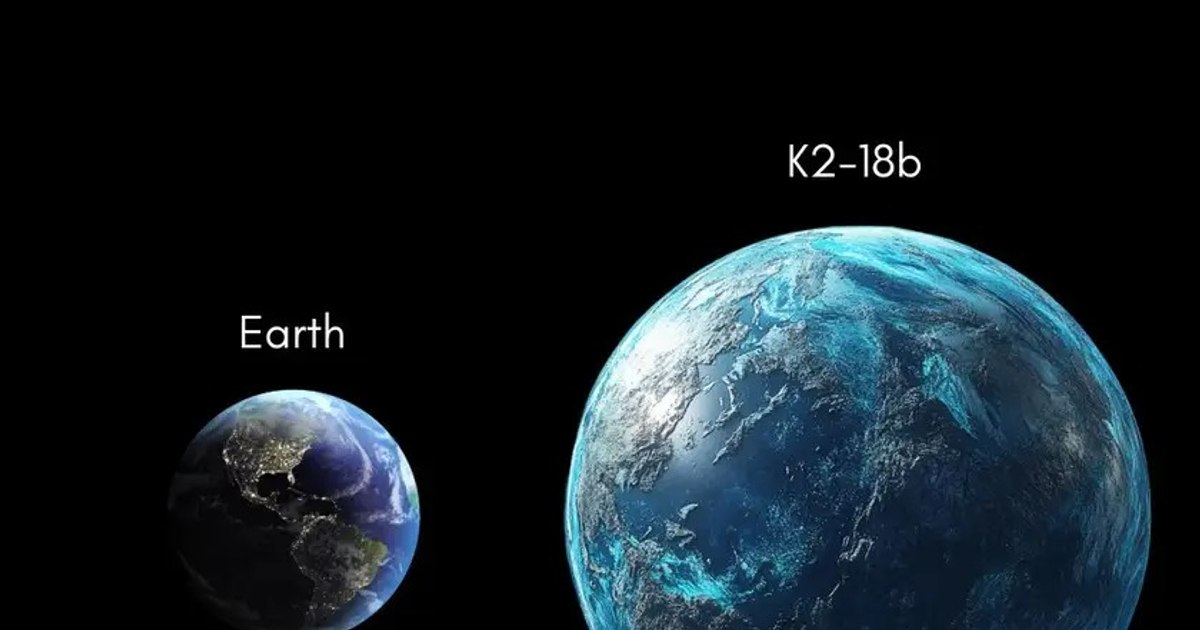
A huge planet at the 124th anniversary of the land offers, according to astronomers, the strongest proof so far that the extraterrestrial life could prosper beyond our solar system.
K2-18B is at millions of years-long-floor photo
The observations made by the James Webb space telescope on a planet called K2-18B seem to reveal the chemical fingerprints of two compounds that, on Earth, are known to be produced only by life forms, The Guardian reports.
Detecting these chemicals – dimethyl sulphide (DMS) and Dimetil disulfurura (DMDS) – does not constitute a clear proof of the existence of extraterrestrial biological life, but could bring a much closer answer to whether or not we are alone.
“This is the most solid proof so far regarding a biological activity beyond the solar system”said Professor Nikku Madhusudhan, an astrophysician at Cambridge University, who led the observations. “We are very cautious. We must ask ourselves both if the signal is real and what it means.”
He added: “Over decades, we might look back at this time and admit that it was the moment when the living universe became accessible. This could be the turning point where, suddenly, the fundamental question if we are alone in the universe becomes one to which we can answer.”
Planet nine times larger than the earth
He added: “Over decades, we might look back at this time and admit that it was the moment when the living universe became accessible. This could be the turning point where, suddenly, the fundamental question if we are alone in the universe becomes one to which we can answer.”
K2-18 B, located in the constellation of the lion, has a mass almost nine times larger than the Earth and is 2.6 times larger than diameter. Orbits in the habitable area of a red dwarf star, smaller twice as the sun. When the Hubble telescope detected water vapor signals in 2019, scientists said it was “The most habitable world known” beyond the solar system.
Subsequently, the remarks of Madhusudhan’s team from 2023 showed that the signal was, in fact, methane. However, the researchers argued that the profile of the planet is compatible with a living world, covered by a vast and deep ocean – a vision still played. Moreover, the Cambridge team reported a possible trace of DMS.
The planets outside the solar system are too distant to be photographed or visited by robotic probes. But scientists can estimate their size, density and temperature, as well as the chemical composition, following the planet while passing through the host star and analyzing the star light filtered by its atmosphere. In the latest observations, the wavelengths absorbed by DMS and DMDS have dropped suddenly when K2-18 passed through the red dwarf.
“The signal was strong and clear”Madhusudhan said. “If we can detect these molecules on habitable planets, it is for the first time we succeed as a species … it is amazing that it is possible.”
Disputed conditions
A challenge in identifying other possible processes is that on K2-18 B the conditions remain disputed. While the Cambridge team supports a water ocean scenario, other researchers say that data suggests a gaseous planet or one with magma, not water.
There is also the question whether DMS could have been brought to comet planet – but this would require an intense bombing, considered unlikely – or produced in hydrothermal springs, volcanoes or electrical storms through exotic chemical processes.
“Life is one of the options, but only one of the many”said Dr. Nora Hänni, a chemist at the Institute of Physics of the University of Bern, whose researches have shown that DMS also exists on frozen and lifeless comets. “We should exclude all the other options strictly before stating that it is about life.”
Others claim that measuring the planetary atmosphere may never provide proof “Smoking” of life. “It is an under -appointed aspect in the field, but technosemnas, such as an intercepted message from an advanced civilization, could be clearer evidence, despite the unlikely to find such a signal.”said Dr. Caroline Morley, astrophysician at Texas University in Austin, adding that the discoveries are, however, an important progress.
At a distance of 120 years light, there is no prospect to resolve the debate through close observations, but Madhusudhan notes that this was not an obstacle in discovering black holes or other cosmic phenomena.
“In astronomy, the question is never about how we get there”he said. “We try to establish if the laws of biology are universal in nature. I do not see it as: ‘We must swim in the water to catch the fish.’
