
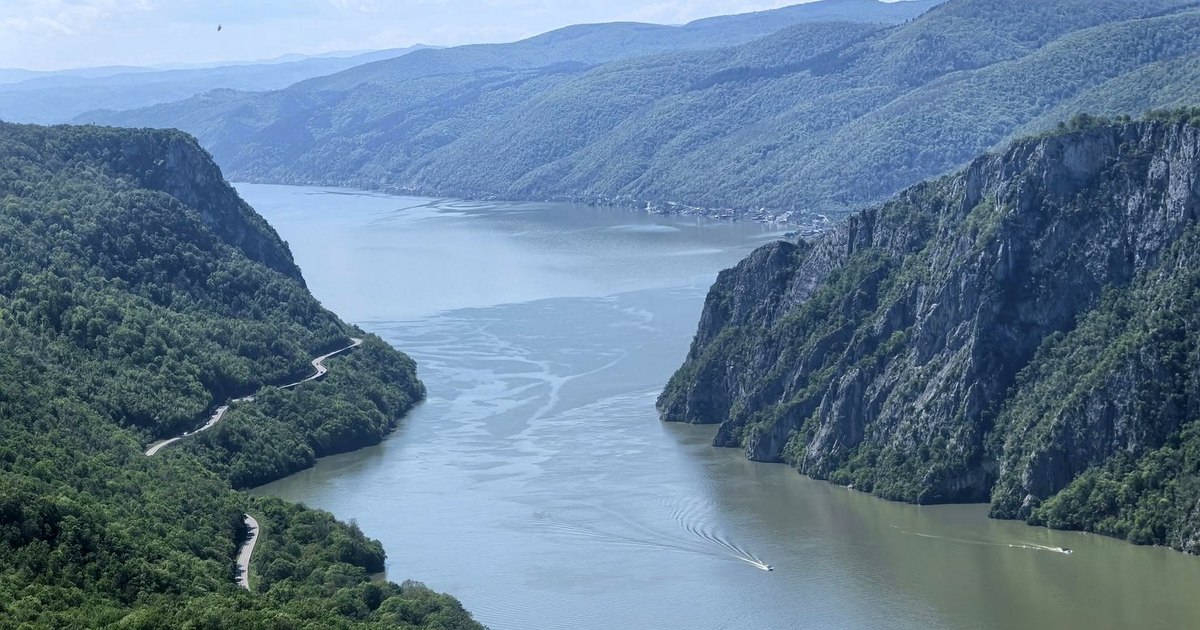
The most spectacular accumulation lakes in Romania are in the middle of some story landscapes and are surrounded by legendary roads, which can make the trip to the tourist destinations an unforgettable adventure.
The Danube clus. Photo: Atilla Dobai. Facebook
The journey on the banks of the largest accumulation in Romania offers impressive views and would last for a few days.
The accumulation lake The Iron Gates I, is actually a sector of almost 130 kilometers of the Danube, where the level of the river was raised, and its river was enlarged by several tens of meters to ensure the volume of water needed for the largest hydroelectric plant and to facilitate the navigation of large ships, through the “” ”
The place where the Danube was “tanned”
The Iron Iron I Lake was arranged in the 1960s, following a project conceived by Romanian and Serbian engineers. The accumulation has an area of 700 square kilometers and a length of 130 kilometers. It starts from the Iron Gates dam, built in the town of Gura Văii (near Drobeta-Turnu Severin), and reaches upstream to the area of Romanian Baziaș and Golubac city of Serbia.
For almost a decade thousands of Romanians and Serbs worked on the construction of the hydropower and navigation system on the Danube. The arrangement of the river brought important economic benefits to the two countries, the hydroelectric plant being designed at a capacity of 1,200 MW. The accumulation lake also solved the navigation problems through the Danube boilers, a gorge of nine kilometers where the passing of the large vessels was extremely difficult.
The cornerstone of the Iron Gates Hydrocentra was separated on September 7, 1964, and the works at the dam simultaneously, both on the Serbian bank of the Danube and the Romanian one, being linked by a provisional bridge between Gura Văii and SIP. Over 20,000 workers worked on the construction of the dam, locks and power plants. Eight years later, on May 15, 1972, presidents Nicolae Ceausescu and Iosif Boz Tito inaugurated the Iron Gates System I.
Ada Kaleh and Old Orșova, dynamite
The hydropower and navigation system The Iron Gates and sealed the fate of old settlements on the banks of the Danube. The new accumulation lake sank in the 1960s island of Ada Kaleh, located near Orșova and Drobeta-Turnu Severin, inhabited since ancient times and then populated by about 600 people, most Turkish.
Thousands of people were also evacuated from the localities of Orșova, Ada-Kaleh, Fășelnița, Dubova, Vârciorova, Tafări, Jupalnic, Ogradena, Tîșovița and Plavișevița. Under the pressure of time and waters, some constructions from Orșova and on the island of Ada Kaleh were demolished with the help of dynamite. Others pretended in the rubble, hit by projectiles and ironed by tanks. The damage was included in the scenario of a Romanian didactic film, called “Assault”, filmed in Orșova and Ada Kaleh.
“And when the troops arrived, with fighting cars, with armament and materials, the ‘assault’ began and at the same time the assault of some unquestioned odds by the military studio: live films, above or below some real burned buildings, thrown in the air, hit by real projectiles, filming and even under the wall Fire and smoke, on roofs shaken by the breath of explosions ”informed the newspaper Defense of the Fatherland in 1969, at the appearance of the film “Assault”.
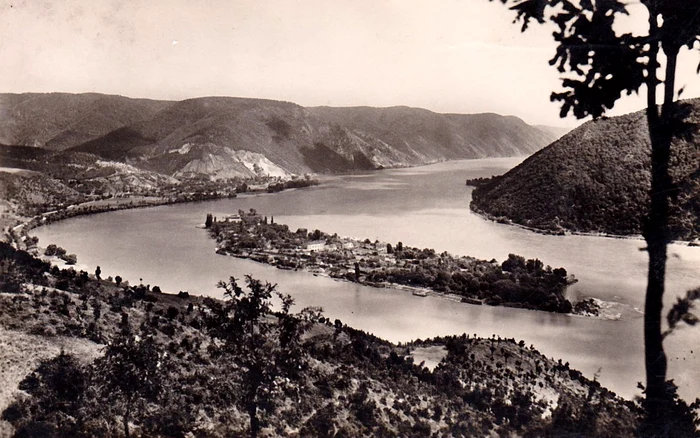
Ada Kaleh. Illustrated by the time
In the coming years, the island of Ada Kaleh completely disappeared under the Danube waters, which grew almost 40 meters upstream.
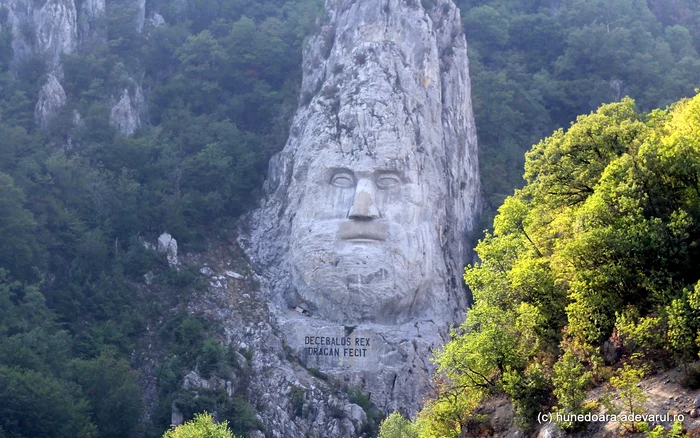
Decebal’s face. Photo: Daniel Guță Adevărul
A valuable monument on the Danube bank has been saved from the disappearance. Tabula Traiana, a sculpture four meters long and 1.75 meters high, dedicated to Emperor Trajan, had been carved in the stone above the ancient road dug by Romans in the rocks of the Danube boilers.
The Traiana Tabula resisted over 19 centuries, since the Daco-Roman wars, but in the 1960s it was moved 30 meters above to not be covered by the waters of the accumulation lake.
The spectacular roads on the Romanian Danube shore
On the opposite bank, Decebal’s face, the largest sculpture ever made in Romania, watches over two decades above the Danube boilers, being dug in a rock near Orșova. Today, this is one of the most photographed monuments in Romania.
The river is bordered here by the 140-kilometer road that connects Baziaș to Orșova, accompanying the Danube by one of the most spectacular areas of the river: the Danube Clisura, located in Caraș-Severin and Mehedinți counties.
This road overlaps with one of the routes used by the Roman armies to enter Dacia, after crossing the Danube on bridges built from vessels.
One of them started next to the town of Baziaș, where the Roman Castrul Lederata had been erected, and the other from Orșova, the old city of Dierna.
Equally spectacular is the Orșova road – Drobeta Turnu Severin (video), a road of about 30 kilometers, passing on the left bank of the Danube, near the Iron Gates dam I. A lot of viaducts and a few tunnels increase the attractiveness of this route.
Vidra and Oașa lakes, transalpine pearls
Transalpine (video), the mountain road that connects the lands of Sibiu to the south of Romania, crossing the Parang Mountains, was arranged in the 1930s and completely paved, on a length of about 150 kilometers, only in the 2000s.
The spectacular road was built with the establishment of the first cottages in Rânca, located at 1,600 meters altitude, in Gorj county. King Carol II inaugurated the beginning of the modernization works of the transalpine ridge route, which was to open access to the new tourist complex.
“The views are unique by the enormous distances that are offered to the eye in a clear time, which does not happen often at the peaks, and by the terrible gap that borders the parapet and threatened the rocks above. In these wild regions, much of the year cannot be circulated because of the snow, and to the Mountain, and to the November, He reported, in 1938, the newspaper Curetul.
Vidra, “Olympic” resort
In the mid -1960s, over 8,000 workers were sent to the first large hydropower site in the Parang Mountains, where Vidra, Lotru – Christian Brocell, with an installed power of 510 MW, the highest on the inner rivers of Romania were to be arranged.

Vidra Voineasa resort from Vâlcea county Aerial Panorama Photo water and friends. Facebook
The communist regime saw in this Alpin land a remarkable tourist potential, the authorities intending to arrange a ski area meant to host the Winter Olympics.
The mountain road in the area of Lake Vidra was called Europe 15 and was to attract foreign tourists to Valea Lotrului, where the “Olympic” Vidra, Alba and Mura resorts had to be developed, with a capacity of over 5,000 places. Voineasa, located nearby, was to be transformed into a resort.
At 30 kilometers from Lake Vidra, another spectacular lake, Lake Oașa, would flood, in the 1970s, Valea Frumos, a place that is said to inspire Mihail Sadoveanu in his works Valea Frumo and the stories from Bradu ‘Strâmb.
The hydropower arrangement of the Sebeș Valve began in 1972, aiming at the construction of six hydroelectric plants between Lake Oașa (video) and Sebeș.
In the following years, four large hydroelectric plants were made in Gâlceag, Șugag, Săsciori and Petrești, with a total installed power of about 342 MW, and later two micro -hydroelectric plants were added to the Căpâlna and Cugir. Today, the main attraction is Lake Oașa, whose dam is crossed by Transalpina.
Sebeșului Valley does not only offer spectacular natural landscapes, but also historical landmarks. Here is the Dacian fortress from Căpâlna (Alba county), included in the UNESCO heritage, along with five other Dacian fortresses in the Orăștiei Mountains. In its vicinity, there are some Saxon villages, famous for their fortified churches.
Also, on the ridges near Lake Oașa, tourists can discover the traces of the military camps of the Romans, erected during the Dacia conquest campaigns, on the Comărnicel Peak (1,896 meters) and on the peak of Pătru (2,133 meters).
Through the Bicaz Gorges to the largest lake in the Carpathians
Lake Izvorul Muntelui – Bicaz is the largest artificial lake on the inner rivers of Romania. The works at the Bicaz Hydroenergetic Complex on the Bistrița river started in 1950, the project including the Bicaz dam, with a height of 127 meters, the accumulation lake of over 30 square kilometers and hydroelectric plants, called VI Lenin, with an installed power of 210 MW.
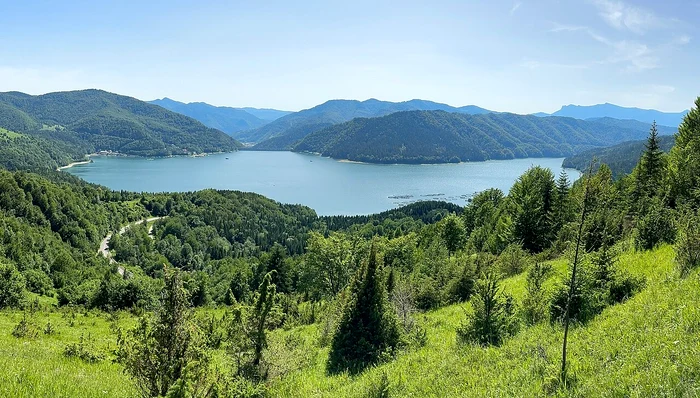
Lake Izvorul Muntelui. Source: Wikipedia
“Bicazul, the first great hydropower achievement in Romania, also called the Romanian Hydroenergetics School, was a real school for the hydroenergetic specialists who, later, made the other great constructions on Argeș, Lotru and the Danube”,, inform Hidroelectrica.
For the establishment of the accumulation lake, over 20 localities, in which about 18,000 people lived, were relocated. The villages of Răpiunea, Cârnu and Reteș from Neamț county have completely disappeared, along with their cemeteries. In other villages, such as Hangu and Fârțagi, the locals, guided by the priests, unearthed their dead and moved them into the cemeteries on the hills, climbing the so-called “road of the dead”.
Nearly 20,000 people, many of them political or deported prisoners, were brought to Bicaz to work at the hydropower complex and the construction of the dam, completed in the early 1960s.

Bicaz Gorge. Source: Wikipedia
The accumulation lake Izvorul Muntelui – Bicaz, Bicaz Gorge and Red Lake are the most emblematic places to visit in the Hășmașul Mare Mountains in the Eastern Carpathians.
These are accessible on DN 12, a spectacular 90 -kilometer road that crosses the Eastern Carpathians between the cities of Gheorgheni (Harghita) and Piatra Neamț (Neamț), ensuring an important transcarpal connection between Transylvania and Moldova, through the Bicaz Gorges.
