

Five years ago, the debate between online and offline learning seemed rather theoretical: there were schools, textbooks, teachers in classrooms. Online was perceived as a focus for technology fans or rescue for the very busy ones.
But the pandemia has changed the rules of the game. Millions of students, from Tokyo to Timisoara, woke up in front of the screens. And now, when things have settled, the essential question arises: which method is more effective for learning English?
Differences that can no longer be ignored
At first glance, the differences are obvious. Offline means direct contact, board, teacher, colleagues in banks, smell of coffee on the halls. Online means Zoom, Google Docs, applications, flexible program and unlimited access to native speakers.
But if we look more closely, the real differences are elsewhere: what kind of skills are developed better in one environment or another? And what does “better” actually mean?
What are the studies say: clear data
A study by Johns Hopkins University (2022) showed that online learning, on average, is not inferior to the traditional one in terms of results – provided that certain elements are respected: motivation, structure and pedagogical support.
Another meta-study published in the Educational Research Review (2021), which analyzed over 140 international research, concluded that hybrid models (combination between online and offline) offer the best results in the assimilation of the language.
Online: Freedom and Technology
Online platforms have opened access to modern and efficient methods, including those who are just beginning. For example, Novakid beginner English uses interactive games, one-one lessons with native speakers and attractive visual materials. The purpose is not only to learn English, but to live it actively, as part of the daily.
Other advantages of online learning:
- flexible schedule;
- the possibility to resume lessons;
- use of artificial intelligence for personalized exercises;
- Learning routes adapted to the needs of each student.
disadvantage? Of course: maintaining attention can be difficult, procrastination is more common and, in some cases, the direct or clear feedback is missing – especially in free courses.
Offline: classic but still valuable
Traditional foreign languages and face -to -face meditations remain favorite options for many. Especially for those who value direct contact, nonverbal language and group dynamics.
The advantages of the offline environment:
- real and immediate interaction;
- deeper emotional involvement;
- communication without technological filters;
- Motivation through colleagues and the presence of the teacher.
But there are also disadvantages here: fixed program, need to move, less methodological flexibility and often higher costs.
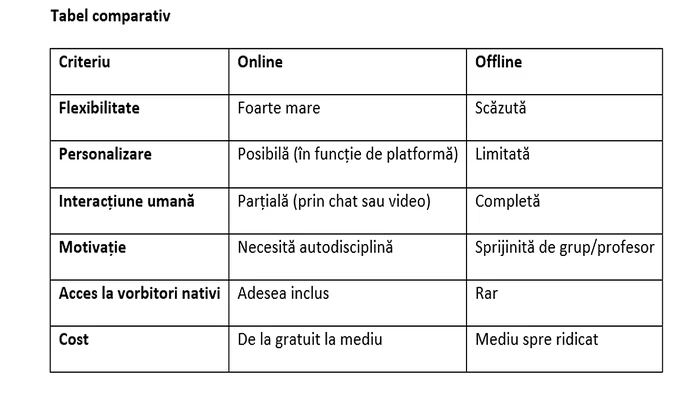
Does the format or approach matter more?
Many specialists agree that the form matters less than content and method. An online lesson with a native speaker can be ten times more efficient than a classic hour in a class, with a tired teacher who mechanically follows a manual. And vice versa.
When is the online and offline more suitable?
Choose online if:
- You live in a small town and you have no access to good courses;
- You have an unpredictable program and flexibility is essential;
- You want to learn with native speakers;
- You feel comfortable at your own pace, without direct supervision.
Choose offline if:
- It is hard for you to focus in front of a screen;
- you prefer direct human interaction;
- You are a child or elderly – in these cases face learning often has a better efficiency;
- You have motivation, but you lack the structure and discipline.
A pretty subjective truth
Today, the borders between “online” and “offline” are increasingly diffuse. Traditional schools use Google Classroom and Zoom, and online platforms organize conversation clubs and real -life events.
Maybe the correct question is no longer “what is best?”, But “what suits me?”. Because English is not just a set of grammatical and vocabulary rules. It is memory, emotion, context. And the road to it is inevitable.
