
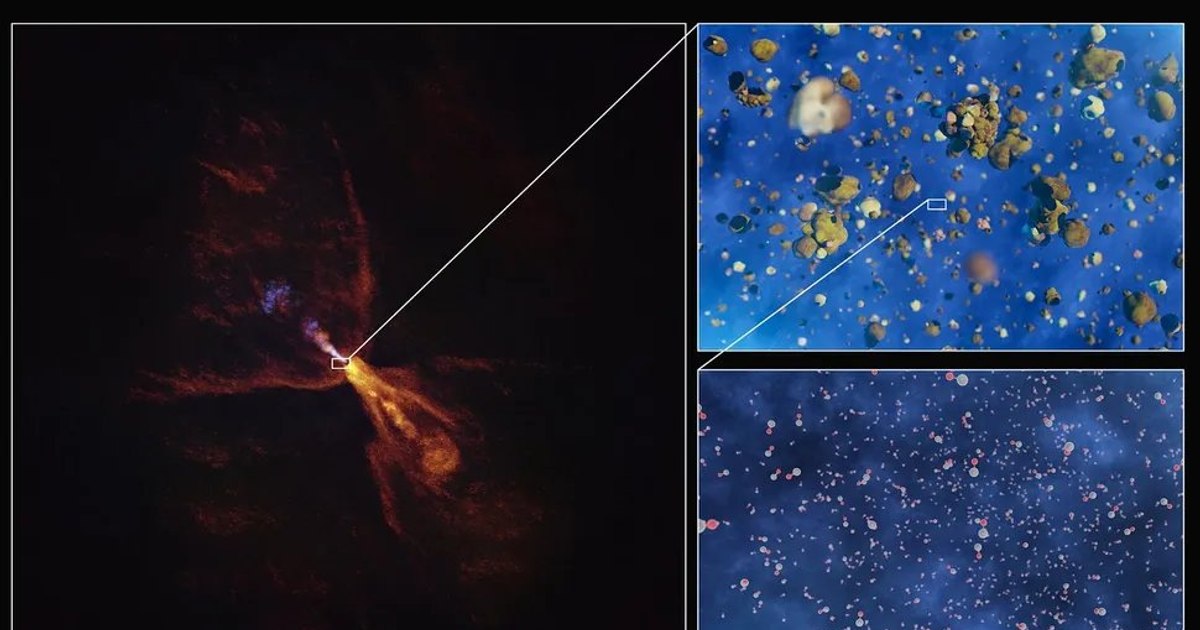
Astronomers observed the first stages of the formation of planets around a star, a process similar to the one by which the solar system was formed, according to a study published on Wednesday in Nature magazine.
Photo: astronomiaum
“For the first time we identified the first stages of the formation of the planets around a star, other than our sun.” Melissa McClure, a professor at Leiden University in the Netherlands and the main author of the study, in a press release of the Austral European Observatory (ESO), was excited.
Located in the orion nebula, at 1300-light, the Hops-315 is a young star that looks a lot like the sun in its first years, according to Agerpres.
These emerging stars are surrounded by gas and dust discs, called protoplanetic discs, in which the planets are formed. Inside these discs, crystalline minerals containing silicon monoxide (SIO) can be condensed to extremely high temperatures. In time, they coagulate, gaining in size and mass to form planetsimal, the first solid parts of the planets.
In our solar system, these crystalline minerals, which later gave rise to planets such as the Earth or Jupiter’s nucleus, were caught in ancient meteorites. Astronomers use them to give the beginning of the formation of our Milky Way Corner.
Observing the disc around Hops-315, the study authors found evidence that these hot minerals were beginning to condense. Their results show that Sio is present around the young star in gaseous state, as well as in these crystalline minerals, suggesting that it is just beginning to solidify.
“This process has not been observed so far in a protoplanetic disk nor elsewhere outside our solar system.” says Melissa McClure (US), study co -author.
These minerals were first identified using the James Webb Space Telescope (JWST). Scientists then observed the system with the Alma of ESO instrument in Chile to determine the exact origin of chemical signals.
They found that they come from a small portion of the disc around the Star, equivalent to the orbit of the asteroid belt that surrounds our sun. This makes Hops-315 a mirror of our own past.
“This system is one of the most suitable we know for exploring some of the processes that have taken place in our solar system.” Merel Van’t Hoff, professor at Purdue (US) and study co -author, also claims.
