
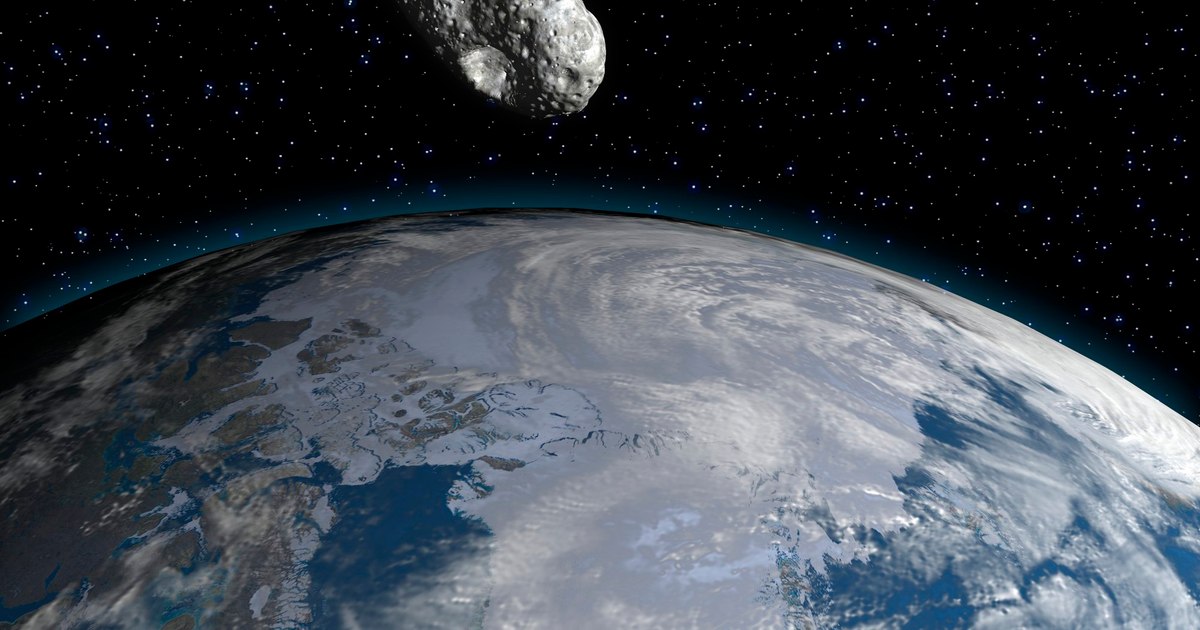
A new international study suggests that the Earth has constantly around it at least six “Mini-luni” – small bodies temporarily on orbit around the Earth, and many of them could even be fragments of our natural satellite.
Two such recent objects seem to be fragments of the Moon. Photo: x / @popmech
The study shows that these tiny satellites, about 2 meters in diameter, would have formed as a result of the impact of asteroids with the surface of the Moon. Pieces of rock and monthly dust would have been thrown into space and, in some cases, attracted by terrestrial gravity, entering a temporary orbit around our planet, notes the Daily Mail.
“It is like a dance in which the partners are constantly changing and some leave the ring for a while,” explained researcher Robert Jedicke, from the University of Hawaii, for Space.com.
The study was conducted by a team of scientists in the US, Italy, Germany, Finland and Sweden.
The authors of the study estimate that, at any time, there would be around 6.5 mini-munuses with a diameter greater than 1 meter in the land-luna system. These objects, known in the right scientific terms “Temporarily captured objects”, I remain around the Earth for a limited period – sometimes a few months or years – soup that escapes in space or rarely collides with the planet or the moon.
Until now, it has been assumed that these minions come from the asteroid belt between Mars and Jupiter. But the new research, published in the scientific journal ICARUS, contradicts this hypothesis and argues that some of them could come from the Moon.
Two such recent objects, Kamo’Oalewa and 2024 PT5, seem to be fragments of the Moon.
Kamo’Oalewa, discovered in 2016, reflects the light in a specific way to the monthly surface, and its composition-rich in silica-is almost identical to that of the monthly rocks. As well as 2024 PT5, noticed for the first time on August 7, 2024, which was nicknamed “The second temporary month” of the earth.
These discoveries bring even more weight to the theory “Huge impact”, according to which the Moon formed about four billion years ago, following the collision of the Earth with a heavenly body the size of the planet Mars. The material ejected in space would have formed the moon – which would continue to “fragment“And send small pieces back to the parent planet.
